
Meet the 28-year-old conductor leading Shrewsbury Symphony Orchestra
Bedwyn Lloyd-Phillips, 28, talks about his musical journey, new role at Shrewsbury Symphony Orchestra and ambitions as a conductor
Bedwyn Lloyd-Phillips, 28, is making his mark on the region’s orchestral scene and has landed his first professional opera conducting role. He tells Katy Rink about his musical journey, his passion for bringing music to life and his ambitions for the future.
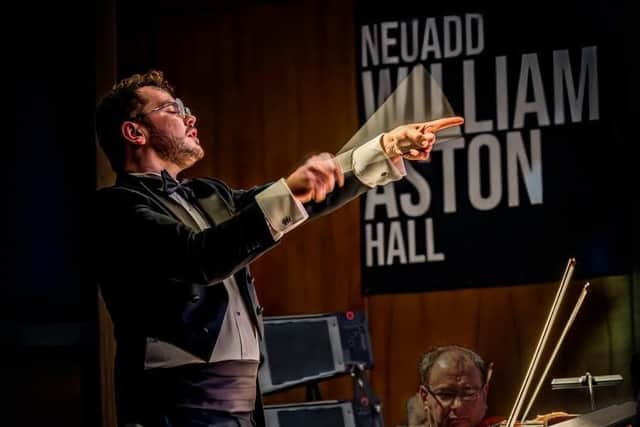

How did your musical journey begin?
When I was in Year 3 at school in rural Wales, near Bala Lake, my grandad gave me a piece of copper pipe and showed me how to blow a raspberry through it. That was what made me want to take up the trumpet.
None of my family are musicians – I come from a rural farming background – but I went to a very musical primary school, with lots of singing, and we took part in the Eisteddfod every year.
I nearly gave up the trumpet, but my mum urged me to carry on, and I'm so glad she did. Joining Liverpool Philharmonic Youth Orchestra as a trumpeter in sixth form was a big deal. I was playing at the Philharmonic Hall (the home of Sir Simon Rattle!), performing amazing pieces such as Stravinsky's Firebird and playing side by side with the Royal Liverpool Philharmonic.
How did you know you wanted to be a conductor?
It was watching the BBC Proms in 2013, when Yannick Nézet-Séguin led the Rotterdam Phil in a performance of Prokofiev's Fifth Symphony. I'd never heard music like that before. You could tell he was loving it – the way he interacted with the orchestra and the way they responded to him. He was having so much fun that I knew I wanted to do that.
Why choose conducting over playing the trumpet?
We were performing Mahler's Fifth Symphony with Richard Howarth, a well-known conductor in the North West. The second trumpet part is one of the most brilliant second trumpet parts ever written. I suddenly realised I didn't want to be playing second trumpet, nor did I want to be playing first trumpet – I wanted to be up on the podium conducting.
Richard has since been very supportive and given me lots of opportunities to deputise for him with Blackburn Symphony Orchestra. That led to me being invited by the orchestra to lead concerts with them.
What was your first conducting job?
My first proper conducting 'gig' was in 2017, the day before I went to the University of Birmingham to study music. I'd organised a concert in Mold, with the support of a few Wrexham Symphony Orchestra players. I hadn't had any training or anything before that. I've no idea why they let me do it!
Who are you working with now?
As a conductor, you have to be prepared to put in the miles if you want to get ahead. Over the next two terms, I'll be working with Shrewsbury, Wrexham, Blackburn and Chester orchestras.
I'm currently principal conductor of Shropshire Chamber Orchestra, and have just conducted a full opera, La Fanciulla del West, for charity with Verismo Opera in Shrewsbury Abbey.
It's a different challenge working on a shoestring or within a limited timeframe. You have to know what to prioritise to deliver an impactful performance overall, rather than getting hung up on small details.
What excites you about conducting?
It's the palette – the range of sounds that each instrument can achieve individually and then, when you put them all together, it's awesome. I love talking to players to find out what their instruments can do – the different colours and techniques – and using that to inform my conducting.
I also love the insane mental gymnastics involved. You have to be 20 pages ahead in the opera pit, with all these conversations going on in your head, knowing when the tricky bits are coming up, working with the orchestra and singers at the same time and appreciating what's happening off stage. It's relentless, but I don't think there's anything more satisfying in the world.
What's been your most memorable concert so far?
I was conducting Elgar's First Symphony with Wrexham Symphony Orchestra, and when we reached the slow movement, something happened that was quite extraordinary. It was as though the orchestra had never played it like that before. Everyone came up to me afterwards and said they'd felt the same thing. I don't know if it's explicable. It was just total cohesion and a shared desire to achieve the same outcome.
You can pinpoint different moments when something has been transcendental or special, although sometimes you can't explain why.
What have you most enjoyed about conducting amateur orchestras?
You get a different level of pride and joy from doing a good job with non-professional orchestras. The players are such different characters, with diverse backgrounds, jobs and life stresses – and this one thing brings them together once a week.
I get a lot of pleasure from making sure everyone enjoys the music, even if they might not like the piece!
What makes a good conductor?
A good conductor needs to be adaptable, yet immovable in their commitment and belief. Being a good communicator is vital.
The English word 'conductor' fascinates me. In German, it's 'der dirigent', a director, and the Welsh word 'arweinwyr' has the sense of being a leader or guide. But you really are conducting the energy, emotion and meaning of the score from the orchestra to the audience and vice versa. It's one of the rare instances where English is more poetic!
A conductor needs to have personality to bring people on board, but the journey belongs to the score, the orchestra and the audience.
What kind of conductor are you?
For me, music theory is secondary to the emotional and historical aspects of a piece, and the colours you can encourage an orchestra to bring out of it. So my approach is less academic and more about feeling and experience.
The days of dictatorial conductors are gone. For me, it's about being committed to the music yourself and bringing people on that journey with you. That influences the language I use in rehearsals – I'll say 'let's try this', rather than 'do it like this'. I'm not on an ego trip up there! It's such an honour to be part of the process.
How do you get a lucky break?
It's about building your network and being someone people want to work with. It sounds basic, but it's absolutely vital that players come out of the other end having enjoyed the process and wanting to work with you again.
What are you looking forward to?
I'm delighted to have been asked to conduct a new commission written by Welsh composer Gareth Glyn (who has written for the BBC Concert Orchestra, BBC National Orchestra of Wales and Royal Ballet Sinfonia, among others) on tour with OPRA Cymru.
I'm a native Welsh speaker – I only really started learning to speak English when I was 11 – so I'm excited to work on a Welsh-language opera. I think it will suit the way I work. I've always loved Grace Williams' music, and I can see how the phrasing and melodies would work with Welsh words.
I'm giving up my teaching job in North Wales to focus on my conducting career. I hope to unlock some doors, whether that's securing a fellowship with an orchestra or receiving more invitations to tour internationally. There is no clear career path in conducting, so it's obviously a risk, but I'll remain professionally curious and embrace the opportunities as they come my way. And I would, of course, love to conduct the BBC National Orchestra of Wales in the future!
The Shrewsbury Symphony Orchestra autumn concert takes place on Sunday, November 22, at 3pm in Alington Hall, Shrewsbury School. Tickets cost £17.50/£2.
For tickets, visit Ticketsource.