
Pope Leo XIV wraps up Argentina visit before an emotional trip back to Peru
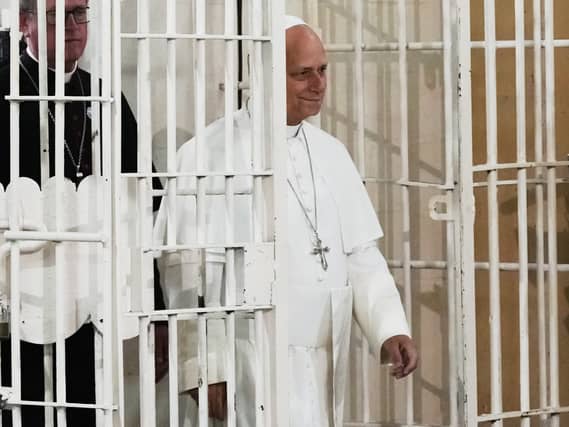

Leo visited Devoto Prison before celebrating his final Mass at Argentina’s national shrine, the Basilica de Nuestra Senora de Lujan.
Pope Leo XIV told inmates at an Argentine prison with a dark history tied to the military dictatorship that there is always hope for redemption and reconciliation.
Leo visited Devoto Prison before celebrating his final Mass at Argentina’s national shrine, the Basilica de Nuestra Senora de Lujan, where one million people were expected — the latest of the record-setting crowds that have welcomed Leo on the first papal visit to Argentina in nearly four decades.
Both sites have important sentimental connections to Leo’s predecessor, Pope Francis, who never returned home during his 12-year pontificate.
But Leo’s final stops in Argentina pale in comparison to the emotional highlight of his South American trip, when he returns to his adopted homeland of Peru later on Wednesday.
A massive national party is planned to greet the Chicago-born Leo, who spent more than two decades as a missionary priest and bishop in Peru and holds dual citizenship in the United States and Peru.
He is known to Peruvians as Padre Robert and beloved for ministering to poor communities, especially in times of crisis.
In Buenos Aires, Leo visited Devoto Prison, where Francis often ministered as the city’s archbishop, celebrating Mass, going into cellblocks housing inmates with Aids and washing prisoners’ feet during the annual Holy Week ritual.
The prison, inaugurated in 1927, is being shut down permanently, with its more than 1,000 inmates moving to a new penitentiary complex.
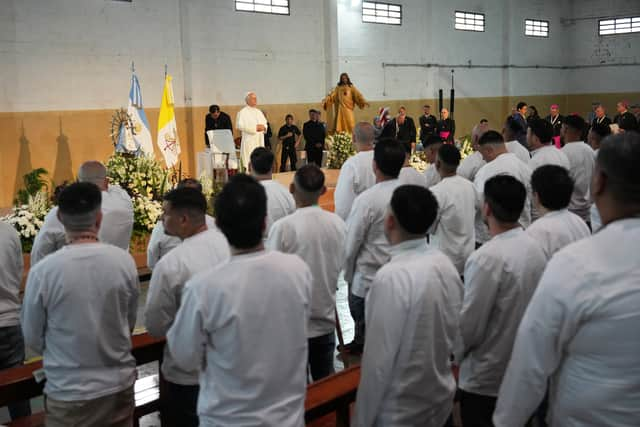
Only about 75 prisoners were on hand for Leo’s visit, chosen primarily because they were active in the prison’s religious programming, said the prison chaplain, the Rev Matías De Martini.
Wearing identical white uniforms, they sat in rows in the prison gymn, facing a stage bearing the flags of Argentina and the Holy See, and a statue of the Virgin of Lujan, which Francis had gifted to the prison during his years as archbishop.
The prison is grim and shows its age. Its corridors were dank, and harsh fluorescent light glinted off the worn bars dividing each wing. Red fire extinguishers lined the main hallway, and guards stood at attention, some holding plastic riot shields.
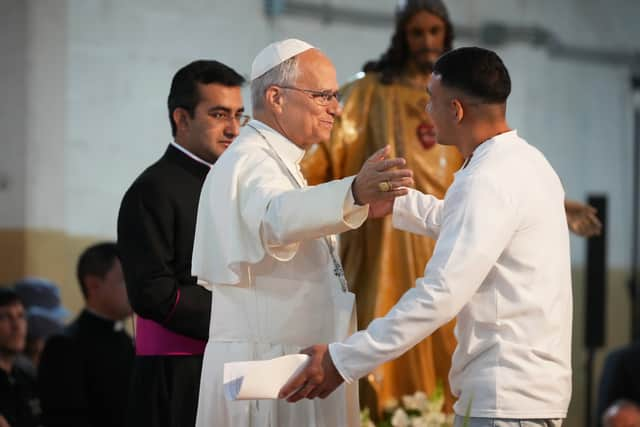
Leo heard stories from inmates of lives marked by drug addiction, crime and homelessness. He told them that their “troubling realities” are all too familiar.
“The sense of omnipotence produced by drugs, the false power that comes from easy money, the cowardly sense of security that comes from inflicting violence upon the weakest, and the impunity that results from corruption,” he said.
He urged them to use their time in prison, and the limitations they face, as a chance for redemption.
“The evil that assails the human heart wreaks havoc on society and on the lives of many people, sometimes reaching extremes of inhumanity,” he said. But he said that a light continues to shine.
“This means that even amid the evil, pain and deepest failures you may have experienced or caused, your present circumstances can become an opportunity to begin your lives anew,” he said.
Leo did not refer explicitly to the prison’s dark history, but his reference to impunity and corruption could be seen as directed not just at the current inmates and prison administrators but at past eras as well.
During Argentina’s last military dictatorship (1976–1983), Devoto functioned as a clandestine detention and torture centre. It was designated a Memory Site in 2012 to ensure the military repression is not forgotten.
Human rights lawyers have petitioned the courts to block any sale or disposal of the prison’s land and facilities once all inmates are transferred, saying “the space must be preserved until the investigations regarding the crimes against humanity that occurred” there are finalised.
In 1978, during Argentina’s military dictatorship, 65 inmates held on ordinary criminal charges were killed at Devoto in what became known as the Seventh Pavilion Massacre. The military government described the killings as a riot and covered them up.
Nearly a half-century later, in December 2025, a federal court found that 153 inmates had been tortured, including the 65 who died in a fire that broke out as guards violently cracked down on the prisoners, and called the events grave human rights violations.
It sentenced two former prison chiefs, Juan Carlos Ruiz and Horacio Martin Galíndez, to 25 years in prison. Both men were over 90.
Leo has carried on Francis’ practice of meeting inmates on his foreign trips, reminding them that they are not alone and remain beloved children of God.
After the prison visit, Leo was to make a pilgrimage to the Basilica de Nuestra Senora de Lujan, dedicated to Argentina’s patron saint.
The municipality of Lujan, about 45 miles north west of Buenos Aires, urged pilgrims to arrive days in advance because of the sheer scale of the event and the extensive security and logistical deployment.
The basilica hosts one of the greatest demonstrations of faith in Argentina. Each October, hundreds of thousands of pilgrims walk there from Buenos Aires and nearby towns to give thanks or make requests to the Virgin of Lujan, to whom Francis was particularly devoted.
This year, despite persistent rain, more than 2.8 million people took part, a record for the shrine, municipal authorities said.