
Israeli president officially gives Eisenkot first chance to form next government
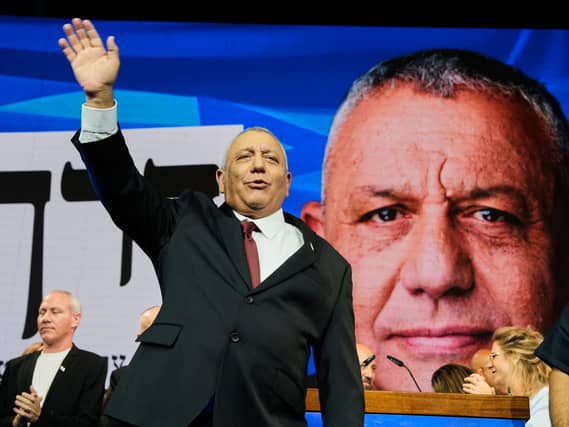

The opposition leader now has six weeks to form a government.
Israeli President Isaac Herzog has officially given opposition leader Gadi Eisenkot the first chance to form the next government.
After the formal announcement on Sunday evening, Mr Eisenkot – who ran as Prime Minister Benjamin Netanyahu’s main rival – now has to launch complicated negotiations with potential coalition partners.
He has six weeks to form a government.
The October 27 elections gave neither Mr Netanyahu’s bloc nor Mr Eisenkot a clear majority in parliament.
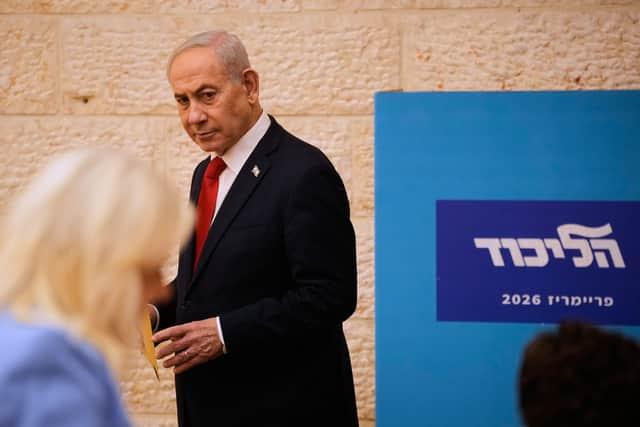
Among the kingmakers — and most politically fraught potential allies — are the Arab-led parties. They made historic gains in the election and have been a target of Mr Netanyahu and his allies.
Mr Herzog’s decision is another blow to Mr Netanyahu, who lost his parliamentary majority in the election.
But it does not guarantee that Mr Eisenkot will be the next prime minister.
In Israel, people vote for parties, which form alliances. A coalition needs to have a majority of at least 61 seats in the 120-member assembly, known as the Knesset, to form a government.
Mr Netanyahu’s coalition plunged from a peak of 68 seats to 53.
The opposition bloc, led by Mr Eisenkot, won 48 seats, and Arab-led parties secured the other 19.
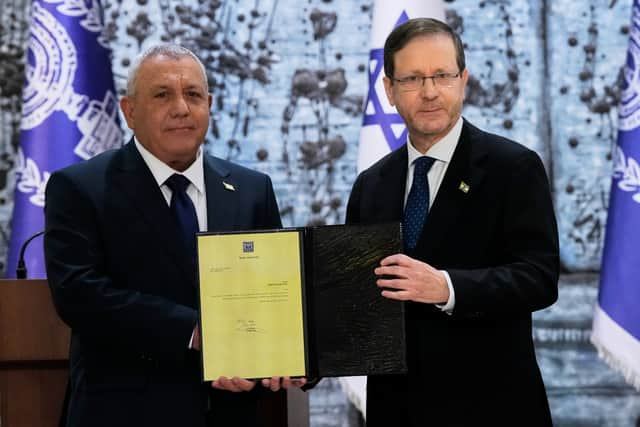
But after his consultations last week, Mr Herzog decided that Mr Eisenkot had the best chance of cobbling together a coalition.
This was because the Arab-led parties said they were ready to support him.
But it remains unclear whether Mr Eisenkot is willing or able to bring them into a future coalition.
After three years of wars in Gaza and across the Middle East, co-operating with Arab-led parties is politically difficult.
Mr Eisenkot has three options: a powersharing agreement with Mr Netanyahu, support from Arab-led parties — something several members of his bloc do not support — or an agreement with the ultra-Orthodox parties, which demand military exemptions for their community.
Mr Eisenkot, a former army chief, and his partners made equal military service a central part of their campaign.
Specifically, they are seeking an end to the long-standing draft exemptions enjoyed by the ultra-Orthodox.
After Mr Herzog announced on Saturday that he would tap Mr Eisenkot, the candidate vowed to form a government as quickly as possible.
But doing so will almost certainly require compromises or broken promises.
Mr Netanyahu has repeatedly claimed the election was “stolen” by Arab parties, which rallied their supporters to vote in large numbers. But he has offered little evidence to support the claims.
Mr Netanyahu is expected to continue his pressure tactics against Mr Eisenkot, saying any alliance with the Arab parties would be an act of betrayal.
Israel’s Shin Bet security agency has launched an investigation into possible foreign interference in the vote, but the country’s Central Elections Commission — and Mr Herzog — say the vote was valid and even if wrongdoing is found, it did not have a significant impact on the result.
Mr Netanyahu called for a “national unity” government with Mr Eisenkot on Saturday night.
But it remains unclear whether the two rivals could agree on a powersharing agreement, and these coalitions are fragile and often collapse.