
Former head of Italian road operator convicted over deadly 2018 bridge collapse

Giovanni Castellucci received a 12-year sentence.
An Italian court on Thursday convicted the former chief executive of Italy’s main road operator and 31 others over the 2018 Genoa road bridge collapse that sent vehicles plunging and killed 43 people, a disaster that exposed serious lapses in the maintenance of Italian infrastructure.
Dozens of family members of the victims packed the court as Chief Judge Paolo Lepri read the verdicts against 57 defendants, including former executives and officials.
Many relatives broke down in tears as the sentences were read.
The former chief executive of highway operator Autostrade per l’Italia, Giovanni Castellucci, was sentenced to 12 years in prison, the highest in the case after four years of trial and four hours of deliberations.
Castellucci’s lawyers said they would appeal, noting in a statement that as chief executive, their client had relied on Italy’s leading engineers, and that a construction defect had not been detected by experts for more than half a century.
Also convicted were Autostrade’s former head of maintenance, Michele Donferri Mitelli, who was sentenced to 11 years in prison.
The former chief executive of the SPEA engineering company, Antonino Galata, received five years and six months.
Defendants faced charges including negligence resulting in the collapse and manslaughter stemming from alleged failures to maintain the bridge, which was part of a main route linking northern Italy with the French Riviera.
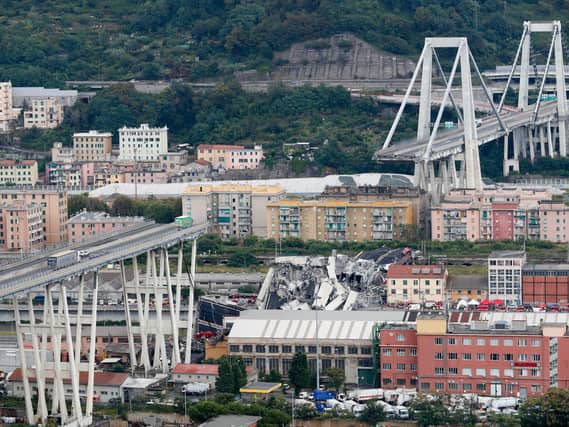
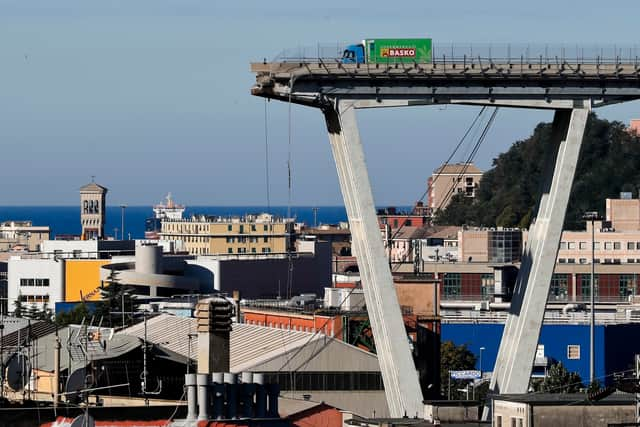
Shortly before noon on August 14, 2018, a 650ft section of Genoa’s Morandi highway bridge gave way during a rainstorm, sending dozens of vehicles plunging to the ground.
In total, 32 people were convicted and handed sentences ranging from one year and 11 months to 12 years.
Others were either found not guilty, or lesser charges had expired under the statute of limitations.
“I think it is important that responsibility extends beyond those at the top. Autostrade, SPEA and the transport ministry all had roles to play. I hope the state’s responsibility also emerges clearly,” Egle Possetti, who heads a committee to preserve the memory of the bridge victims, told reporters outside court.
“I lost my sister, her two children, my brother-in-law and even their little dog. That’s where my determination comes from, to make sure they receive justice and that their deaths were not in vain,” she said.
“Our expectation is to feel our pain recognised and to have it acknowledged that this did not happen by chance, but because of serious failures in maintenance,” said Raffaele Caruso, one of the lawyers representing victims.
Considered an engineering marvel when it opened in 1967, the Morandi featured three A-shaped concrete pylons and concrete-encased stay cables.
Mr Caruso, who represents the family members of three victims, said that the trial showed that warning signs about defects in the pylon that collapsed had existed for decades.
He cited maintenance on the other two starting in 1993 that was never extended to the third.
“From 1993 onward, the problem was known. We had three identical pylons. Two had already shown the same defect, and no-one seriously asked whether the third one had it as well,” Mr Caruso said.
The current Autostrade chief executive, Arrigo Giana, issued a public apology on Thursday in an open letter published in major Italian dailies.
“The actions and decisions of some people left indelible scars,’’ said Mr Giana, who joined Autostrade last year.
“Offering today the apology that was not made then is, for us, a moral imperative that goes beyond establishing legal responsibility and the course of justice toward the truth.”
Autostrade and its subsidiary reached a deal on corporate liability earlier in the proceedings, paying roughly 30 million euros (£25.5 million) in financial penalties.
The agreement spared the companies from a trial as corporate defendants and potentially much harsher sanctions, including exclusion from public contracts.
The settlements were reached after the companies adopted new compliance procedures aimed at preventing similar accidents, and after victims were compensated.
A new bridge designed by Genoa-born Italian architect Renzo Piano opened in 2020, spanning a memorial to the victims of the Morandi bridge collapse.