
PSNI ‘won’t be found wanting’ over new Pat Finucane investigative opportunities

The public inquiry into the murder of the Belfast solicitor is hearing opening statements in Belfast.
Police in Northern Ireland will “not be found wanting” in considering investigative opportunities uncovered by the public inquiry into the murder of Pat Finucane, a barrister has said.
A legal representative of the Police Service of Northern Ireland (PSNI) said the inquiry into the shooting of Mr Finucane in Belfast is perhaps the final opportunity to correct an injustice and provide truth.
A hearing was also told the UK Government believes that as much of the inquiry examining the killing should be conducted in public as is possible.
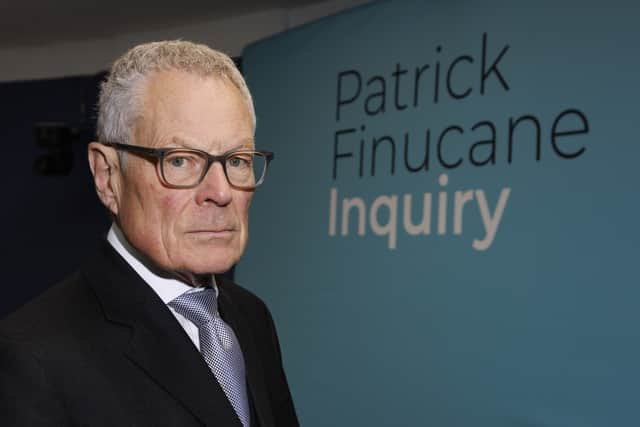
Sir Gary Hickinbottom, chairman of the Patrick Finucane Inquiry, is hearing opening statements from core participants.
Mr Finucane was 39 when he was shot dead at his home in north Belfast by loyalist paramilitaries in front of his wife and children in February 1989.
Several examinations of the case have found evidence of state collusion.
The Finucane family campaigned for decades for a public inquiry to establish the extent of security force involvement.
The hearing on Wednesday heard from Martin Wolfe KC, representing the PSNI.
He said: “The PSNI recognises that the despicable murder of Patrick Finucane on the 12th of February 1989 callously ended the life of a husband and a father and a prominent, successful and effective legal professional, and in doing so brought immense suffering to a family home and to his many friends.
“In horrific parallel, the PSNI acknowledges that the murder created an injustice which has never been adequately addressed.
“The PSNI also recognises that this inquiry represents an important opportunity, perhaps a final opportunity, to address this injustice and to provide for fulsome truth.
“Of course, it is an opportunity which ought to have come before now.”
The barrister said the PSNI welcomed the opportunity to engage and co-operate with the inquiry.
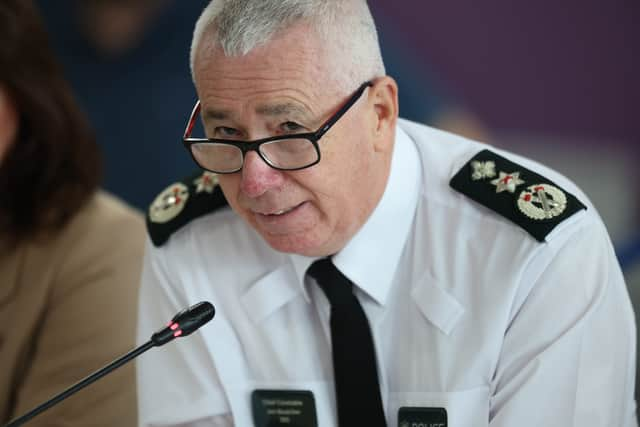
Mr Wolfe said PSNI chief constable Jon Boutcher wanted to repeat an apology to the Finucane family which was initially delivered by the force in 2012 following the publication of a review of the murder by Sir Desmond de Silva, which found collusion but concluded there was no overarching state conspiracy in the murder.
He said: “It is important to emphasise that this apology, which was appropriately offered by the PSNI 14 years ago, remains appropriate today.
“It is right that it is reiterated before this inquiry now.
“The purpose of the apology and the acknowledgement of wrongdoing which underpinned it also reflects the understanding and belief of the current chief constable Jon Boutcher.
“It is an apology through which PSNI acknowledges the brutality of Mr Finucane’s murder and it underscores the fact that this was an act of criminality, which was entirely without justification.
“It conveys the view of the PSNI that this was an appalling crime which had the immediate and lasting consequence of leaving a family bereft of a husband and a father.”
The barrister said Mr Boutcher had committed to bringing his understanding of legacy issues to inform the PSNI response to issues in the public inquiry.
He said: “He recognises that the unconditional apology which he has communicated through these opening remarks will be rendered meaningless if the PSNI fails to fully play its part in helping to secure the answers that the Finucane family need and deserve.”
Mr Wolfe said the PSNI has “no appetite to stifle or restrain any investigation which is directed to uncover the truth of what happened”.
He added: “On the contrary, it encourages the investigation which has commenced, and if this reveals further investigative opportunities which PSNI can take forward in the criminal justice realm, it will not be found wanting in their pursuit.
“It is beyond time for a comprehensive elucidation of the relevant facts, so that suspicions can be confirmed or allayed.”
The inquiry also heard from Peter Coll KC, representing the UK Government.
He said at the heart of the inquiry was the “brutal, unjustifiable” murder of Mr Finucane.
He added: “Counsel to the inquiry have rightly said that Patrick Finucane, the man, must not be lost in the examination of his killing.
“The UK Government agrees.
“As established by earlier investigations, his murder involved collusion with the state.
“Obviously, that should never have occurred.
“It was utterly wrong.”
Mr Coll said the Government had been “engaging constructively” with the inquiry.
He also said the Government “does not depart” from an apology delivered to the Finucane family by former prime minister David Cameron in 2012 following the publication of the de Silva review.
Mr Coll said: “In their opening, counsel to the inquiry also identified the need to understand how the army, special branch, MI5, and the government interacted, how information flowed between them, what oversight there was or was not.
“This will involve, so far as now possible, going behind stated policies and procedures to examine the realities of how matters worked on the ground.
“The Government recognises that this will include consideration of the conduct of ministers and officials, and the policy and legal framework for agent handling.”
The barrister added: “In terms of openness and national security, the UK Government’s position is that as much of this inquiry as possible should be conducted in public.
“The family, indeed the wider public in Northern Ireland and further afield, are entitled to see the evidence for themselves wherever that can be done safely.”
Mr Coll said where there is material which cannot be made public relating to agents, it should be accompanied by a public summary.
He added: “Sir Desmond de Silva was careful to say that his conclusions should not impugn the many RUC and military personnel who served with distinction during an extraordinarily violent period.
“The Government shares that view.
“However, this does not qualify what the UK Government has accepted.
“Honouring those who served lawfully, often at great cost, depends on being honest about the occasions when state actors failed to meet the standards of behaviour that should properly be expected of them.
“In 2012, the then prime minister told the House of Commons that if the UK wishes to uphold democracy and the rule of law, it must be prepared to be judged by the highest standards and to face up fully when it falls short.
“This inquiry provides the means by which those standards will be applied and tested.”