
Burnham says Neets review will outline new ways to support young people


No 10 earlier failed to rule out that reforms would affect existing claimants.
Prime Minister Andy Burnham said the Neets review will “point to a new way of supporting young people”, after its author Alan Milburn said his proposals to tackle the number of out-of-work youths would not be “pain-free”.
The Government’s independent reviewer of youth unemployment suggested some people could receive less financial support under his proposals.
No 10 earlier failed to rule out that reforms would affect existing claimants, saying the UK cannot afford to “continue paying the cost of failure” when young people fall out of work, education or training and should instead “invest earlier” in their success.
Mr Burnham said the detail would come out next week, but told journalists in Ireland: “I do believe it will point to a new way of supporting young people and that new way will mean giving young people support when they need it as teenagers, rather than leaving them on benefits in their 20s.”
He cited more mental health support, apprenticeships and more opportunities beyond university.
Under Mr Milburn’s plans, under-25s would no longer be able to claim the health element of universal credit (UC) or personal independence payments (Pip), according to a Times report.
They would instead move on to a “youth allowance”, paid at the same level as the standard rate of universal credit, prompting campaigners and MPs to voice concerns over the extent of future support.

Mr Burnham sidestepped a question of whether it would be difficult to get the support of Labour backbenchers for plans to cut benefits for under-25s, saying: “The principle that we’ll be working on is that we will guarantee support for young people”.
He added: “The status quo clearly isn’t working, so we are ready to to grasp the nettle here and make a better system for young people, but you’ll have to wait till next week to see the details.”
No 10 earlier declined to guarantee that existing claimants would not fall within the scope of any changes adopted following Mr Milburn’s review, but insisted the “safety net” would be maintained for those unable to work.
A Downing Street spokeswoman said the Government would consider its recommendations “in full”, adding: “The Prime Minister has already been clear that we need fundamental change in how we support young people to grow up in this country.
“As he has set out, we face a choice: we can either invest earlier in young people’s success or pay the cost of failure through the benefit system, but we cannot afford to do both.
“As you know, our focus is on creating jobs and opportunity, not crude cuts that push young people into crisis and simply move costs elsewhere in the system.”
Pressed on whether the Government is committed to ensuring its reforms do not affect existing claimants, the official said: “I think we’ll respond to the recommendations when the reports are published.”
Opening the door to changes for existing claimants will risk reigniting a row with Labour MPs who last year pressured Sir Keir Starmer’s government to water down proposed welfare cuts, with protections for people already receiving Pip a key sticking point.
Facing a major backbench rebellion, the Prime Minister ultimately shelved plans to tighten eligibility for the benefit at all in order to get the legislation through the Commons.
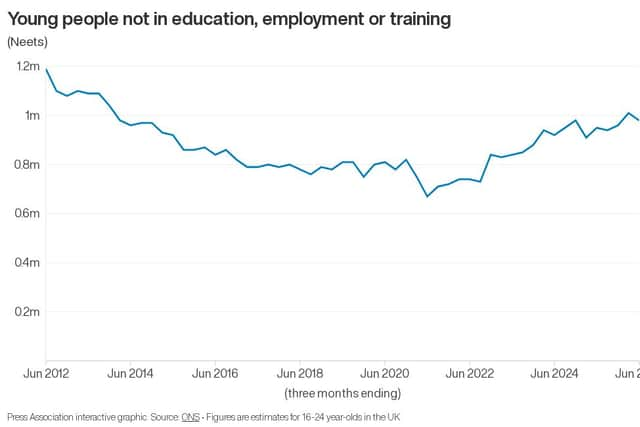
Mr Milburn was commissioned under Sir Keir to review the issue of so-called Neets – 16 to 24-year-olds not in education, employment or training – which topped a million earlier this year for the first time in more than a decade.
He has previously warned the figure could rise to one in six by 2031, representing 1.25 million young people, and estimated the crisis is costing the UK around £125 billion a year – taking in factors including losses in taxes alongside higher health and welfare spending.
Statistics out earlier this month also showed just under half (45.3%) of Neets were classed as disabled in the year to March – a proportion which has more than doubled in just over a decade.
Charities representing disabled people have expressed concern at how Mr Milburn’s proposals, which he has described as a “big rewriting of the welfare system”, might work.
And Labour MP Clive Lewis criticised the former minister for revealing some of his proposals before they can be scrutinised in full, saying MPs were left unable to answer questions from constituents about how they might be affected.
He called it irresponsible to “generate this kind of fear and uncertainty through media interviews”, adding that he had written to the House Speaker to complain.
Several Labour MPs expressed doubts about the new plans. Bell Ribeiro-Addy, who was part of the revolt which forced the Government to abandon proposals in summer 2025, said: “I am not sure I could vote for cuts unless it’s very clear what we’re voting on,” she told BBC Radio 4’s Today programme.
She said she did not believe “you get a disabled young person into work by taking away the money that helps them to get into work”, noting that Pip is not an out-of-work benefit.
Labour MPs Neil Duncan-Jordan and Rachael Maskell, who both temporarily lost the whip after voting against last year’s Bill, said there was not enough public information yet to say whether they could support the changes.
Asked whether young people facing any reduction in their benefits should have another source of income guaranteed in its place beforehand, Mr Duncan-Jordan told the Press Association: “Absolutely, and what if the employment doesn’t work out? Does the individual start over again?”
He also questioned whether the Department for Work and Pensions staff would have the resources and skills to deliver the employment support programme Mr Milburn was suggesting.
Ms Maskell told PA: “Disability is complex, as it can be about the barriers that society creates as well as the challenges people experience in being able to gain independence or optimise activity.
“Conflating this with a stick approach to work is wrong, which is why Pip was a separate benefit to UC.”
Labour MP Nadia Whittome urged the Government to bring forward a plan to help young people into work “without punitive sanctions”.
Dame Meg Hillier, who was a leading rebel against the initial welfare proposals under Sir Keir, defended Mr Milburn’s approach and argued the plans set out so far were “very different to what was happening a year and a half ago”.
“(It) is a real vision for what needs to be done,” she told BBC Radio 4’s World at One programme.
“Some of these proposals are perhaps not a surprise that he’s got to coalesce around the problem. He’s now proposing some of these solutions, and I think it’s quite radical and quite bold to be looking at… but quite right to be looking holistically at the person in the middle of this, not just about the money or the structure of the benefits.”
Chrystyna Chymera-Holloway, from the National Autistic Society, said the plan will “live or die on the sequencing”.
She told PA: “Jobs and support to get into those jobs have to exist, and bespoke autism support to get into jobs has to exist before any changes that remove vital funds from people. That is the crucial underpinning of the success of any new system.”
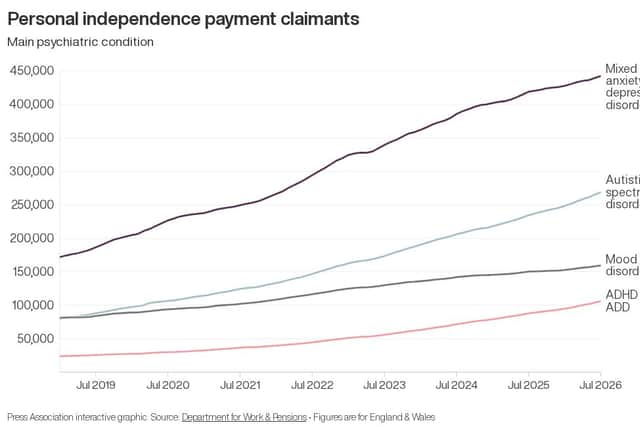
Some 268,965 Pip claimants were classed as having autistic spectrum disorders as of July 31 2026, according to data published in September by the Department for Work and Pensions.
This is up from 79,395 in January 2019 when data began, according to PA analysis.
James Taylor, executive director of strategy at disability equality charity Scope, said the proposals trailed so far are “concerning”, adding: “We’d urge the Government to tread carefully in its response. Restricting access to Pip won’t make young disabled people’s extra costs disappear.”
George Bangham, head of social policy at the New Economics Foundation, said the Government “should reject the false choice between funding employment support and funding benefits”.
Action for Children said existing claimants will “understandably be worried about today’s reports”, but that there was not enough detail available yet to understand “who would gain, who would lose out and what protections would be in place for those facing the greatest barriers”.
Disability charity Sense said it is “deeply concerned that, if these proposals are taken forward without proper funding for specialist employment support alongside welfare changes, some young disabled people could lose out”.