
Things are looking up for a 21st century airship revival in Bridgnorth - but this new dawn has beckoned before
They're coming back - not that they've ever been away for long. But it would be prudent not to get too carried away just yet, as a new dawn has beckoned for airships many times over the years without those uplands ever becoming truly sunlit.
Could it be different this time? If it is, Bridgnorth-based company Straightline Aviation will be in the vanguard as it has placed a near-£40 million order for a fleet of American-built Z1 hybrid airships. Delivery of the first is expected in 2028 with initial flights planned for humanitarian and remote cargo missions in Brazil, Alaska and northern Canada.
Thanks to technological advances, helium-filled hybrid airships are only superficially similar to airships of old. They are billed as a cheap and environmentally-friendly alternative to other methods of moving cargo and passengers, can land (almost) anywhere that's flattish, and don't float, but fly - they are heavier than air and a fifth of the aerodynamic lift is generated by the shape of the hull and vectored thrust from the engines.
Our region has plenty of experience and know-how when it comes to airships. Step forward Mike Kendrick, founder chairman of Straightline Aviation.
In 1988 Mike - who was brought up on a council estate in Wolverhampton - formed the Virgin Airship and Balloon Company in Telford, in partnership with Sir Richard Branson.
In March 1992 one of its illuminated airships inadvertently sparked a "Martians are landing" scare across the West Midlands. Police switchboards were jammed as thousands of people reported sightings of an oval-shaped "spacecraft" hovering over Wolverhampton and Birmingham, before creating consternation throughout Wombourne, Pattingham and Perton as the airship returned to its base at Halfpenny Green airfield, near Bridgnorth, after a routine night flight.
Also in the game was Thunder and Colt, based in Oswestry with Per Lindstrand as managing director, with its GA 42 airship. Nine were built, some being used as aerial camera platforms, and one of them was an advertising billboard at cricket internationals in the late 1980s.
Halfpenny Green was, incidentally, the site for setting the world airspeed record for a non-rigid airship on January 19, 2000. Mike Kendrick and Jim Dexter reached 94.7kph (58mph), breaking the existing record of 77.5kph. Their record was later beaten by American adventurer Steve Fossett.

But for readers of a certain age and with long memories, their first sight of an airship will probably stretch back to the early 1970s, when the Goodyear Airship, called Europa, made several visits to the West Midlands and Shropshire, being based temporarily at RAF Cosford.
An evocative photo in our archives shows it flying by the landmark Goodyear chimney on the Goodyear factory on Stafford Road, Wolverhampton, both of which have now passed into history.
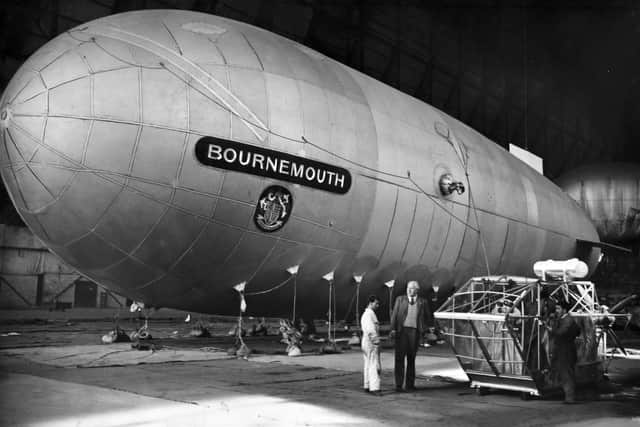
Turn back the clock still further, and we have the Bournemouth, the brainchild of a crusader who refused to let airships die. When she made her maiden flight at Cardington, near Bedford, the spiritual home of British airships, on July 19, 1951, she was the first dirigible to fly in Britain for many years. Dirigible isn't anything to do with rigidity - it means capable of being controlled.
The man behind the 109ft craft was enthusiast Lord Ventry and he was given some help by the Corporation of Bournemouth, where he lived. Sadly Bournemouth never got to see the airship bearing its name fly over. On one flight dangling ropes snagged on ground obstructions and brought her down on a gymnasium roof, leading to lengthy repairs, and then in April 1953 Bournemouth was damaged beyond practical repair in a hangar accident.
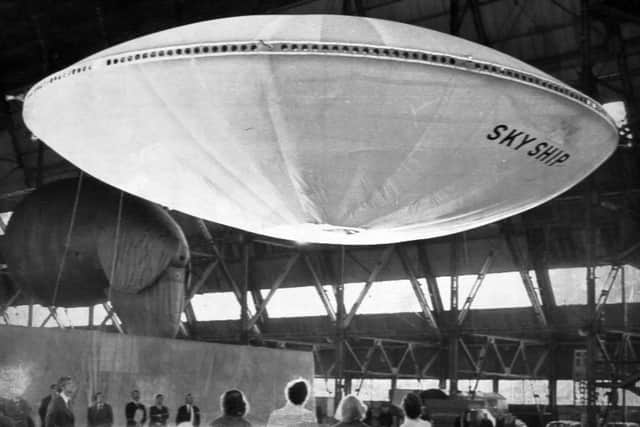
In the 1970s new materials and technologies brought new opportunities. In April 1975 things took a sci-fi turn when "the world's first flying saucer," called Skyship, took to the air at Cardington in a radio-controlled unmanned flight.
While this disc-shaped prototype came to nothing, more conventional airships, also as it happens called Skyship, operated in the 1980s, with the first scheduled airship service since 1937 launched from Leavesden Airport, near Watford, on April 23, 1986, sponsored by British Caledonian.
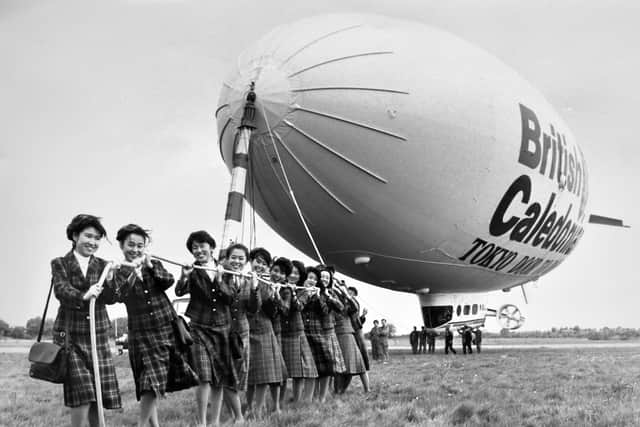
It was a sightseeing flight to London, or would have been - it turned back because of bad weather.
The flights were popular with the passengers but not necessarily with everybody on the ground, with 45 people complaining to Watford council about noise and invasion of privacy from the low-flying airship.
Today a new generation of airship designs are offering promise in an era when climate change concerns and sustainability are to the fore. Time will tell, but so far as airships are concerned, things are looking up.
Comment Guidelines
Iconic Media encourages reader discussion on our stories. User feedback, insights and back-and-forth exchanges add a rich layer of context to reporting. Please review our Community Guidelines before commenting.