
Shropshire town is 'dog capital of UK' with highest proportion of dogs to people in the whole country
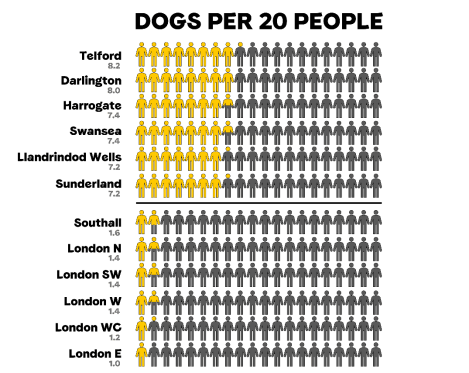
New research has shown that there are 8.2 dogs for every 20 people in one Shropshire town.

Research by Dogs Trust, University of Exeter and University of Leeds found the dog population of the UK to be around 13 million – four million higher than previous estimates.
Previously, estimating the total dog population was challenging due to a lack of comparable and accessible data.
But Dogs Trust has collaborated with researchers from the two universities to combine and model data from 18 diverse sources - including a breed registry, an academic institution, veterinary organisations, pet insurance companies, and animal welfare charities - to create a more accurate picture of our canine companions' population.
That data has turned up some interesting revelations, including where in the UK has the highest dog-to-person ratio.

And with 8.2 dogs per 20 people, the title of 'dog capital of the UK' has been given to none other than Telford.
Telford is followed by Darlington, with 8 dogs per 20 people, Harrogate and Swansea both have 7.4, and Llandrindod Wells has 7.2 dogs per 20 people.
Compared to people, the lowest densities of dogs were reported for six areas of London, covering postcode areas N, E, SW, WC, W and UB - here, for every 20 people, there was approximately one dog.
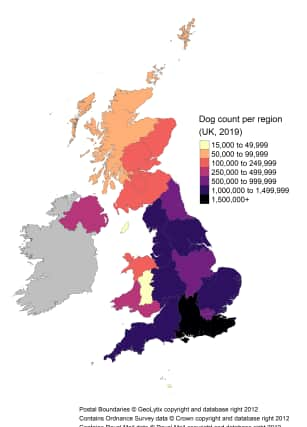
Eighty-three per cent of the UK's dogs called England home, with the South East and North West regions being the most dog-packed areas. 9.1 per cent of the UK's dogs were found in Scotland, with South Scotland and Lothian the dog hotspots north of the border.
Meanwhile, Wales was home to 5.8 per cent of the UK's doggy population, with South and West Wales being the most populated. Completing the picture, Northern Ireland was home to 2.1 per cent of the UK's dog population.
Dr Kirsten McMillan, deputy head of research at Dogs Trust, said: "The UK is well known for being a nation of dog lovers, but it turns out we may have significantly underestimated how many dogs are out there by over four million!
"This inaccuracy can have serious implications as it affects important statistics like how many dogs of different breeds or sizes live in certain regions, how the dog population grows each year, and the overall trends in dog ownership.
"This new study is the most comprehensive analysis of the dog population in the UK to date. It's packed with valuable insights for everyone involved in dog welfare and our friends within the welfare sector, veterinary care, epidemiological, and business fields.
"With plans to replicate this study in the future, we'll be able to track changes in dog populations over time, helping us better understand the changing population, including breed popularity and its impact on welfare.
"It's been fascinating to uncover stark differences in dog density throughout the UK, with Telford and Darlington emerging as leaders, boasting the highest dog-to-human ratios. These and future statistics provide valuable insights into regional trends and the dynamics of pet ownership across the country."
The study also uncovered some intriguing insights into the age distribution of dogs across the UK. Notably, Northern Ireland had the highest national proportion of older dogs, with more than half its canine population classified as either geriatric (over 12 years; 16.9 per cent) or senior adult (ages seven to under 12; 38.9 per cent).
Meanwhile, Scotland had the largest national share of mature adult (two to under seven years) dogs, making up 40.4 per cent of its population. Interestingly, the study found little variation in the proportions of puppies, juveniles and young adults across the UK, indicating a more uniform age distribution in those categories.
Comment Guidelines
Iconic Media encourages reader discussion on our stories. User feedback, insights and back-and-forth exchanges add a rich layer of context to reporting. Please review our Community Guidelines before commenting.