
Here's where you can watch the partial solar eclipse - plus expert guidance on doing it safely
It is billed as the best chance to view a solar eclipse in the UK for the next 54 years
This week will offer a chance to see the fullest solar eclipse in the UK since 1999 - and one Shropshire organisation is hosting a fun day to mark the occasion.
The unique event takes place on Wednesday (August 12) offering the potential of the UK’s fullest solar eclipse for the next 54 years.
Shropshire Astronomical Society will be hosting an Eclipse 26 Space Fun Day, where people will be offered expert guidance on how to view the rare phenomenon.
Running from noon until late, the event is being held at Rodington Village Hall.


The eclipse itself is expected to be visible from 6.15pm to 8.05pm.
The fun day will also include a host of activities, including hourly planetarium shows, space arts and crafts, a chance to discover the moon, rocks from space, space and astronomy displays, a telescope clinic and live communication with satellites.
Admission is free for children under five, £1 for five to 18-year-olds, £2 for adults, and £5 for families.
People are encouraged to take a picnic and enjoy the afternoon.
Wednesday’s partial eclipse promises to be the most spectacular since 2015, when some parts of the UK saw the moon cover 83 per cent of the sun.
In Shropshire there were a host of events to mark the occasion, with schools and people across the county taking advantage of the unusual event.
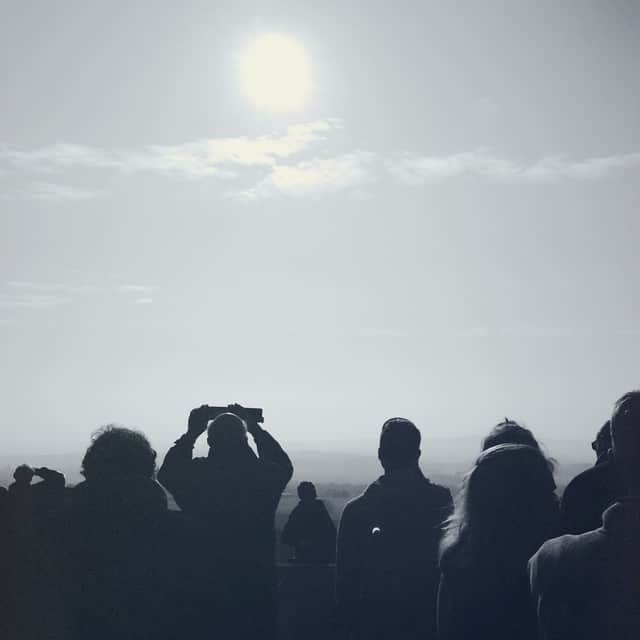
This Wednesday more than 90 per cent of the sun will be obscured by the moon between 6.17pm and 8.06pm - the largest coverage visible from the UK since the total eclipse in 1999.
Devon, Cornwall and the westernmost parts of Pembrokeshire in Wales are set to see the eclipse at its fullest, with between 94 per cent and 96 per cent of the sun obscured by the moon.
Plymouth in particular could see the moon cover 94.66 per cent of the sun at 7.16pm on Wednesday, according to the Met Office.
Parts of the West Midlands and the South West, the rest of Wales, Northern Ireland, and the westernmost parts of Scotland can expect to see 92 per cent to 94 per cent solar coverage.
Ahead of the event The Royal Greenwich Observatory has warned the public that regular sunglasses are not safe enough to view the cosmic phenomenon.
Imo Bell, a planetarium astronomer at the observatory, previously said: “It’s not a total eclipse, but over 90 per cent is really exciting. We’re not going to get one this good for a really long time.
“So, it’s important not to miss it, and to be prepared. You can’t just go out and expect to have a look because it’s really dangerous for your eyes.
“So, you can use solar eclipse glasses, which are very, very different from sunglasses – they block out so much light that you can’t see anything through them except the sun, because that’s how much light they need to block for the damaging light of the sun to be safe to view.
“Ideally a solar telescope is an amazing way to witness it, and if you don’t have one of them then you can look into whether your local astronomy society is doing any events.
“And if all else fails, you can project the image of the eclipse using a household item like a colander which has lots of holes in – point the colander towards the sun with your back facing it, and in the shadow of the colander you’ll be able to see the eclipse in the holes, which is really cool.”
The next time the moon obscures as much of the sun will be in 2081 and the next total solar eclipse in the UK will be in 2090.
Ms Bell advised getting to a vantage point facing west, with minimal buildings around, as the best way to view the eclipse.
She said: “We might notice the sky getting a little bit dark, so if you’re looking safely, it’ll look a bit like the moon is taking a bite out of the sun, you’ll see something that looks a bit like a crescent sun.”
Reykjavik in Iceland and Spanish cities A Coruna, Oviedo, Zaragoza, Bilbao and Valencia will see a total eclipse on Wednesday, in which the moon fully obscures the sun.
Comment Guidelines
Iconic Media encourages reader discussion on our stories. User feedback, insights and back-and-forth exchanges add a rich layer of context to reporting. Please review our Community Guidelines before commenting.