Labour of love over Russian battle in miniature
It is a labour of love which has taken 50 years to complete.
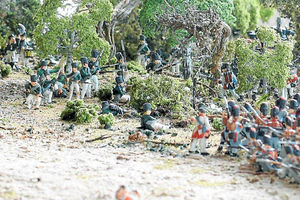
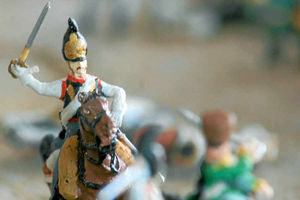
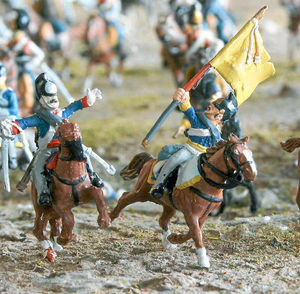
The stunning recreation of one of Russia's most famous battles contains almost 2,000 individual figures, each standing 25mm in height.
It is the work of part-time model-maker Gerald West from Bridgnorth. The 61-year-old has devoted countless hours painstakingly making a model of the Battle of Borodino, which was immortalised in the Tolstoy's classic War & Peace.
The model was completed last month just in time for the 200th anniversary of the battle, which is revered in Russia as the centrepiece of the 1812 war against Napoleon's Grande Armeé.
The battle was one of the largest day-long clashes in military history and involved more than 200,000 troops.
Mr West, a retired railway commercial manager, has recreated the battle, recorded in a famous painting by Louis Francois Baron Lejeune to a 1:72 scale.
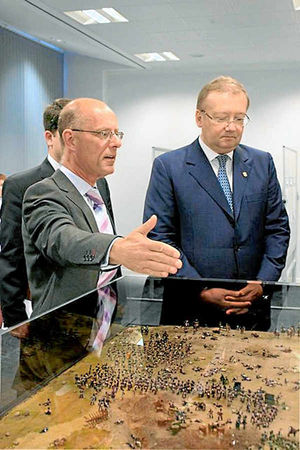
He said: "The model was first exhibited at the London culture office of the Russian Embassy. It will now be at the offices of the Scotland-Russia Institute in Edinburgh until early November.
"The day of the official opening, on September 6, the Russian Ambassador, Alexander Yakovenko, presented me with a set of commemorative stamps especially created for the occasion.
"I also managed to feature on RTV1, the equivalent to the BBC1 main news, just after President Putin's lead item."
Mr West said he began work on the project in 1974 but had long breaks in between due to his children and work commitments.
He said: "I was becoming hooked on the battle and saw the film War & Peace in a Leeds cinema.
"In 1973 I bought Chris Duffy's book on the battle and the campaign of 1812.
"The time I spent on the model varied from 20 hours-a-week to nothing.
"I went to the actual battlefield in May and that's when the layout began to form in my mind. I then worked on it solidly and completed the finished article in August.
"I tried to produce individuals so where possible I would avoid mass producing identical figures, particularly the dead, dying and wounded."
About 10,000 people died in the battle and another 70,000 were wounded as the French Grande Armée, under Emperor Napoleon I, attacked the Imperial Russian Army of General Mikhail Kutuzov, near the village of Borodino.
The battle was a pivotal point in Napoleon's campaign as it was the last offensive action he fought in Russia.
By withdrawing, the Russian army preserved its combat strength, eventually allowing it to force Napoleon out of the country.
Mr West, who has always had an interest in military history, said his model was a battle to the south of the centre of the battlefield.
He said: "There were three, two-metre high earth emplacements open at the rear and this was what formed my display.
"Generally the models have been subject to alteration by knife and plasticine, the latter set hard by nail varnish – unwanted colours donated by my understanding wife and daughters.
"The models are on average 25mm tall and 98 per cent are essentially polythene, which is the most difficult plastic to glue and is not friendly to any heat application.
"They are, however, responsive to brute force and arms, legs and heads will assume a changed position if held in a new stance for at least 20 seconds. This helps one figure look in a different direction than his near identical colleague."