
Shropshire sculpture marks newly identified resting place of St Erkenwald
A striking new sculpture has been installed at Soulton Hall
Soulton Hall near Wem has attracted international attention following claims that it is the newly identified final resting place of the seventh-century bishop, St Erkenwald, the patron saint of the City of London.
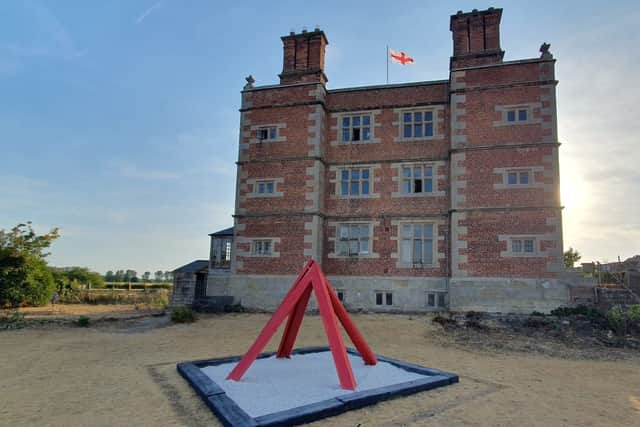

The Tudor hall was built by Old Sir Rowland Hill, a Shropshire-born Lord Mayor of London. This summer, Hill is also the subject of an episode of The Rest is History podcast.
Research led by consultancy Byrga Geniht, working with Soulton Hall, suggests the house was designed to evoke the shrine of St Erkenwald after Sir Rowland was ordered to destroy the saint's relics and high altar stone during the Reformation. The researchers believe the hall instead became a place where the relics were quietly protected.
The rooms containing the stone have recently been conserved and registered as a Place of Worship, with ecumenical services involving Anglican, Roman Catholic and Orthodox churches. The location identified by researcher James D. Wenn as St Erkenwald's burial place was investigated using photographic evidence of marks in the lawn alongside advanced geophysical surveys carried out by the University of Exeter.
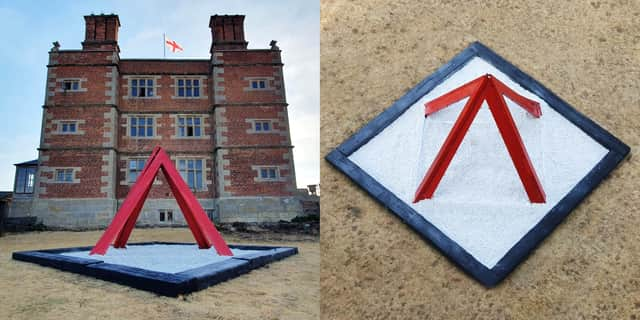
To help safeguard the site while longer-term plans are developed, a large steel sculpture known as Feretory has been installed.
Created from reclaimed steel farm roof trusses and painted red to echo the cross on the flag of the City of London, the sculpture was designed with advice from James D. Wenn and James Syrett of Byrga Geniht, together with internationally renowned sculptor Jamie McCartney. It was welded by Soulton Farm engineer Phil Wheeler, reflecting the role the working farm has played in preserving the estate's history.
Mr Wenn said the sculpture draws on the geometry of Soulton Hall itself.
"Old Sir Rowland's Soulton is a red cube which had a pyramid on top, and if you add pyramids to each face of a cube you get this special shape called a rhombic dodecahedron that was a symbol for virtue and the eternity of the soul in the Middle Ages and beyond," he said.
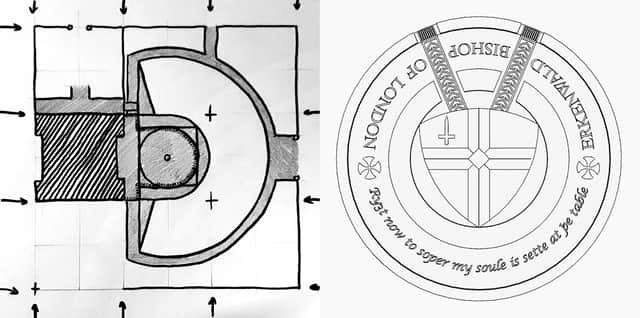
"It is the 'multifaceted polyhedron' the Pope referenced in his recent encyclical, where he talked about harmony across a diversity of perspectives. The sculpture hints at a pyramid on top of the lined box in the soil found by the geophysics that contains St Erkenwald."
Mr McCartney said: "The strength of Feretory is how effectively it answered the immediate security needs before the story became public. Plans are underway for a permanent solution, for which I understand fundraising is now in its early stages."
Fellow sculptor Jacob Chandler, who created a series of works for Soulton inspired by Shakespeare's As You Like It in 2024, said: "My permanent works capture fleeting moments in time, while Feretory is something temporary that references deep eternal truths."
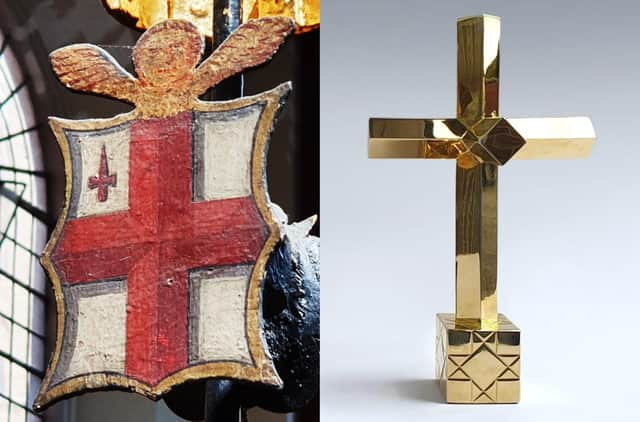
Mr Chandler has also collaborated with Byrga Geniht on In Hoc Signo, a work exploring the shared geometry found in the City of London flag, Soulton Hall's Tudor design and Feretory.
Plans have now been drawn up for a permanent landscaped memorial at the site, including a bronze tablet honouring St Erkenwald. The proposal has received approval at ecumenical meetings in Westminster and Whitehall, although organisers say it will depend on a fundraising campaign that has only recently begun.
James Syrett of Byrga Geniht said: "James Wenn and I are based in Essex, and Erkenwald was a prince and bishop of the East Saxons. It is deeply meaningful to contribute to honouring one of our own in this way."