
Shrewsbury remembers Dr Charles Burney in night of choral excellence - review
A Mirror Held Up to Heaven: Ex Cathedra review
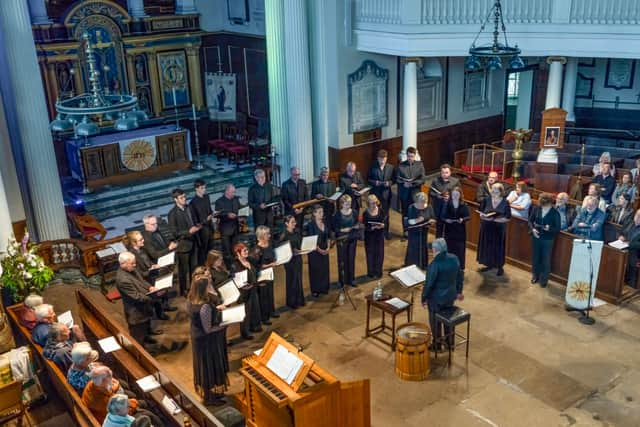
James Fraser-Andrews reviews the Shropshire Music Trust’s latest concert at St Chad’s Church in Shrewsbury, featuring one of the UK’s finest choirs, Ex Cathedra, conducted by founder Jeffrey Skidmore. The programme marked the tercentenary of one of Shrewsbury’s own sons, the 18th-century music historian and composer Dr Charles Burney.

Once I had a rather dyspeptic acquaintance who regularly wrote into Radio 3 to complain about all “all the modern rubbish” they insisted on playing. By that he meant music written since March 26, 1827, the day Beethoven died.
Alas, he, like Beethoven, has long since moved on to his reward, which includes, we can only hope, a repertoire more to his liking. I thought of him on Friday night because that celestial playlist – so we hope and perhaps believe – may resemble the programme lavished on us by Ex Cathedra in the Shropshire Music Trust’s final concert of its season.
The occasion celebrated the tercentenary of Dr Charles Burney, inquisitive musical historian, composer, belovèd friend-to-the-bewigg’d-stars, born in Shrewsbury in 1726 and devoted to travelling across Europe to compile the first History of Music in the English language.
The repertoire he encountered – and in some cases scrambled to notate – spoke on his behalf three centuries on. The SMT’s artistic director John Moore, one of Burney’s most devoted contemporary champions, read extracts from his writing, offering witty, precise insight into the musical world of the Grand Tour.
From Handel’s Zadok the Priest to Haydn’s The Creation, Bach and a cappella Mozart, there was a feast of peerless music-making. Under Jeffrey Skidmore, Ex Cathedra once again confirmed its status as a global choral force.
Three works, in particular, captured the breadth and emotional reach of the evening.
First came Hanacpachap cussicuinin, the Andean processional from the Jesuit Codex Calcha, where Spanish polyphony and indigenous devotion merge into something neither tradition could have created alone. Skidmore’s singers gave it a sound both ancient and startlingly immediate.
The second highlight was Charpentier’s Transfige, dulcissime Jesu. Against St Chad’s curved stone, the antiphonal writing blossomed with almost painful richness. The soprano lines rose as though the music itself were attempting an ascent. Carefully controlled dissonance kept the ear in a state of sustained tension. Ex Cathedra shaped it into something deeply focused and contemplative.
Finally, the Allegri Miserere. A work often burdened by myth and overexposure, yet here restored to something vital and freshly heard.
Burney’s role in obtaining one of the earliest reliable copies from Rome came to mind, part of his attempt to understand why its effect so far exceeds its structure. Skidmore’s singers matched that sense of revelation with deceptive simplicity and unhurried control.
The famous top C, when it came, twice, was no flourish but a destination. The soprano placed it into a silence so complete the building seemed to hold its breath.
Burney wrote that it would “ravish the soul of every era”. And so it proved. Irrefutably and utterly, Shrewsbury was ravished as it remembered one of its own.