
Devine Musick Piano Trio brings 18th-century music vividly to life - review
A fortepiano, gut-strung violin and cello offered a fresh perspective on Haydn, Mozart and Beethoven in Shrewsbury
We owe much of our understanding of what the late 18th century sounded like to a travelling organist from Shrewsbury.

Charles Burney travelled through France, Italy, Germany and the Netherlands in the early 1770s, listening, asking questions and recording what he heard. His observations of instruments, performers and musical life helped make the Continental music scene accessible to English readers.
Burney's tours, followed by his General History of Music, established him as an important chronicler of 18th-century music. He also played a role in helping Haydn find his feet in London when the composer arrived in 1791.
Thanks to Shropshire Music Trust, Burney's legacy is being celebrated with a special tercentenary exhibition at Shrewsbury Library until October 31, including a first edition of his history.
On Friday, however, we were able to experience something of the Burney sound for ourselves.
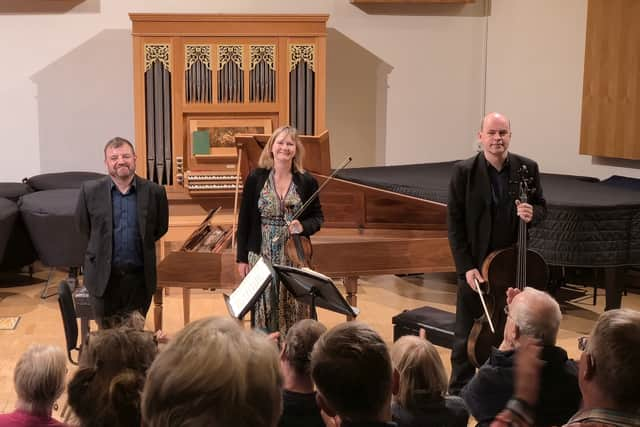
In the 21st-century surroundings of the Maidment Building, the Devine Musick Piano Trio performed music from the 18th century using a fortepiano, gut-strung violin and gut-strung cello.
This was not simply a modern piano trio dressed in period costume. The instruments created a distinctly different sound, with a lighter balance and a greater sense of space between the three players.
Haydn's E major trio, one of his late London works, opened the programme. On a modern piano, the keyboard can easily dominate, but here the fortepiano's bright, quick-decaying tone allowed the violin and cello to speak with much greater freedom.
Pianist Steven Devine made excellent use of the instrument's clear, almost speech-like attack, while Haydn's sudden changes of harmony had an appealing sense of wit and spontaneity.
Mozart's G major trio, K496, followed, with Caroline Balding's violin and Andrew Skidmore's cello complementing the fortepiano beautifully.
The balance between the three instruments allowed each voice to emerge clearly, particularly in the Andante, while the darker tone of the final Allegretto provided a striking contrast.
The programme ended with Beethoven's Piano Trio Op. 1 No. 1.
Here, the young Beethoven's ambitions were clear. The music has a drama and energy that points towards the direction his work would take, and the period instruments brought an extra sense of tension to the music.
The sforzandi had real bite, while the contrasts between loud and quiet were particularly effective. The slow movement was intimate and expressive, reminding us that this music was originally written for rooms where audiences could hear every detail.
That perhaps was the greatest strength of the evening. Rather than simply recreating an historical sound, the trio offered a fresh way of hearing familiar works.
It was a fascinating reminder of how much the instruments themselves can change our understanding of music – and a fitting tribute to Charles Burney, whose careful listening helped preserve the sound of an era for generations to come.
By James Fraser Andrews
Shropshire Music Trust's next concert is Red Priest, featuring Vivaldi's Four Seasons. Details of the concert, the Burney exhibition and the rest of the season are available from the trust’s website.