
New curfews in place in Paris and Lyon after quiet night following weekend riots
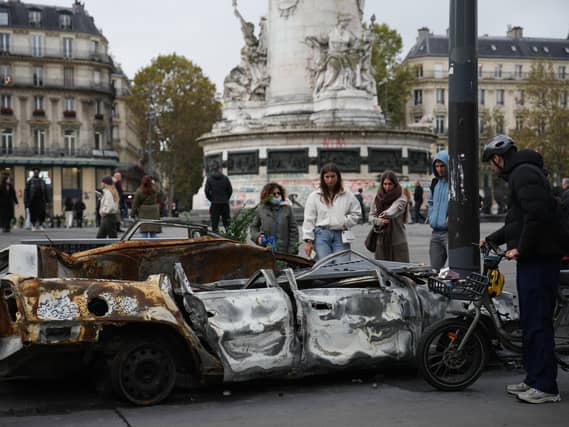

Student unions and groups from the ‘yellow vest’ movement have called for another day of protests on Saturday.
Fresh curfews were being imposed across the city centres of Paris and Lyon on Tuesday after the first quiet night since France’s most destructive rioting in years.
Prime Minister Sébastien Lecornu also said that a “massive” security operation was being planned for new protests on Saturday.
Paris police said the curfew in two designated zones — around Place de la République and the Les Halles shopping district — had restored “public peace” overnight and would remain in place “for as long as necessary”.
The curfew zones leave out other areas hit on Saturday, including the Champs-Elysées and the area around the Saint-Lazare train station and parts of the Rue de Turbigo in central Paris, where protesters set up barricades and lit fires.
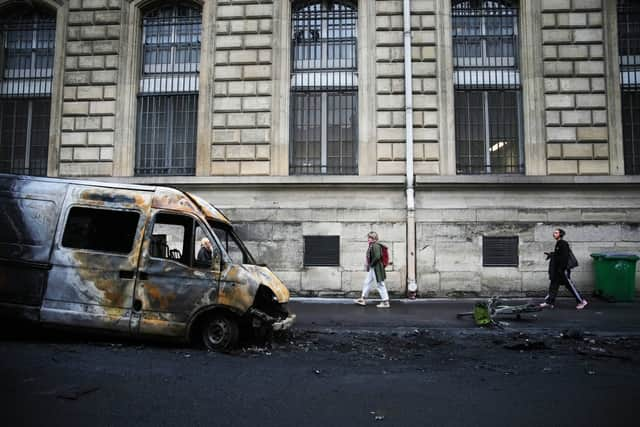
In Lyon, one of France’s largest cities, authorities also renewed a curfew in the city centre from 9pm to 6am, saying no disturbances had been recorded overnight.
Marseille, France’s second-largest city, imposed a curfew for unaccompanied minors starting on Tuesday night.
Student unions and groups from the “yellow vest” movement, whose protests over fuel prices shook France in 2018 and 2019, have called for another day of protests on Saturday.
Soldiers from Sentinelle, the anti-terrorism operation that has patrolled French cities since the 2015 attacks by the so-called Islamic State group, will take over guarding sensitive sites to free up more police officers and gendarmes for crowd control, interior minister Laurent Nuñez told lawmakers on Tuesday.
“The deployment (of police forces) for next Saturday will be massive,” Prime Minister Mr Lecornu told the National Assembly, France’s lower house of parliament, without giving figures.
Police on Tuesday arrested a suspect in the arson attack that charred the historic city hall in Limoges, in central France, Justice Minister Gérald Darmanin said, adding that the person was being held in police custody and may not have acted alone.
French media reported that the suspect was close to radical environmentalist movements and was on a watchlist of people considered potential threats to national security.
Mr Darmanin declined to comment on the suspect’s profile, but said far-left groups appeared to have organised to attack symbols of the state throughout France.
Footage of the 143-year-old building in flames, its bell tower collapsing, spread widely online over the weekend.
US Vice President JD Vance shared it on X, blaming the unrest on immigration and writing: “I pray that France, a beautiful country of amazing people, will stop this madness before more of its landmarks burn.”
President Donald Trump, who also relayed the video, said migrants had “taken over France”.
French officials have instead blamed the violence on far-left groups and opportunistic looters.
At least 2,400 people were arrested after rioters in cities across France on Saturday clashed with police, set cars on fire and stormed public buildings, during nationwide protests against rising living costs and poor conditions in schools.
On Sunday evening, small groups set fire to bins, bicycles and other objects in the streets and looted businesses in Paris, Lyon, Marseille and other cities.
In Paris on Monday night, a police helicopter circled over Place de la République overnight, a central point in the weekend clashes, sweeping the square with a searchlight to check that the curfew was being respected.
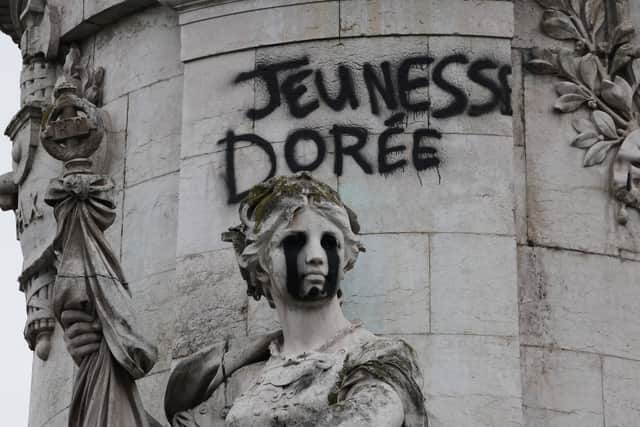
Early on Tuesday, workers used a crane to remove a giant fluorescent yellow vest draped over the statue at the centre of the square, then used pressure washers to blast graffiti off the monument.
Speaking in Lille, Mr Darmanin said 149 people had been jailed nationwide as of Tuesday at noon.
According to the Justice Ministry, of the roughly 2,400 people arrested since Saturday, more than 800 have been sent before prosecutors, most of whom were either put on trial immediately or ordered to appear at a later hearing.
In Paris alone, about 300 people have been sent before prosecutors following the October 17 protests, the city prosecutor’s office said in a statement.
The National Assembly is launching an inquiry into the October 17 violence and the authorities’ policing strategy, its speaker, Yaël Braun-Pivet, said, with findings expected “by the end of the year”.
Protests continued on Tuesday on a smaller scale. Some 400 people, mostly high school and university students, marched in the western city of Rennes, and about 750 in Lyon, under pouring rain.