
Winter warning for NHS as more than 3,500 people a day receive corridor care
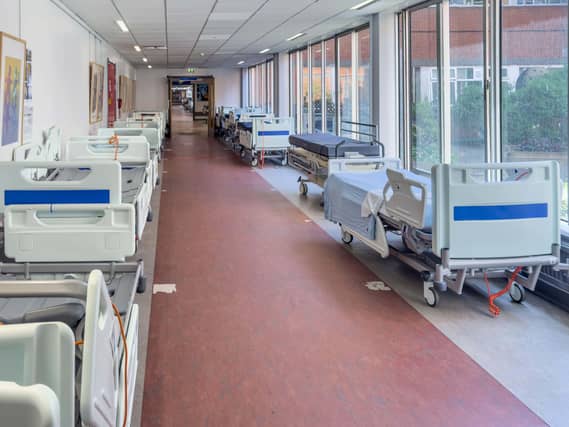

Officials said this autumn has been the ‘busiest ever’ for the health service, with record numbers attending A&E departments.
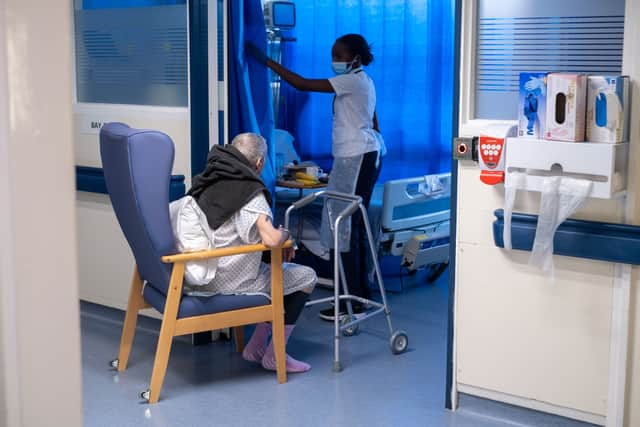
More than 3,500 patients a day received care in hospital corridors or makeshift treatment areas in England last month, as other figures show the NHS is already facing growing pressures before winter has arrived.
The waiting list for hospital treatment has also risen to its highest level in nearly a year.
Officials said this autumn has been the “busiest ever” for the health service, with record numbers of people attending A&E.
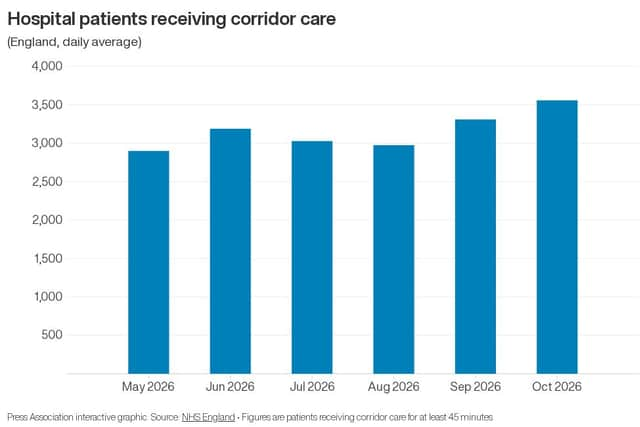
The latest performance data from NHS England shows an average of 3,558 patients received corridor care each day in October, with 2,718 in A&E departments and 840 in other hospital areas.
This is up from a revised average of 3,310 patients a day in September and the highest since figures for corridor care started being collected in May.
Professor Nicola Ranger, general secretary and chief executive of the Royal College of Nursing, called the figures “a mark of shame”.
She said: “Nursing staff will be filled with dread thinking of just how bad things will get as temperatures drop.
“The data shows once again that corridor care is occurring not just in emergency departments but across hospitals. This is an incredibly dangerous situation with much colder temperatures on the horizon.”
Liberal Democrat health spokeswoman Helen Morgan claimed the “true scale of the crisis is likely far worse”.
She added: “We are hearing troubling reports of trusts reclassifying spaces to keep the numbers down.
“Hospitals are under pressure to hit targets rather than put patients first. Patients on chairs in waiting rooms or in converted cupboards deserve to be counted.”
In emergency departments, some 74.0% of patients were seen within four hours in October, down slightly from 74.4% in September.
Dr Vicky Price, president of the Society for Acute Medicine, said “pressures facing A&E do not end when patients leave the emergency department”.
She added: “Our own recent survey found patients spending more than 12 days on acute medical units while waiting for a specialist ward bed.
“When patients cannot move to the wards where they need ongoing care, acute medical units become holding areas. That means fewer beds for the next seriously ill patient, with pressure building back into already overcrowded emergency departments.
“Corridor care cannot be solved simply by moving patients out of corridors. Patients are also spending days in emergency department waiting rooms, often in wholly unsuitable conditions.”
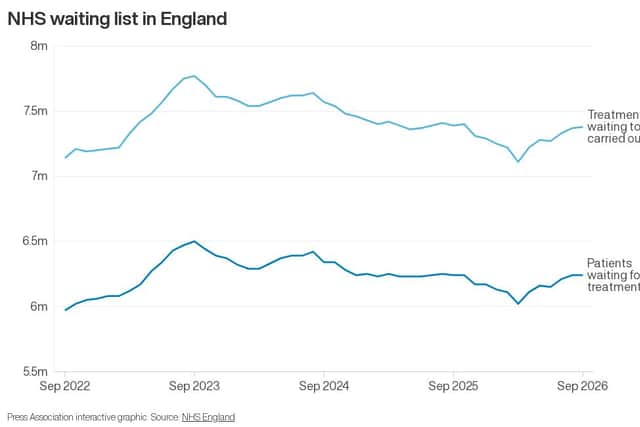
Elsewhere, an estimated 7.38 million treatments were waiting to be carried out at the end of September, relating to 6.24 million patients.
This is up slightly from 7.37 million treatments at the end of August and is the highest since the list stood at 7.40 million treatments in October 2025.
The figure for patients is broadly unchanged month on month, but is also at a level that was previously seen in October 2025.
Long waits for hospital treatment also increased, with an estimated 116,353 people waiting more than a year to start routine treatment at the end of September, up from 113,339 at the end of August.
Meanwhile, an estimated 65.8% of patients in September began hospital treatment within 18 weeks of referral, up from 65.2% in August and above the target of 65% that the Government and NHS England had set for March of this year.
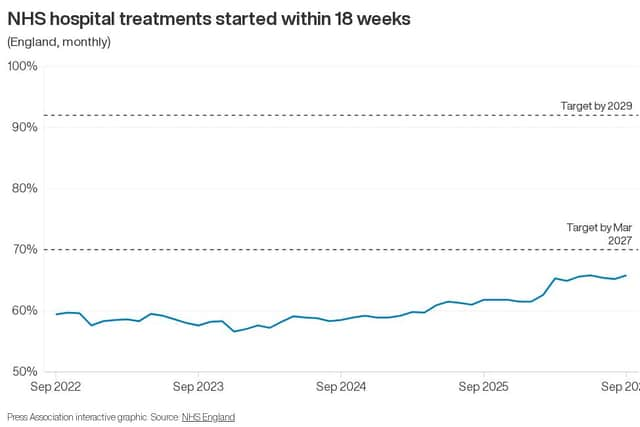
The next target is 70%, which has been set for March 2027.
The Government has also pledged that 92% of patients will begin treatment within 18 weeks by the end of the current Parliament in 2029.
It comes after a report by the Institute for Government urged Prime Minister Andy Burnham to abandon the “fantasyland” target and reduce it to 82%.
Health Secretary Yvette Cooper warned pressures will increase as we head into winter.
She said: “This autumn has been the busiest ever for our NHS, with record numbers of people attending A&E and record numbers of elective appointments and treatments.
“Despite the relentless pressure, the NHS has delivered a record 30.6 million diagnostic tests, checks and scans over the last 12 months, and more people are being treated within 18 weeks than the same time last year.
“I want to pay tribute to all the NHS staff whose commitment and hard work has made that possible.
“As we head into winter, those pressures will increase. That’s why we are bringing in a new £40 million GP programme to help frail, elderly people stay well at home and expanding the Pharmacy First scheme, so people can get care where they need it most.”
However, Sarah Scobie, director of research at Nuffield Trust, said funding “will likely prove too little too late”.
She said: “Progress on bringing down the waiting list has ground to a halt and the NHS is creaking at the seams as it heads into winter.
“In the latest data, over a quarter of patients endured waits of over four hours in A&E, and with October the busiest month on record for attendances, it doesn’t bode well for the months ahead.”
Professor Frankie Swords, NHS national medical director, urged people to get vaccinated against winter viruses to protect themselves ahead of the colder months.
The latest NHS figures for cancer wait times show 76.2% of patients urgently referred were diagnosed or had cancer ruled out within 28 days in September.
This is down from 78.6% in August and is below the target of 80%.
The proportion of patients who began their first definitive treatment for cancer in September within 62 days of an urgent referral or consultant upgrade was 70.7%, down from 71.9% in August.
The Government and NHS England have set a target of March 2027 for every NHS trust to reach 80% for the 62-day measure.
Oncologist and chairwoman of Radiotherapy UK Professor Pat Price said: “Month after month, we continue to see stagnant progress in the number of cancer patients who face deadly delays to treatment.
“We cannot continue to leave patients across the country waiting for lifesaving treatment that could mean all the difference to their lives.”