
Wolves' nineties men on highs, lows and the why they never reached the promised Premier League land
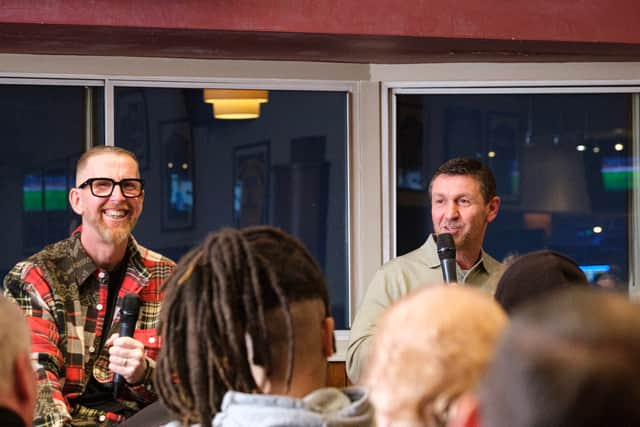
Simon Osborn and Iwan Roberts, two Molineux Men from the Nineties, were back on Wolves soil at the Cleveland Arms recently. Before taking to the stage, they spoke to Paul Berry, with a visit to Saturday’s next opponents Crystal Palace one of the items on the agenda!
For the unfamiliar, The 1% Club is a television quiz show of which the final question has a difficulty level which very few people are expected to answer. A question which only 1% of the country’s population would know.
If you were to devise a 1% Club question about Wolves in the 1990s, it would probably be obvious: How on earth did several squads, packed with so much quality and such a strong collective mentality, not manage to achieve promotion to the Premier League?
A tough one to answer.
Osborn has a go. “So often it came down to moments,” he says, as a relative veteran of six potential pushes which ultimately ended in varying degrees of frustration and disappointment.
“Certain moments during a season when we maybe lost a bit of momentum - be it a week or two - a couple of draws which should have been wins, then players pick up a few niggles.
“So often it felt like we were so close, but somehow we couldn’t quite get over the line.”
Osborn, now 54, and former striker Iwan Roberts, 57, were speaking before another fantastic night at the Cleveland Arms hosted by Matt Murray, which does of course include more positive memories alongside wondering just how Wolves never made it to the Promised Land during their respective spells at the club.
And when it comes to those moments, Wolves’ next opponents Crystal Palace, where Osborn started his senior career some three-and-a-half decades ago, is one of those agonising memories which epitomised the all-too familiar adage of so near and yet so far.
Roberts will never need to buy another drink in the WV1 metropolis by virtue of his hat trick at the Hawthorns in a 4-2 win at West Bromwich Albion in the early stages of the 1996/97 campaign. More on that later.
But that one season in which both he and Osborn were part of the same Wolves team, ended in glorious failure courtesy of a dramatic play-off semi-final defeat against Palace, where a moment of madness at the end of the first leg at Selhurst Park left the Molineux Men with a mountain to climb.
Wolves had finished third in the table, four points behind a Barnsley team who they had battled with for much of the season for the second automatic promotion spot behind runaway champions Bolton.
Palace, who had finished sixth, moved into a 2-0 lead in the 88th minute of the first leg thanks to a goal from Dougie Freedman, later of course to move to Wolves.
But Wolves went straight up the other end to pull one back with the only goal for the club notched by full back Jamie Smith, which would have set the second leg up perfectly.
Incredibly though, there was still time for Freedman to grab his second, and Palace’s third, to leave Wolves with so much to do.


There followed one of Molineux’s most memorable ever atmospheres for the second leg. The stadium was creaking amid the fervour and noise of a vociferous home support.
Agonisingly however, that phenomenal backing wasn’t enough, and when Mark Atkins’ first half goal was cancelled out by David Hopkin, a late header from Adey Williams proved no more than a consolation as another play-off campaign ended in pain and frustration.
“That season was a tricky one for me because I played pretty much injured from the March onwards and had an operation at the end,” says Osborn.
“But then we go to Palace, get it back to 2-1, so we’re right back in it, and concede a stupid goal.
“At 2-1 we’d have really fancied it, back at home, but again, the end of that first leg was one of those moments that I talk about.”
“I know Ozzy spent a few years at Wolves and this was my only season but I really think we should have done it,” adds Roberts.
“We had a proper set of lads, not just in quality but the right attitude, such a good group of people, there were no bad eggs.
“It was Barnsley that pipped up to second and again, it was probably a couple of results at crucial times that cost us.
“There was that pressure and expectancy with the team having missed out before, and maybe the anxiety started creeping in – it feels like we should have done better particularly at home.
“Even into that second leg, two goals down, I still say to this day, that was the best atmosphere I have ever played in – it was monumental.”
“Under the lights when it was like that was something else,” Osborn chips in.
“Such an incredible stadium for those night matches as well.
“Again, we just couldn’t make it, and if we knew what the reasons were, it would never have happened.
“We were fit, we were organised, we worked on everything in training, we were together as a team and we all got on.
“We had all the ingredients, but when we reached a certain point, we just couldn’t take that final step.”
The near miss, indeed near misses, formed just part of the night at the Cleveland Arms which followed our interview.
Both receive great receptions as they were introduced by Murray. Both are top guys, both eloquent about - and appreciative of - their respective spells at Molineux. And both enjoyed excellent careers overall.
For Osborn, his near six years with Wolves began when signed by Mark McGhee in December 1995, the manager he had previously worked with at Reading who had also tried to sign him for Leicester.
Indeed, Osborn had been part of the Royals side under McGhee which outplayed Wolves on the opening day of the season 16 months previously when, despite a 1-0 defeat, they impressed sufficiently to propel the young boss firmly into the consciousness of Sir Jack Hayward.
“For me, Wolves was the club I spent the longest time with during my career,” says Osborn, who started his career with a promotion to the topflight with Crystal Palace, later missing out with Reading, also in the play offs, after finishing second in the season when the Premier League was reducing in size.
“Both my kids were born during my time here and I really enjoyed it.
“I played a lot of football in what was a really good, solid Championship, and, with three years at Walsall later, nearly spent a decade in the Midlands so it’s always nice to be back."
Osborn chalked up 185 appearances in the Wolves’ midfield, a cultured ball player who rarely took the easy option, sometimes to his detriment with the fanbase, but which also led to a string of assists and 14 goals.
Roberts, who overlapped with Osborn during that 1996/97 season, has a far different Wolves story, spending just 12 months at the club and notching 12 goals in 40 games.
A powerful striker, his time at Molineux may have been short in duration but was big in drama, notably by the fact that four of those 12 goals came against the old enemy, West Bromwich Albion.
And that included a hat trick in the 4-2 win in the away game which remains the only treble scored by a Wolves player at the Hawthorns.
In a momentous afternoon down the A41, Wolves were three goals to the good after just 28 minutes, Roberts later completing the hat trick all provided by Steve Froggatt with Steve Bull, who else, grabbing the other.
It has never been forgotten by the Molineux faithful. Nor the man himself.
“That day still gets a fair few mentions on social media – and I absolutely love it,” says Roberts.
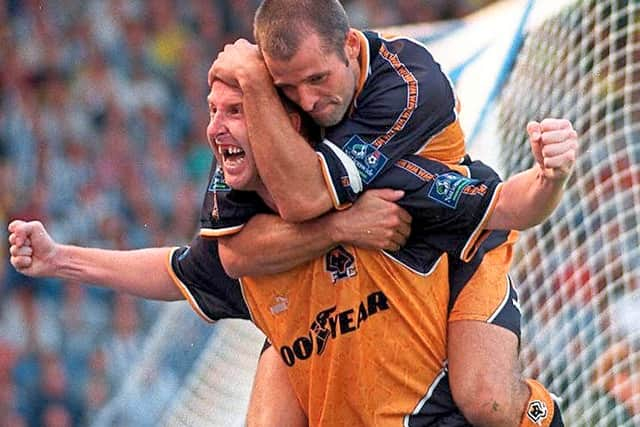
“I’ve still got a great photo from that day, with Ozzy jumping on my shoulders after one of the goals.
“It was always so funny as a player, some teams you always seemed to struggle against and others you often had a really good game against.
“And I always seemed to score against West Bromwich Albion!
“Even before Wolves, at Huddersfield and Leicester I had scored against them, and I must have got more goals against them than any other team.
“Before that day, I really have to thank the fans, because I’d come in as a big money signing, and didn’t score in my first seven games.
“Bully bailed me out, I remember he got a hat trick on the first day of the season at Grimsby, and the fans never turned on me, and I got my first goal at Oxford in the midweek before Albion.
“The fans never gave me stick, they’d got my back and were patient with me, and hopefully that was rewarded not just with the hat trick but another goal in the home game when Deano (Dean Richards) also scored in a 2-0 win.”
Osborn played his part in both wins in that Black Country double – 30 years it on it remains Wolves’ most recent double in the fixture – although his memories of that particular rivalry in general are not quite as positive as Roberts.
“I gave away a penalty in the one game,” he interjects.
“It was one of my first games for the club which made it even worse, but fortunately Stowelley (Mike Stowell) made the save and we came away with a goalless draw.”
The memories are flowing between the two former team-mates who were clearly enjoying catching up, with Osborn also outlining plans to meet former boot boy Darryl Smith the following day.
Clearly while the sustained success in terms of promotion didn’t arrive during their time at Molineux, the experiences, and friendships formed, endured long after they departed.
And talking of those departures, neither really wanted to leave.
Osborn fell victim to manager Dave Jones wanting to go in a different direction with the squad, whilst for Roberts it was more the legacy of Sir Jack’s infamous ‘Golden Tit’ speech following the Palace play-off defeat where he lambasted the amount of money the club had spent with seemingly little reward.
“I remember them showing that interview and the cameras panning to me and Adey Williams as if suggesting we were among the signings who hadn’t worked,” Roberts recalls.
“But I loved it at Wolves, and had no intention to leave.
“I’d been commuting from Leicester but then bought a house in Broseley in Shropshire as I really wanted to commit, and my son Ben had started primary school there.
“It was also the closest I ever played to where my parents lived, and my Dad had been a Wolves fan in his youth.
“I’d been away in Australia over the summer as our twin daughters had been bridesmaids for Stevie Corica’s wedding, and two days before I was due back for pre-season, I got a call from Mark McGhee.
“I had to go in and see him and he told me there had been a bid for me from Norwich, which the club had accepted, but that I should go and speak to them but didn’t have to leave.
“The thing is, when a club accepts a bid for you, then I think you know the writing is on the wall – Mark needed to sell before he could buy and I was one who an offer had come in for, so that was pretty much that.
“Wolves was still the biggest club I ever played for, and we had so many great characters in the dressing room that I would have loved to have stayed longer.”
Roberts went on to spend seven years at Norwich, including being captain, in a career in which he won 17 senior caps for Wales, a figure which would surely have been higher but for hailing from the same era as Ian Rush, Mark Hughes and Dean Saunders.
Osborn, like Roberts, also played for Gillingham amongst others towards the latter stages of a career in which – also like Roberts – his time with Wolves was much cherished.
“It was a joy to come to work at Wolves because of the people who were there, and the atmosphere around the place,” he explains.
“We went out for the odd night out – that was the way of the world back then – but we also worked hard, and everyone was together.
“The club didn’t have its own training facility, so we’d all go and get changed at Molineux and then head down to Newbridge by the tennis club to train.
“There wasn’t like two or three dressing rooms with players separated, we were all together, and I think that always helps with the togetherness.”
Whilst now working away from football, in the construction industry, Osborn keeps track of all his former clubs’ results, as well as the career of son Teddy, who is moving up in the world of refereeing.
Roberts is, as he has for many years, continuing to summarise for BBC Radio Wales and, should Wolves be relegated, may be back in Molineux’s press box next season for trips from Swansea, and potentially other Welsh clubs as well.
In the grander echelons of Molineux history, the men who were the 771st (Osborn) and 776th (Roberts) players to turn out for Wolves, might not receive a huge amount of airtime.
But the way in which they still regard their time with the club, and indeed the way they are received by the fans who flocked to the Cleveland Arms to listen to their recollections, is another cast iron example of what Wolves means to those who represented them, and, in turn, what those who gave their all, mean to the public.
And after all of that, what then would be the answer to the 1% question. Just how didn’t a Wolves side from that era make it to the Promised Land of the Premier League?
Injuries? Refereeing decisions? A loss of form or bad game at key moments?
Probably a bit of all three.
But certainly not for the want of trying, as outlined by Osborn and Roberts on another hugely entertaining night in Wolves.