
Jumpers for goalposts! How Paul Lambert brought Wolves back together
It is now 10 years since Paul Lambert arrived as head coach at Wolves. At a difficult time, he steadied the ship, presided over a memorable FA Cup run, and would have loved his stay to have been longer. He has nothing but good things to say about Wolves, as Paul Berry found out.
During Paul Lambert’s tenure as Wolves manager, every late Thursday afternoon, long after the players had departed, a game would take place on one of the pitches at the Compton training ground.
This wasn’t any sort of elaborate training exercise. Or tactical masterclass. Far from it.
In fact, it was more like a kickabout on the park. Jumpers for goalposts. Next goal the winner.
Because it didn’t just involve Lambert and members of his coaching staff and others from the academy. You know – those that can play a bit.
It also involved anyone else from the Wolves’ staff across Molineux and Compton who fancied joining in. Often 20 against 20, it was quite the spectacle.
You might see Scott Sellars sending in a beautifully-weighted cross for a fella from accounts to try and get on the end of.
Seyi Olofinjana going in for a 50-50 with a press officer, or cleaner.
Rob Edwards finding himself defending against a particularly nippy member of the ground staff.
It was often unbridled chaos, but it was also glorious fun. And was just one of many behind-the-scenes developments implemented by Lambert to try and bring the club back together after a chaotic few months.
“For any club to be successful I think you have to have an atmosphere where everybody pulls together, whatever their job,” he says. “Because at any team you will have those periods of adversity where you will need everybody.
“We could sense that the club was a little bit broken when I came in, there was some animosity about and people weren’t enjoying coming into work.
“I just thought we needed to pull things together a little bit, especially at the training ground, which wasn’t a massive place. There weren’t loads of people there, but we just needed everyone to enjoy what they were doing.
“Staff were all working hard, but when there was some downtime, we brought in those games which brought some fun and gave people the chance to spend time together.”
There were plenty of other ways in which Lambert aimed to embrace the culture and understand the heartbeat of an historic football club, situated not too far from another previous high profile posting just down the road at Aston Villa.
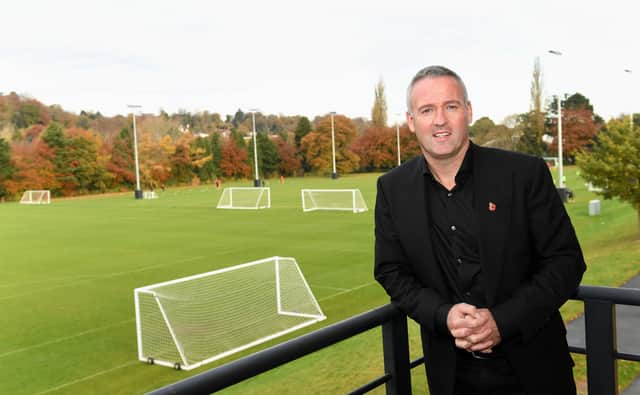

Upon his appointment he invited a large group of supporters active on social media to chat about their feelings and expectations, a gathering which went on for over two hours and included an interruption for all to head outside and join the first team players in observing a minute’s silence for remembrance.
He also arrived deliberately early at his unveiling press conference to share a cuppa with the media – the ‘Midlands Mafia’ as affectionately known – with the aim of creating a clean slate after experiencing some tensions at Villa.
Lambert certainly ‘got it’ when it came to Wolves. There were ups and downs in league fortunes but, having inherited a very randomly-assembled squad following the short-lived Walter Zenga reign after Fosun’s takeover, he provided stability and that strong sense of togetherness.
Along with that Cup run which featured giant-killing wins at then Premier League Stoke, and against Liverpool at Anfield, prior to pushing champions-elect Chelsea close in the fifth round at Molineux.
Ultimately, Lambert’s stay would also prove short-lived. Just over six months after checking in 10 years ago this November.
Wolves, whose then chairman Jeff Shi was effusive in his praise of Lambert just a few weeks before the end of the season, had been alerted to a completely new opportunity with Nuno Espirito Santo set to depart Porto. Which would also lead to a frenzied investment in some top Portuguese talents such as Ruben Neves and Diogo Jota, and others including Barry Douglas and Willy Boly.
It was an opportunity that was simply too good to turn down. Even Lambert, amid his own disappointment, acknowledged that reality, and was pleased to see the spectacular run of success which followed.
But that doesn’t in any way diminish his sense of pride and fulfilment at the spell he enjoyed at Molineux, which included blooding several young talents such as Morgan Gibbs-White, and taking Helder Costa to new heights of performance.
“I knew there had been a lot of upheaval during the Walter Zenga time, but as soon as the Wolves job came up, I was really keen to put myself forward,” he says. “Wolves are a massive club, and even when I was growing up I remember players like George Berry, and then another Scot in Andy Gray.
“I was also aware of the South Bank behind the goal, and just felt if we got that place and Molineux going, it could be absolutely brilliant.
“We had a few full houses during my time, against Chelsea in the Cup, and we beat Villa, and I just felt the potential at Wolves was vast.
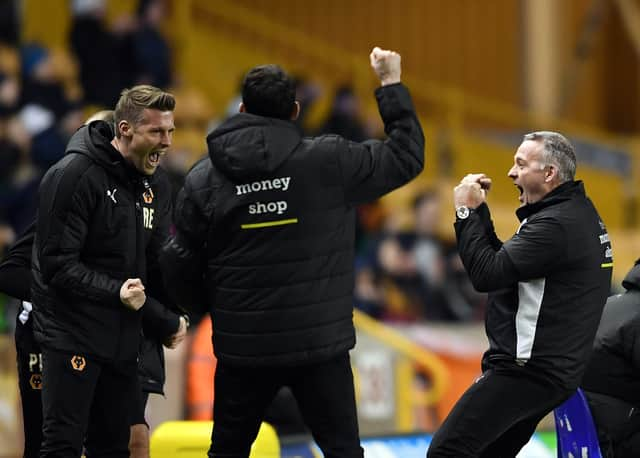
“Meeting the fans was important, just getting to know the culture of the club.
“I just felt it was a club where all the fans were really hard-working, and that is what we had to do as staff and players, to learn that way and make sure everyone was ‘all in’.
“There was a wee bit of dourness when we went in, but I thought I could relate with the people and it just needed to be built up again.
“There is such a great fanbase there and a hell of an atmosphere when it gets going.”
By the time Lambert arrived at Wolves, he was already 30 years into a career which had seen him enjoy huge success as a player. Including earning 40 senior international caps for Scotland and playing at the 1998 World Cup finals.
He made his debut as a 15-year-old with St Mirren, and was part of their team which won the Scottish Cup final against Dundee United just two years later.
He relished coming up against the all-conquering Aberdeen team of that era, and working with St Mirren boss Alex Miller and coaches Martin Ferguson and Drew Jarvie.
Even going further back, he always remembers his coach – Alex Stephen – at Linwood Rangers Boys Club, recently finding a poignant letter sent to him after he left to turn professional.
Lambert went on to win four Scottish Premier League titles with Celtic, two more Scottish Cups, two Scottish League Cups, as well as being a UEFA Cup finalist.
But by the time he had moved to Celtic, he had already landed the highest prize in club football, when winning the 1997 Champions League final with Borussia Dortmund against Juventus.
Lambert set up Karl Heinz-Riedle’s opener in the 3-1 victory, and was lauded for his performance in quelling the influence of legendary Juventus midfielder Zinedine Zidane.
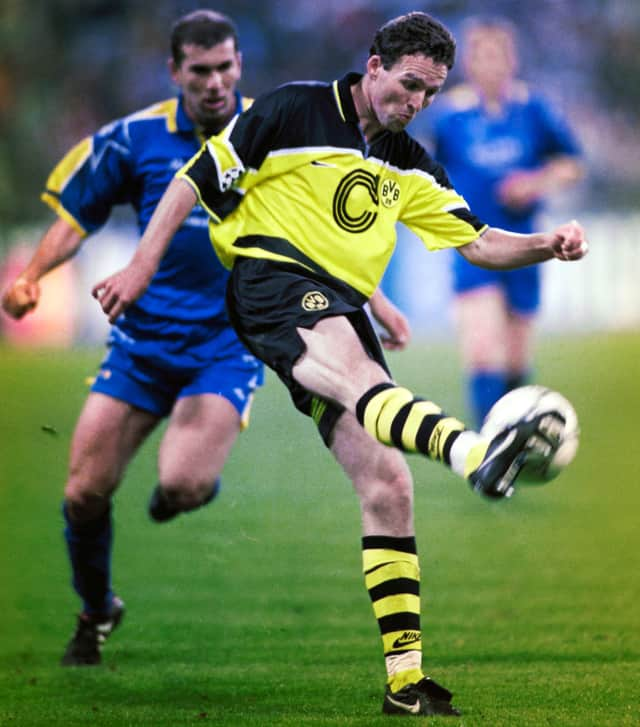
Not only was it the pinnacle of his playing career – becoming the first British player to win European’s top prize with a team from overseas - his time in Germany also sowed the seeds for the managerial roles which followed after hanging up his boots.
“It was when I was at Dortmund that I started writing down everything we did in training, what we ate, how we prepared, what time the meetings were,” Lambert recalls. “And that’s because I was working under, in my opinion, one of the best managers that the game was ever seen in Ottmar Hitzfeld.
“I would have been an absolute mug not to learn from him and his approach and methods, and how calm he was in so many aspects of the game.
“Not to mention how he handled big players, because at Dortmund we had guys that had already won the Champions League and World Cup, so I started keeping a dossier of everything we did.”
Lambert took those experiences and knowledge from a hugely successful playing career into life in management, starting out at Livingston and then moving to Wycombe Wanderers who became the first fourth tier team in 30 years to reach the League Cup semi-finals, going out to Chelsea after drawing the first leg.
Next port of call was Colchester, where a 7-1 opening day win at Norwich probably went a long way to seeing him installed in the hotseat at Carrow Road, delivering successive promotions for the Canaries from League Two to the Premier League.
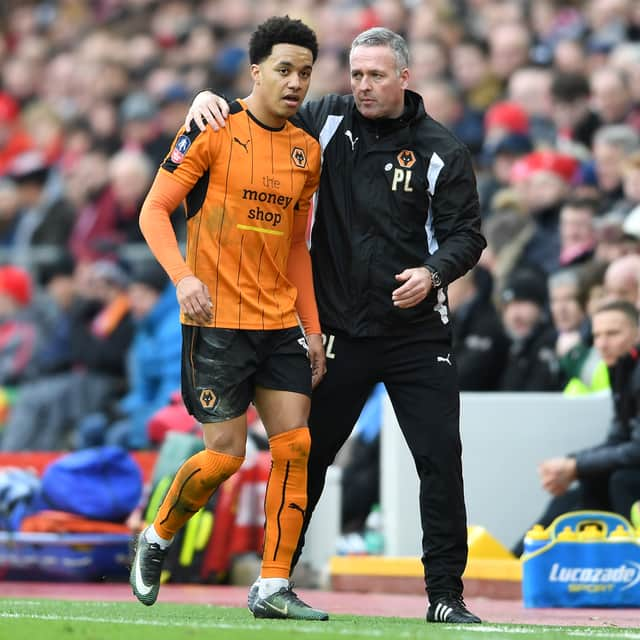
From there came Villa, featuring another League Cup semi-final appearance while grappling with many challenges including cutting the wage bill, although Lambert earned plenty of plaudits for keeping the team in the Premier League with the youngest starting XI in the division.
“We had a really young side at Villa, the finances dictated that, and the owner Randy Lerner was wanting to sell the club at the time,” he explains. “Villa is another great club, but I found it a really tough job, which is why I have always said that keeping them in the Premier League is one of my biggest achievements in management.”
Lambert went on to manage Blackburn and - after Wolves - Stoke and Ipswich.
At Molineux he brought in Stuart Taylor as his assistant, and kept Rob Edwards as first-team coach, both of whom have gone on to manage since.
He was very much a ‘player’s manager’, with experienced figures in the dressing room such as Carl Ikeme and Dave Edwards particularly enjoying his impact, while the Lambert legacy extended to several young players who were given their first opportunities.
At Villa he gave debuts to Jack Grealish and Callum Robinson. At Wolves it was Gibbs-White, as a 16-year-old in the FA Cup win at Stoke, Connor Ronan and Harry Burgoyne.
“As soon as I started working with Morgan I could see how good he was, and I always thought he had the mentality to do it,” Lambert explains. “He had a swagger about him at a young age, in a good way, where nothing really fazed him.
“Connor was another great kid who was a player. We put him in at Sheffield Wednesday on the left and he was man of the match, even though I knew he was going to be a central midfielder.”
That win at Stoke led to the memorable afternoon at Anfield, putting one over his good friend Jurgen Klopp, with whom he completed his UEFA Pro-Licence course in 2004.
Edwards as captain, Burgoyne in goal, the early header from Richard Stearman, a great goal from Andi Weimann, so close to incredible solo efforts from Costa and Jon Dadi-Bodvarsson, and the Icelandic clap with 9,000 travelling fans at full time. It was quite the occasion.
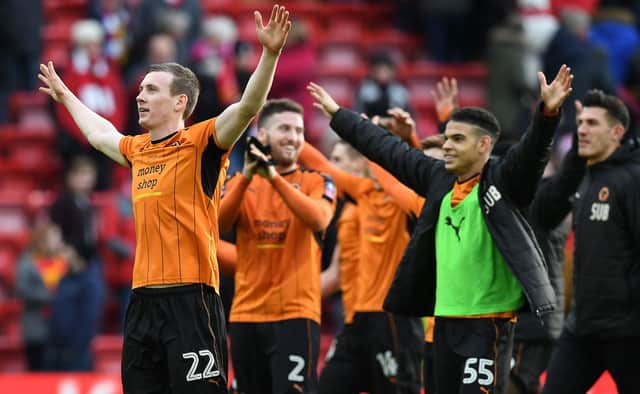
“It was a great day and something I always remember along with that early goal from Richard Stearman was Conor Coady,” Lambert recalls. “He was playing right-back at the time, going back against his former club, and his first tackle of the game put the Liverpool full-back on his backside and I remember thinking, ‘wow – that’s laid down a marker’.
“The lads were brilliant that day, and I will never forget all those fans behind the goal – they created such an incredible atmosphere.
“There were some really talented lads at Wolves at the time, and I remember Helder and Cav (Ivan Cavaleiro) on the wings.
“Cav was up and down a little bit in consistency but when he was on his game he was brilliant.
“And Helder had that consistency where he had such great speed and could go past people and score goals- his ability on the counter-attack was a great asset for us.
“So, all of the lads who had come in during that period I felt that Helder and Cav were the best ones and players I felt that we could have taken with us.”
Wolves finished 15th in that season, and Lambert had been planning to try and mastermind an improvement heading into his first full campaign in charge.
As events transpired, he wasn’t afforded that chance.
He was kept in limbo for several weeks as speculation around Nuno’s arrival intensified, and while there can be no arguments about the incredible job done by his eventual successor, Lambert admits he would have loved a similar opportunity.
“I never wanted to leave and initially was told that I would be staying on,” he reveals. “But then if you look at the finances that were spent at the time, and the quality of the lads that came in – they were incredible footballers as everyone could see.
“Nuno did a great job and got them promoted and then established in the Premier League which was great because Wolves is a brilliant club.
“It’s football and it happens, and the older you get the more you realise that owners will always make changes when they want to.
“Even with the way it finished for me, I am proud of the time I had there, and that we were able to stabilise things in the league and have that great Cup run.”
Lambert is still heavily involved in football, and his most recent posting was a hugely enjoyable role continuing his association with Dortmund by working as their technical director across the Asia-Pacific region.
Extending the club’s youth development philosophy across the area he was, once again, supporting the development of young players and seeing at first hand the work the German giants deliver in that sphere.
At 57, with a host of playing, coaching and managerial experience behind him, there is clearly still a strong motivation and desire to pass that on and maintain his strong links within the game.
While part of that experience, just six months at Molineux, didn’t ultimately last as long as he would have wanted, it may have been short, but was most definitely sweet.
Comment Guidelines
Iconic Media encourages reader discussion on our stories. User feedback, insights and back-and-forth exchanges add a rich layer of context to reporting. Please review our Community Guidelines before commenting.