
Medic Skitt: It’s my duty to share burden of Shrewsbury injuries
Shrewsbury Town have had some serious bad luck over the last couple of years with injuries.
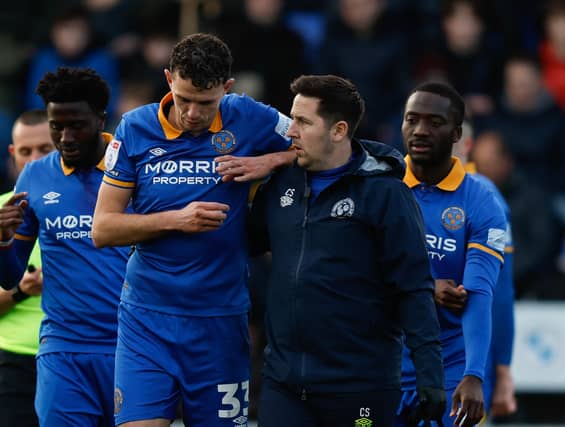


In Steve Cotterill’s last season in charge at the Croud Meadow, there was a time when the manager could barely fill a bench.
Town had a small squad, but injuries completely crippled them.
The situation was similar for Matt Taylor at times last season when he was head coach in Shropshire – Town seemed to suffer a long list of contact injuries picked up during games.
Taylor had built a bigger squad but it crippled them too.
Town will be hoping for a cleaner bill of health this time around as they try to avoid any injury crisis.
When current head coach Paul Hurst came in as boss in January, Salop’s fortune on that note changed with them managing to navigate the remainder of the season without too many scares.
When players go down injured, and the number of squad members pile into the treatment room that must put enormous pressure on the medical staff.
Salop head of medical performance Chris Skitt says he does not see it as pressure – but whenever he goes on to the pitch to treat a player he is concerned for their wellbeing.
“I wouldn’t describe it as pressure, I am not one to really feel pressure I suppose,” Skitt said. “I would, as I am running on to the pitch, hope that it is not bad because I don’t want to see a player essentially put any risk to their livelihoods.
“It is important to realise these players, this is their career. It is a short enough career at the best of times but with the risk of long-standing injuries, it can be shortened even more so.”
Skitt was brought back to Salop at the start of last season and is a popular figure among the players and even the fans in Shropshire.
And he has explained what he has to go through when a player goes down injured.
“My initial thoughts are ‘hopefully this is just a knock and they are just trying to get their breath back’ but from there, it is going through a system to understand what is going on,” Skitt continued.
“The way I work I always go from the worst possible situation and work backwards to what it is.
“In some circumstances, it is a case of them dealing with a significant injury and it is them understanding it.
“Then you have to deal with things like scans, when can you get them booked in, if it is a knee it is when can I get them in to see the knee consultant.
“You have to deal with the management. More often than not, as soon as you walk off on the sideline they are asking how long it is going to be and how long are we going to lose them for.
“And then you deal with the psychological impacts – which I believe are massively undervalued in football. So there is a lot to do. I feel like I have a responsibility to the club, the player, the family of the player to wear the burden of their worries and make it as easy as I can for them at a very difficult time.”
Comment Guidelines
Iconic Media encourages reader discussion on our stories. User feedback, insights and back-and-forth exchanges add a rich layer of context to reporting. Please review our Community Guidelines before commenting.