
Matt Maher: Do referees really need a fresh bone of contention?
It is hard not to view the proposed trial of sin bins in professional football as an answer to a question no-one asked.
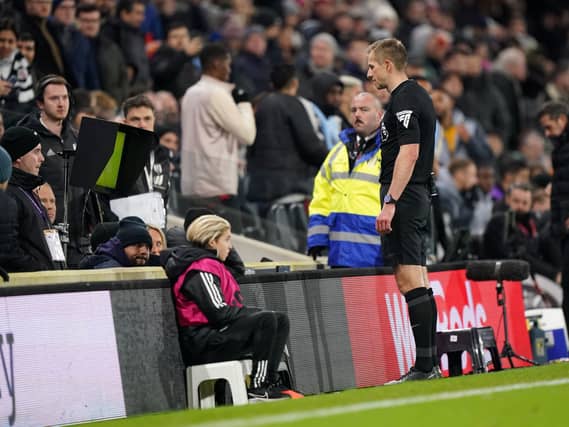


The logic behind the plan, announced this week by the game’s lawmaking body Ifab, appears sound enough on paper. Who doesn’t want to see a reduction in cynical fouls and dissent?
Yet if the past few weeks have taught us anything, it is just at this moment football doesn’t need any more variables adding to an already jumbled officiating mix.
Referees are having a tough enough time consistently applying the laws already at their disposal. Just ask Wolves and Gary O’Neil.
So often has O’Neil found his team getting the rough end of the stick, any sense of anger has dissipated into exasperation.
In the moments after referee Michael Salisbury had awarded Fulham their second, game-clinching penalty on Monday night, the Wolves boss could be seen looking at his assistants, shaking his head and shrugging his shoulders. What can you do, indeed?
It says plenty about the way O’Neil has conducted himself that, despite having to speak at length about controversial refereeing and VAR decisions after three of Wolves’ last four matches (not to mention a couple of others earlier in the season), he has not said anything to warrant an FA charge.
One suspects the response of sporting director Matt Hobbs, suspended one match for calling Anthony Taylor “f****** useless” after the recent 2-2 draw with Newcastle, chimes closer with that of most supporters.
O’Neil has remained respectful and done his best to try and make sense of why certain decisions have been given against his team.
He gives the impression of a man who, despite having more cause than most to be unhappy with referees, is still on their side, recognising the difficulty of the job they do.
It was telling and even a little worrying, therefore, to hear him ponder on Monday night whether such an approach has actually worked against him and Wolves?
“I try to remain respectful. But do I actually need to do something that people are going to visibly see, or do I just stand there and behave in a way that I’m supposed to behave?” wondered O’Neil, who hinted he had previously dissuaded his frustrated players from kicking up a stink on social media.
The question of respect feeds directly into one of the more concerning by-products of VAR, namely that its introduction, together with those interminable slow-motion replays which can make even the slightest reflex appear a cold, calculated act, encourages players to be less honest.
Such an accusation could not be thrown in the direction of Max Kilman, after the Wolves captain stayed on his feet when Carlos Vinicius thrust his forehead into his nose at Craven Cottage. Video assistant Stuart Attwell’s failure to suggest the yellow card shown to the Fulham attacker be upgraded to a red was Monday’s clearest officiating blunder and you could not help but think a different decision might have been forthcoming, had Kilman’s reaction been akin to that of Hwang Hee-chan during a similar incident at Bournemouth in October.
Both Fulham penalties, meanwhile, came after minimal contact between defender and attacker. The second, which saw Harry Wilson go over the leg of Joao Gomes, was the less egregious. Yet while Gomes left himself open to trouble by dangling out a leg, there could be few doubts Wilson knew what he was doing.
In the case of the first penalty, when Nelson Semedo was adjudged to have fouled Tom Cairney, it was difficult to determine whether there had been any contact between the pair, even after viewing several replays. Cairney was adamant there had and that, such is the pace of the game, it was sufficient enough to bring him down.
But then during a midweek TV interview (in which, ironically enough, he rejected the idea of sin bins for precisely the reasons given above and expressed his own concerns with VAR), he did not help his cause by saying: “I felt the contact and I went down.”
Cairney and Wilson were, of course, only doing what many other players would do in the same situation. It would be wrong to single them out.
The trouble is such behaviour, the “winning” of fouls, has become such an accepted part of the modern game.
“Actions which a few decades ago would have bluntly been called “cheating” are instead now “clever” and are rarely, if ever, called out. Certainly not by managers who will think nothing of directing their ire toward referees.
You can’t blame VAR for starting this particular problem.
You can argue the introduction of technology, with players knowing every tumble will be checked and is open to interpretation, has made things worse.
For all that it often feels reasonable to criticise referees and much as the inconsistencies surrounding the application of VAR can be maddening, it is also true the job of the officials is frequently made harder by the players.
Kilman’s honesty on Monday deserved better.
In that moment, his decision not to go to ground might have been “costly” to Wolves’ prospects of getting a result at Craven Cottage.
In the long-term, despite all the myriad issues around VAR’s implementation, you can’t help but feel things would at least get a little better if more players followed his lead.
Comment Guidelines
Iconic Media encourages reader discussion on our stories. User feedback, insights and back-and-forth exchanges add a rich layer of context to reporting. Please review our Community Guidelines before commenting.