
Johnny Phillips: How London replaced the north as the talent hotbed
A few weeks ago I turned out for a charity team from back home in Liverpool who had come down south for a game in north London.

The salt and pepper hair was a giveaway in our team, but it was great to be sharing a pitch full of lads who were similarly the wrong side of 40 and more.
Chatting in the bar afterwards we shared stories of schoolboy football and how big it was back in the day before academies swept up the local talent at an early age.
At the home of the Liverpool County Football Association headquarters in Walton there are walls full of team photographs littered with stars from the 1970s, 80s and 90s.
The city, like others in the north, was a classic hotbed of football.
Huyton alone – with a population of just 33,000 – produced the likes of Steven Gerrard, Peter Reid, David Nugent, Joey Barton and Tony Hibbert.
Working-class cities in the north have always had a tradition of producing professional footballers.
In the North-East, Wallsend Boys Club is famous for producing more than 90 professional footballers, including Peter Beardsley, Steve Bruce, Alan Shearer, Steve Watson, Lee Clark and Michael Carrick.
But then something changed.
Gradually the dominance of the north was replaced with the emergence of south London.
The ‘Concrete Catalonia’ is home to a new generation of stars such as Jadon Sancho, Wilfried Zaha, Joe Gomez, Aaron Wan-Bissaka, Ebere Eze and many more.
This shift in power to the capital has been explored by one of our younger number from that charity team, Callum Murray – Huyton born and bred – who works in performance psychology at Integer Football.
In his book Something In The Water, he examines the changing of the guard and how youth football has developed in this country.
“The change in the Premier League, where the trend is for foreign coaches, players and tactics is part of this,” he says.
“Elite football in England looks a lot different to 30 or 40 years ago when places like Huyton and the North-East towns were creating these players.
“Those areas reflected what elite level football looked like. Back then it was white, English, 4-4-2.
“Over the last 10 or 15 years that has changed for the better, but to the detriment of these towns where there has been less diversity and change.
“Football today is full of different shapes, sizes, backgrounds and influences.
“Places like south London – the diverse places – reflect that. Huyton and similar places are still producing footballers but just not at elite level.”
So can this be put down to density of population, or is it more complex than that?
“That’s part of it,” Murray continues. “With so many clubs in London these players are getting elite level coaching at a younger age.
“When I spoke to families in South London there would be kids who trained with Arsenal on Monday, Chelsea on a Tuesday, Palace on a Wednesday and so on.
“They are exposed to more elite level coaching. The cultural element is important too, with the rise of cage football.”
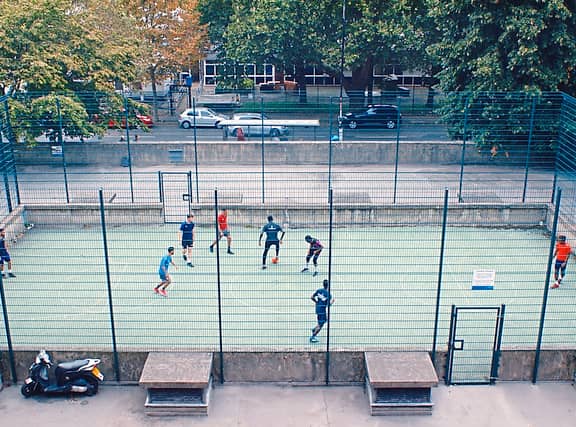
London’s small, caged concrete pitches, a characteristic of many inner city estates, have become a breeding ground and scouts will often turn up to see the potential on offer during these street games.
“The research is there in terms of the benefit of small-sided football and cage football takes that to the next level,” Murray continues. “You’ve got to be strong, fast, resilient – mentally and physically – because you’re going to get kicked about, it can be initimidating.
“You’ve got to be creative. When I’ve watched cage football, sometimes a nutmeg or another piece of skill will get a bigger reaction than a goal; you’re embarrassing your opponent.
“Players like Zaha and Eze, what these players do with the ball and how creative they are, they get people up off their seats.
“It’s not just for attacking footballers. Wan-Bissaka is a great example of that, someone who played a lot of cage football growing up.
“He’s very rarely dribbled past and always gets a foot in. He’s strong, fast and uses his body well. He can predict what the opponent can do.”
Murray delves into football hotbeds around the world, making for an interesting examination of how young players develop in different ways according to where they are brought up and how they are influenced.
He suggests that south London has found an eclectic mix of some of the best and most productive football heartlands around the world.
“The type of football played in the favelas of Brazil is comparable to that in south London,” he explains. “France and their cages in Paris are similar too. The immigration, diversity and mix of ideas has produced a thriving hotbed in south London.”
The question going forward is: Can this area of the capital keep producing talent or will it be replaced by another emerging area in the coming years?
“It seems to be sustainable and there are a lot of these [cage] players coming through,” Murray concludes. “It’s probably safe to assume that greater immigration in northern towns in next 10 years or so will have a knock-on effect too.”
Comment Guidelines
Iconic Media encourages reader discussion on our stories. User feedback, insights and back-and-forth exchanges add a rich layer of context to reporting. Please review our Community Guidelines before commenting.