
Big Interview: Former Aston Villa striker Darius Vassell keeps an eye on the future
It’s now just over two years since Darius Vassell retired from playing, but football remains a huge part of his life.
The former Aston Villa and Manchester City striker who was capped 22 times for England has swiftly moved into coaching.
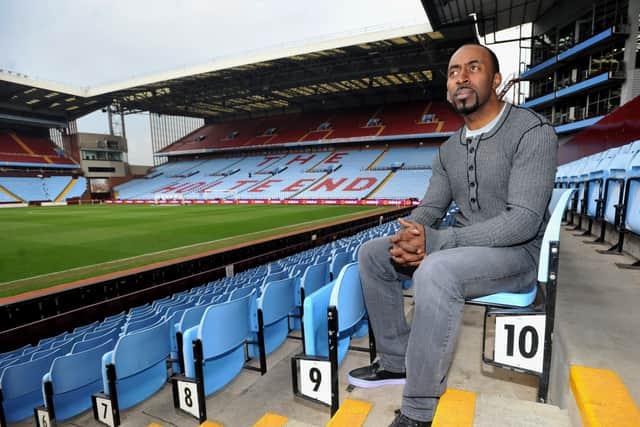

He is a specialist coach at Wolves academy, providing expert forwards advice to all age groups while also working with the under-15s.
But this is not a second career based solely on raw ambition, there is an altruistic element to it.
“When I’m coaching, I see the glow in the youngster’s eyes,” he said. “I know what they’re feeling.
“It takes me back to what it was like myself playing football for the fun of it,” he said. “I wasn’t thinking about making it, money, or dreams.
“It was just because I loved the game. There comes a point when you’ve got to go back to that. I think I’m there.”
Vassell is happy at Compton, he’s enjoying his job, and it’s made him appreciate those who looked after him when he was coming through the ranks at Villa.
“It’s a great place, I’m learning every day, they’ve got great people there.,” he said. “They asked me the question, ‘what’s your end goal, what do you want to be?’
“I feel like I’m actually doing it now. How far it takes me depends on how good I am at it and how much people feel like they need me to assist.
“I help with the strikers through the age groups in the academy, I put on sessions for them when I get the chance to go over the weaknesses in their game and enhance their strengths.
“I look after the U15s with another great manager, Ian Cranson.
“It’s a really good atmosphere and I’m really enjoying being a part of it. I never knew how much work goes in to getting these youngsters sorted out.
“I’m proud to say I’m involved in it but I wish I was a bit more appreciative of it at the time, I think you do take it for granted a little bit when you’re younger.”
But Vassell wanted to do more than just coach the best youngsters in the catchment area.
As well as his professional life at Wolves, the former England striker has set up an evening soccer school for men, women, boys, and girls of all ages and all abilities in his hometown of Birmingham at Newman University.
“People are asking why I’m doing it, there are three reasons,” he said. “I want to give a little bit back, I feel like it’s going to develop me as a coach, and also I think about when I was younger and playing, what would I have really loved to have been able to do.
“And that would have been to actually play with some of the players I used to look up to.
“If I can offer that to people, young, old, male, female, whoever it is, if they want to better their game, that’s a service that could go a long way.”
Raised in Gravelly Hill and schooled in Erdington, Vassell is acutely aware of the privileged position playing football has left him in.
And there is a nostalgic element to his soccer school that taps into the essence of the game, an essence that has perhaps been lost in recent years.
He’s not been long retired but football has already changed immeasurably since his playing days.
“I’ve been back to Villa, a place where I love to go,” he said. “It’s home in a way for me, and that has completely changed.
“It’s a football factory, I’m surprised there aren’t just kids rolling off the production line and landing on a pitch.
“You see the computer stuff, the members of staff, sport science teams, nutritionists, the classrooms that they’ve got and you start to realise it is serious business now.”
The money that was in the game when he was playing has shot up another level in the past few years.
Kids coming through at Wolves now dream of unfathomable riches because they can visualise a future that involves them playing in the Premier League.
But part of his role as an academy coach is to manage those expectations.
“It’s definitely part of our job and it’s difficult too because that money is in your face,” said Vassell. “Young players have got access to the internet and newspapers, it’s always there.
“So they know what’s going on around them and they can quickly start to think they’re on that pathway to the same things.
“It’s up to us to instil the understanding that hard work, dedication and concentration are things that need to be in place for them to achieve their goals.
“Wolves have a philosophy that every player follows at the club and as long as we stick to that we’ve got a good chance of getting lads through the system.”
He hopes that speaking from a position of experience, as a former Premier League striker, the words of warning strike home.
And he can remember hearing some sage advice from the generation of strikers before him.
“I spoke to a few to be honest,” he said. “I remember Les Ferdinand speaking to me, not so much on the pitch, but I’d see people at events. Ian Wright’s had chats with me at golf events.
“With regards to coaches, my coaches at Aston Villa were defenders! People will say that’s no use to you, but you’d be surprised.
“They told me everything they hated going against. I felt they did a great job with me but if I just had a striker there to balance it off as well then who knows where I would have been able to take my football.
“The closest I got was at Manchester City when I was playing under Mark Hughes. And then injuries came along.”
Vassell’s partnership with Sven-Goran Eriksson, the manager who played him at City and then handed him his England debut, is well known.
But oddly enough, the Swede is not the manager who had the biggest influence on him.
“Everybody says that but funnily enough, as much as he rated me as a player he was real and honest with me and there were times I wasn’t doing it and he would drop me,” said Vassell.
“Sven is somebody who I will always be thankful for, he gave me my England debut.
“But I’d say John Gregory for giving me my Villa debut, because without that nothing else would have happened.”
Vassell comes across as a man happy with his lot, who is now eager to help others out.
His passion for football, the game and not the business, means he will probably always be involved in it in some way or another, even if it’s coaching a Sunday league team down the park.
But there’s more to his life than just football. Everything he does in retirement is for his daughter Persia, who is nearly three years old.
Even the title of his autobiography was called ‘The Road to Persia’.
“Will she be a footballer? I don’t know,” he said. “I’m looking forward to seeing what she wants to be but there’s every chance that she’ll be sporty. She loves her music too.
“I’m trying to be responsible now, she’s been a big addition to my life and a lot of what I do is for her to see the right way about doing things. Daddy has to be responsible and wants the best for her.”
Comment Guidelines
Iconic Media encourages reader discussion on our stories. User feedback, insights and back-and-forth exchanges add a rich layer of context to reporting. Please review our Community Guidelines before commenting.