
'My fight to be seen and heard in the brutal world of AI'
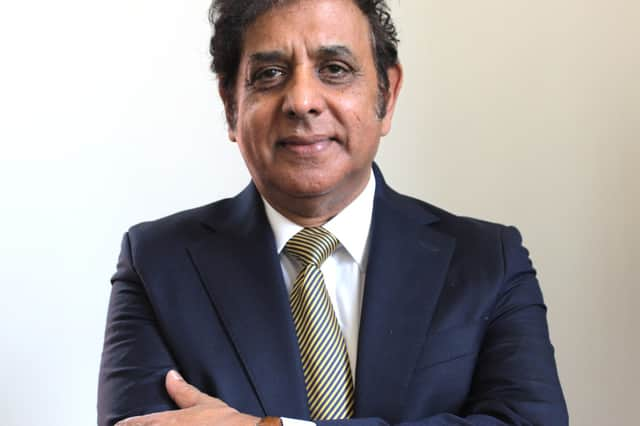
Roshan Doug: ‘The pace of change is astonishing. I’m finding it difficult to keep up with it’
I’m going to make a confession: I’ve been having an existential crisis.
It began in Covid, when almost overnight we had to learn a new way of living. We worked, chatted, laughed and cried through our screens. And our conversations were punctuated with the same familiar questions: ‘Are you there?’ ‘Can you hear me?’ ‘Can you see me?’
Today those questions haven’t disappeared. If anything, they’ve become even more relevant.
Can our politicians and lawmakers see us, hear us? Is social policy made with us in mind or is it designed independently of us and our feelings?
I feel I’m becoming invisible. So it got me thinking.
We’re living in an age of artificial intelligence. We answer the phone and aren’t entirely sure whether we’re speaking to a real person or an automated voice. We receive emails that sound strangely human but may be generated by something outside our realm. I find myself wondering whether I’m living in the real world at all.
Who exactly is Roshan Doug? Is he simply another voice floating around the internet? And what about editors – the custodians and gatekeepers of news and current affairs? Are they flesh and blood or sophisticated bots writing stories and replying politely to emails?
For example. I’ve been writing this column for almost a year, yet until last week I had never met the senior journalists I speak to at the Star face to face. For all I knew, they could both have existed only inside my laptop. So I was genuinely delighted to discover that both Mark Drew and Mark Andrews are, in fact, real people.
We met over coffee in Costa last Thursday and I confess it was strangely reassuring. They weren’t algorithms. They weren’t AI avatars. They were two thoughtful, experienced journalists who have spent years observing the world and trying to make sense of it.

Perhaps I was especially pleased because they belong to my generation. Like me, they’re middle-aged men who have lived through enough political fashions and social revolutions to know that certainty is often in short supply. They understand the difficulty of navigating their way through modernity – life isn’t black and white.
After years of dealing with young television producers – usually called Emily or Amy, in their late twenties, well-meaning and liberal and who invariably pronounced my name as RoshANN – meeting two seasoned editors from this region felt wonderfully refreshing.
But if I’m honest, it isn’t about locality. Nor did this existential uncertainty begin with AI.
Turning 60 a couple of years ago probably intensified it. Coupled with the death of my sister – the youngest sibling – I suddenly found myself questioning not only the justice in the universe, but where society was heading, and whether I understood anything anymore.
Even my understanding of the natural world appears to have been rewritten.
For most of my life I believed – along with billions of other people across every civilisation – that biological sex was determined at birth.
How naïve we apparently were. It now seems that everything tens of thousands of notable philosophers, scientists, doctors, judges, anthropologists, religious leaders and legislators believed has been overturned. What we apparently needed all along was a generation of purple haired graduates with piercings and tattoos to explain that there are countless genders and that sex itself is open to personal interpretation.
There’s no doubt that the pace of change has been astonishing. And I’m finding it difficult to keep up with it. I struggle to understand why people’s feelings must supersede reality and facts. Or why covering one’s face in public has become an issue we seem reluctant even to discuss. Or why offensive comments on social media can sometimes appear to attract greater public outrage than acts of physical violence.
I struggle to understand why homeowners can fear prosecution for defending themselves against burglars, why authorities have sometimes seemed hesitant to confront organised criminality for fear of causing offence, or why pensioners who have worked and paid taxes all their lives often feel forgotten while those arriving illegally across the English Channel appear to receive assistance unavailable to many struggling British families.
And I confess I find it difficult to comprehend how individuals who have openly advocated the destruction of Britain and its democratic institutions can subsequently enter mainstream politics, campaigning more passionately about conflicts overseas than the problems facing the communities they seek to represent. It can’t be just that I’m getting old. I’m sure other readers feel exactly the same. Maybe that is why so many people today speak of feeling politically homeless, invisible even.
They haven’t suddenly become extremists; they’ve simply watched the centre of gravity move around them. Moderate opinions that were considered entirely ordinary 20 years ago are now often portrayed as extreme or politicly charged. No more jokes about foreigners. No more jokes about mother-in-laws. In fact, more jokes. The new world is about seriousness not humour.
No, my existential crisis can’t just be about ageing. Perhaps it’s about trying to recognise the country I’ve lived in all my life, where people knew who they were, understood right and wrong, and demonstrated a modicum of common sense.
They could laugh. Or perhaps, in an age of artificial intelligence, social media and societal upheaval, we’re all quietly asking ourselves the very same question we first asked on those awkward Zoom calls during Covid: ‘Are you there?’ ‘Can you hear me?’ ’Can you see me?’ Or am I talking nonsense like some ghost in the machine?
* Social commentator Roshan Dough is an educationalist and a former poet laureate. @DrRoshanDoug
Comment Guidelines
Iconic Media encourages reader discussion on our stories. User feedback, insights and back-and-forth exchanges add a rich layer of context to reporting. Please review our Community Guidelines before commenting.