
'The Moon was always less about science and more about wonder' - my excitement at Nasa's Artemis II mission
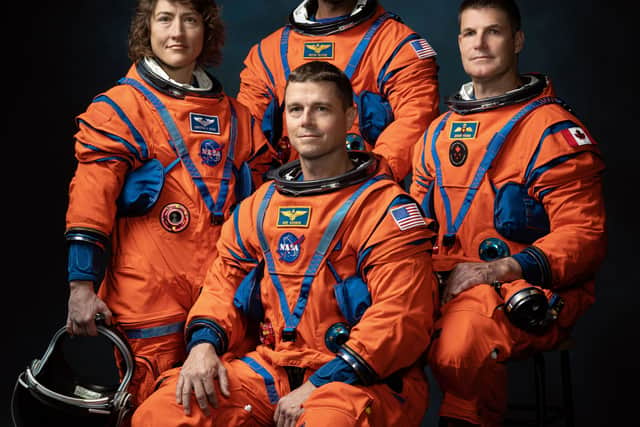
Nasa is reaching for the Moon again with Artemis II. Roshan Doug explains why he still gets excited by the adventure of space flight.
I grew up in the late 1960s and early ’70s utterly besotted with rockets. Much of that came from my teacher, Mr Bispham, who taught science with the fervour of a man trying to convert us to a new religion. He was simply mad about space.
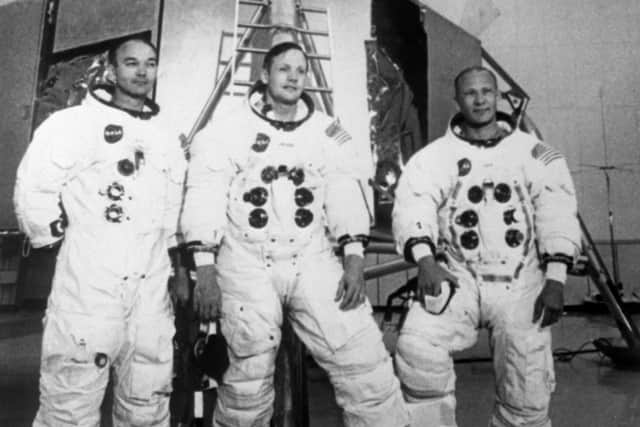
He’d bring in pictures of Apollo 11 – NASA logos, diagrams of the Saturn V, Neil Armstrong and Buzz Aldrin trussed up in those brilliant white suits that made them look half-human, half-marshmallow.
For him, and therefore for me, the Moon wasn’t just a rock in the sky; it was the future. Space felt clean, purposeful, heroic.
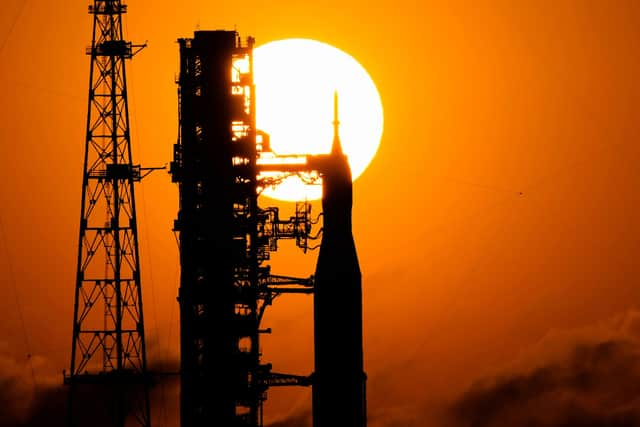

While other kids asked for train sets, I wanted a rocket and a launch pad. Maybe that’s why Artemis II still excites me, at least emotionally.
Officially it’s just a crewed fly-by of the Moon. No landing, no flags – just a long, careful arc 238,000 miles out and back. A rehearsal. But to many of us, it’s something else: the reopening of a promise that’s been dangling since childhood, a promise updated, delayed, and repackaged so many times that nostalgia now does half the heavy lifting.
We’re told we’ve done all this before. Six landings between 1969 and1972. Astronauts hopping about, playing golf, driving rovers, posing for photos like they’d popped out for a slightly dusty picnic. And then – silence. Since then, humanity has barely ventured more than about 400 miles above Earth, the height of the ISS. That’s our ceiling now.
Several astronauts have admitted it, in careful tones: low Earth orbit is where we operate. Beyond that, we start sounding nervous.
Some of that nervousness stems from the Van Allen radiation belts –discovered in 1958, now spoken of with the solemnity of a medical diagnosis. Radiation exposure. Shielding limitations. Electronic frying. All very adult concerns. It does make you wonder how Apollo spacecraft, guided by computers less powerful than a digital watch, breezed through those belts repeatedly.
Complicating this is NASA’s rather startling admission that we’ve ‘lost’ the technology to return. Not misplaced plans, but a deeper industrial amnesia. The knowledge dissolved somewhere between glam rock and punk. We can reconstruct medieval cathedrals and Roman roads, but the Moon rocket? Sorry – the know-how expired.
Context, of course, matters. During the Cold War, space wasn’t really about exploration. It was theatre – optics, symbolism, power projection. And early on, the Soviets were winning: first satellite, first dog, first man in orbit. Yuri Gagarin circled the Earth while the US was still working out which way was up.
Humans had reached only a few hundred miles – impressive, but firmly in Earth’s neighbourhood.
Then the US didn’t just catch up; it leapt. Not 400 miles but 238,000.
Straight to the Moon. Six times. And then packed it all in. That leap mattered politically. It created the enduring image of American technological and moral superiority – an image that outlasted the Cold War itself.
Which brings us back to Artemis. Even after almost 60 years, why is our most advanced outpost still only 300 miles up and not somewhere near the Moon? Or is 300–400 miles simply the limit of what we can reliably manage?
Meanwhile, Russia again occupies the designated role of geopolitical villain, and the West –especially the US – reaches for familiar symbols of dominance: military might, sanctions, high-tech weaponry, and, yes, space exploration.
But Artemis increasingly feels less like exploration and more like political theatre – a revival of an old performance staged for a global audience fluent in HD nostalgia. Since the mid-1970s, every US president has promised we’re going back. Carter, Reagan, Bush,
Clinton, Bush again, Obama, Trump. It’s always ‘five years away,’ a deadline that forever recedes. Launch dates slip from months to years, then dissolve into new timelines that arrive with each new administration.
My scepticism hasn’t always been welcome. An ex-girlfriend once snapped, after listening to my mutterings about radiation belts and evaporated technology, “Darling, you’re so f..king thick!” It remains the most impassioned defence of Apollo I’ve ever heard.
And she may be right.
And yet – Artemis II still tugs at something. Perhaps the Moon was always less about science and more about wonder. A mythic destination designed to make children like me look up, imagine wildly, and believe humanity could rise above its squabbles. And maybe, despite everything, there’s still some truth in that – whatever Mr Bispham might be thinking.
* Roshan Doug is an educationalist and a former Birmingham poet laureate
Comment Guidelines
Iconic Media encourages reader discussion on our stories. User feedback, insights and back-and-forth exchanges add a rich layer of context to reporting. Please review our Community Guidelines before commenting.