
'I spent a day at polo - and the crowd was very different to what I expected' - Roshan Doug
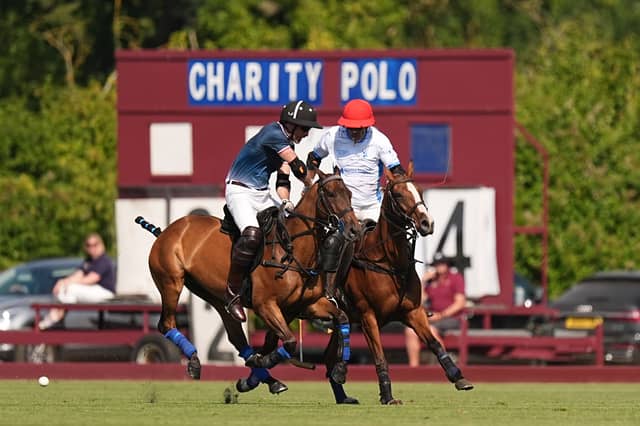

Roshan Doug reveals why trip to the polo was an eye-opener
There are many ways to spend a Sunday afternoon. You could wrestle with flat-pack furniture.
Mow that over-grown lawn in your garden. Or, if fortune smiles upon you, you might find yourself invited to the Cartier Queen’s Cup Final at Windsor, surrounded by horses, hats, champagne and enough pageantry to make Princess Diana's wedding feel modest.
My son and I had precisely that good fortune, and both he and I were on our best behaviour watching our Ps and Qs.
Now, before anyone reaches for their social media pitchforks, let me clarify: the crowd was not some sepia-toned relic of a bygone age. It was modern Britain in full technicolour.
Looking around, there were people from every conceivable background, nationality and accent. Families, tourists, businesspeople, horse lovers, and a few clearly pretending to understand polo rules while nodding with extreme confidence.

This is precisely why Britain's heritage matters. It is not about race. It is not about exclusion. It is about shared inheritance - traditions that belong to anyone willing to embrace them.
Polo is often called the Sport of Kings, which sounds grand until you realise it involves people galloping at terrifying speed while trying to hit a small ball with what is essentially an expensive stick - the mallet. Think hockey meets chaos, with perhaps better hats.
The game may feel quintessentially English today, but it was encountered by the British in India during the Raj and brought back as part of a wider exchange of culture, ideas and habits that shaped both nations.
For me there is a deeply personal thread running through it all. My grandfather and great-grandfather both played polo in Lahore before the Partition of India in 1947, when, as Hindus, they were compelled to leave their homes and move east into India. On my father's side, the family were landowners with a deep love of horses and equestrian pursuits. Hunting, riding and polo were not pastimes but part of everyday life.
That thought made me smile. My son, who is also a polo player, now carries that same tradition forward in a very different country and context, which makes moments like yesterday feel oddly like watching a conversation across generations.
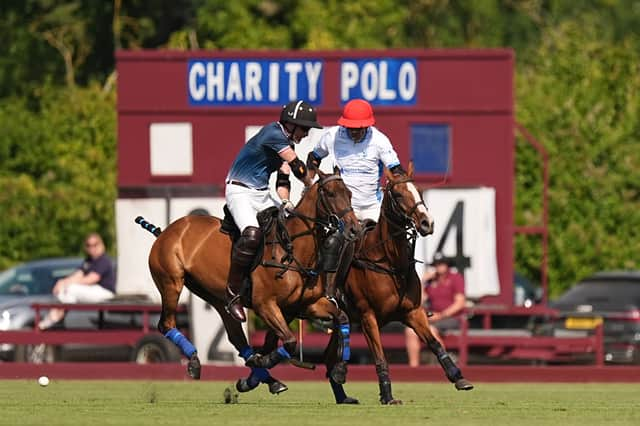
Standing beside the field at Windsor, it struck me that heritage is not a museum piece. It lives in shared experiences like this, where nobody is checking your background, only whether your team is about to score.
Of course, part of the experience is what happens off the field. The divot-stomping interval is a uniquely British moment in which hundreds of well-dressed people pretend to be helping the grass while secretly checking whether the champagne queue is moving faster than the horses. Somewhere in the background an announcer explains the rules with the confidence of someone who - let's be honest - may also be improvising. One of the understated pleasures is listening to commentary drift between serious analysis and complete invention, especially when delivered in tones that suggest the speakers have never doubted themselves for a second.
Watching it all, it becomes clear that social inclusion here is not a slogan but a lived reality. It is people arriving from different countries, cultures and histories and choosing to stand side by side for a shared afternoon. Nobody is asked to explain their lineage; they are only asked whether they prefer rosé or something stronger.
Britain’s traditions endure not because they are exclusive, but because they are shared. If they can bring together people from every background over fast horses, questionable rules and a glass of champagne, then they are doing something right.
I left Windsor with my son thinking that perhaps Britain's greatest strength is not its past, but its ability to keep inviting new people into it. Traditions survive not by standing still, but by being shared, adapted and enjoyed again and again. And if that involves a few thousand confidently pretending to understand polo, then so be it.
On the drive home, my son and I agreed on one thing: the horses were definitely fast, the players were arguably brave, but the spirit of the day and quality of relaxation belonged to us all.
Comment Guidelines
Iconic Media encourages reader discussion on our stories. User feedback, insights and back-and-forth exchanges add a rich layer of context to reporting. Please review our Community Guidelines before commenting.