
When travellers' caravans passed through Shropshire and the Black Country
Travelling back through time in pictures to reflect a way of life with its own culture and traditions
Age-old tradition meets the modern world…
Today you can occasionally still come across traditional travellers’ caravans with tethered horses grazing nearby, but we’re going back in time with some archive images to bring you scenes from yesteryear reflecting their way of life.
So let’s first go to the village of Beckbury in November 1952 when, according to the original Express & Star caption: “Errands are forgotten, play stops, and the children pause to watch the gipsy caravan as it passes through the village.”
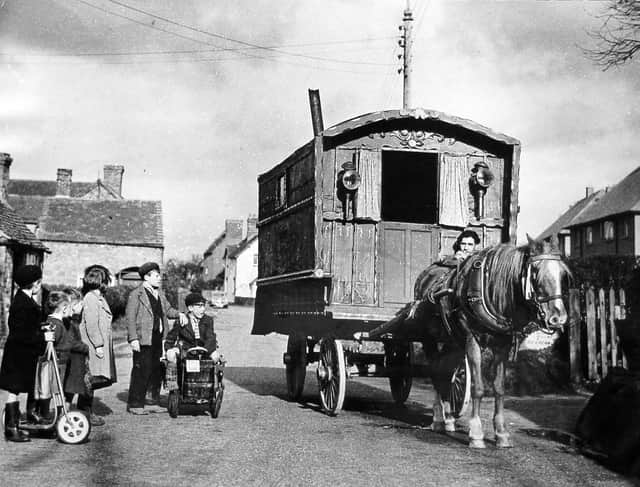

And we have extra information about this scene thanks to the memories of one of the children who watched it go by.
Fourteen years ago Alfred Smith of Eaton Constantine passed through his childhood haunts in Beckbury, sparking reminiscences about the day a gipsy caravan had gone by and he was photographed as he watched. By an extraordinary coincidence we published the image he remembered so well just a fortnight later.
Born in June 1943, he would have been nine, and is the lad standing by the boy riding in the little wooden tractor (we had thought it was a car, but Alfred corrected us). It was blue and white with a little trailer behind it and Alfred’s granddad had made it for him. The pedals were under the steering wheel, and you pedalled it with your hands.
Alfred, whose nickname at the time was “Tinker”, lived at 15 The Council Houses, Beckbury, and the lad in the tractor, Bobby Unik - this spelling is phonetic as Mr Smith was unsure of the spelling - also lived in the council houses.
Alfred told us: “I had probably been pushing Bobby on it when the horse and gipsy caravan came up. I remember that a van came up and stopped behind the caravan and a man got out with a camera and asked us two lads to come a little closer to the caravan, and they took a photograph which he said would be in the paper that evening - and it was.
“My mother cut the photograph out of the paper. I haven't seen it since I was about 13.
“The caravan had stopped and the gipsy lady had gone to Bowker's shop to get some groceries. You can see the gateway next to the horse's head.”
Alfred did not know the names of the other children, but thought the tallest girl could be Margaret Unik, a relative of Bobby’s.
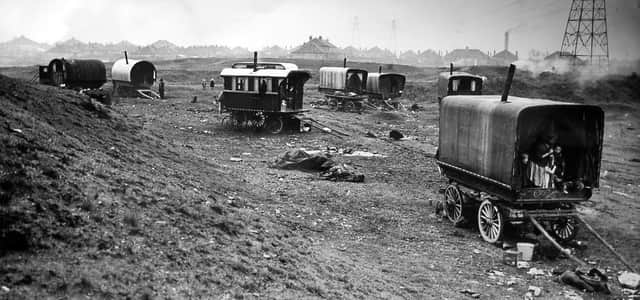
Our second photo is very slightly earlier, having appeared in the Wolverhampton Chronicle in May 1951, and shows a camp at Stow Heath, Wolverhampton, which was the “cause of much controversy between local residents and the gipsies”.
“There, 20 caravans rest, in addition to tents which accommodate 'overflows' of the Romany families.
“Remove the skyline from the picture and it is dateless and would be difficult to identify as a scene in any particular country. Romanies still live and thrive throughout every country in Europe.”
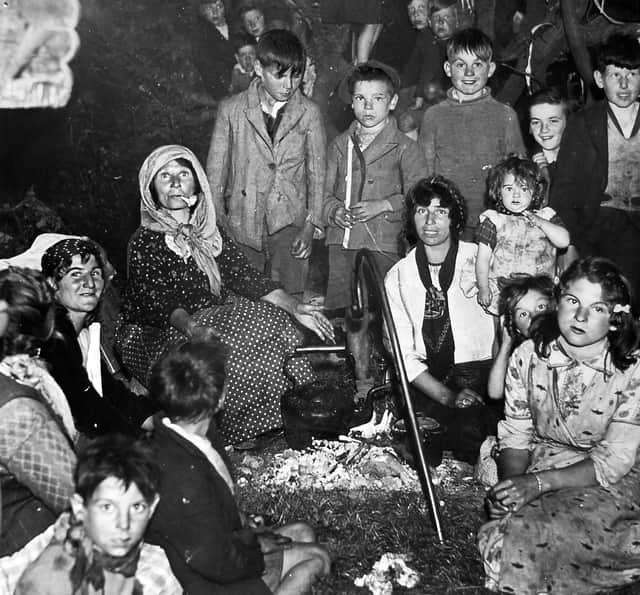
Lastly we go back to wartime, May 1940 to be precise, when the Express & Star caption was: “Not a scene from a romantic operetta but a real life study of Romanies at Bushbury Lane, Wolverhampton.
“The children in the background had been attracted to the camp fire just before the blackout by the singing of one of the caravanners. Note the clay pipe in the mouth of one of the gipsy women.”
Comment Guidelines
Iconic Media encourages reader discussion on our stories. User feedback, insights and back-and-forth exchanges add a rich layer of context to reporting. Please review our Community Guidelines before commenting.