
One last picture for the Dawley boys before war changed their lives
No leave, no post, no homecoming - how Shropshire’s Great War soldiers were victims of callous treatment from military top brass
August 5, 1914, and the Dawley boys were ready.
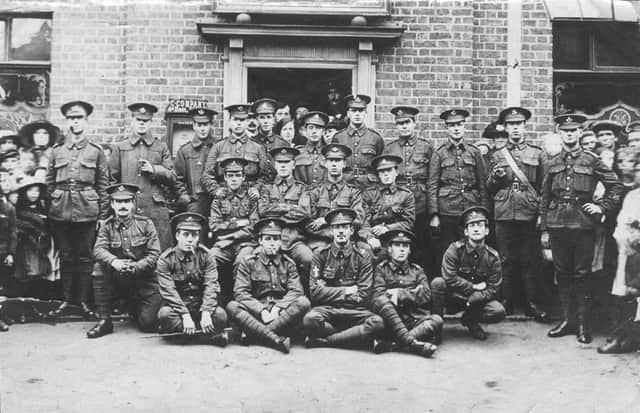
It was the day after Britain's entry into the Great War and, as they posed for a picture outside the town's Elephant and Castle pub before going off to fight, a small crowd gathered to watch them.
They were men of C Company of the 1st/4th Battalion King's Shropshire Light Infantry, civilians with military training who were ready to answer the country's call.
The photo taken that day is poignant as some would never see home again. They were about to board two horse-drawn waggons to go to Wellington to join the rest of the Company and they would sail on October 29 to the Far East.
The battalion would return in 1917 when they were victims of shocking mistreatment. As they sailed into the English Channel they looked forward to some well-earned leave and seeing their loved ones for the first time in nearly three years. There was eager anticipation in Shropshire at their return.
But it did not happen. Instead the soldiers, who had received no mail from home for six months, were sent without leave to the fighting in France. They were still wearing their tropical kit of shorts and thin shirts.
We are lucky to have two accounts, one from Alfred Edwards of Dawley, who was 20 at the time and is the soldier at the left end of the middle row, with the hands of the man behind on his shoulders. It seems it is Mr Edwards who pinpointed the date to August 5.

The other is from Cecil Bland of Malinslee, in an interview at the age of 98 in May 2001, five months before he died.
His stepfather Joe Bailey kept a pub in nearby Chapel Street called the Summerhouse and the family was friendly with the Halls who ran the Elephant and Castle.
Cecil, 11 at the time, recalled: "The soldier on the extreme left, standing, is Cliff Ball, who was a Corporal at the time. Later on he had a wholesale grocery shop in Dawley, with his brother Noah.
“Standing in the doorway are Joe Hall and his wife (they ran the Elephant and Castle), and the next one I recognise is Harry Poole, from Horsehay (the third soldier standing, from right).
“Next to him (holding baton and with cross-strap) is the Sergeant Major, and on the far right is Tommy Skelton, who was a Corporal at the time, but got to be a Sergeant Major. He lived at the Rough Ground, as they used to call it, at the back of the Royal Exchange, in a row there.
“Second from left of the four soldiers in the middle row is Alf ‘Codge’ Roberts. On the bottom row, on the extreme left (half kneeling, with moustache), is Tommy Jones of Old Park. Fourth from left is Alf ‘Codge’ Corbett, the gym instructor – if your name was Alf, you would get the nickname ‘Codge’.
“Fifth from left is Tommy Price from Horsehay and the soldier crouching, far right, is Harry Skelton, Tommy Skelton’s brother. The only other person I know is Liz Gears of Horsehay, who is extreme right, with a hat.”
Mr Bland said all the soldiers he recognised survived World War One, but they were lucky, as it is said about half of those on the picture were killed.
Mr Edwards was 69 when he was interviewed in 1963 by the old Dawley Observer about the picture, a creased and damaged copy of which he had kept in his wallet.
Remembering how they were sent to France without leave after their return from the Far East, he said: "Talk about shiver. It was a marvellous bit of mismanagement. It was three or four days before they got round to issuing us with any overcoats or proper clothes. And us used to the ruddy heat, I ask you.
"To top it all we hadn't had any leave, not a day, not a weekend off even."
Comment Guidelines
Iconic Media encourages reader discussion on our stories. User feedback, insights and back-and-forth exchanges add a rich layer of context to reporting. Please review our Community Guidelines before commenting.