
How the West Midlands remembered VE Day - poignant interviews from the files of Peter Rhodes
Eighty years ago this week, Field-Marshal Wilhelm Keitel signed Germany's unconditional surrender, marking the end of the Second World War in Europe. For the battle-hardened servicemen who had spent years fighting, it came with a huge sigh of relief. For the children who had grown up during a period of rationing and wartime austerity, it was one huge party.In 1995, to mark the 50th anniversary of VE Day,, the Express & Star's Peter Rhodes spoke to people across the West Midlands about their memories. This is what they said:
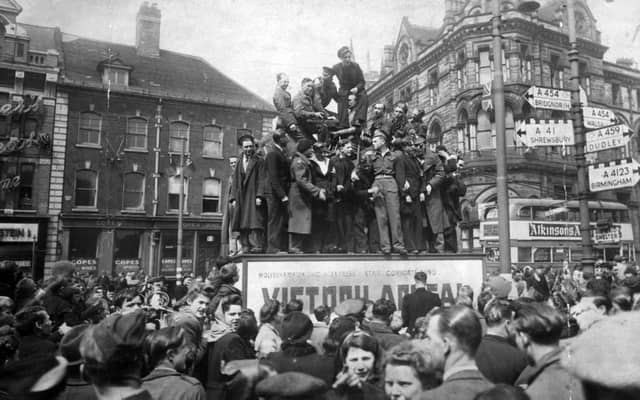

If VE Day seemed a long time a-coming, so did little Marjorie May Corns.
She was two weeks overdue when her mother, Mrs Emily Corns, went into labour on VE Day. Marjorie arrived at the family home in High Street, Wombourne, just as the church bells opposite were ringing out for victory.
During the war years church bells had been silenced, to be sounded only as a warning of invasion.
"It was a wonderful day," recalled Mrs Corns, living in Wombourne close to her daughter, now Mrs Marjorie Sutton.
"At three o'clock Mr Churchill began his speech announcing the end of the war. I started in labour and she was born just as the victory bells rang our. We hadn't heard our bells."
So why wasn't a child born on this special day given a more appropriate name?
"Yes, she might have been called Victoria," says her mother, "but I had promised to name her after Marjorie, her godmother.
"But we gave her the middle name of May to remember the month."
*****
VE Day for Joe Gough came deep inside Germany, at Luneberg Heath. The British were on one side of the river, their Russian allies on the other. In the early hours of May 7, 1945, the teleprinter suddenly clattered and Joe, a Royal Corps of Signals message handler, stared in wonder as the most important print-out of the war arrived. It was from General Eisenhower at the Allies' supreme headquarters, for distribution to all army units.
The words that millions of servicemen had waited six years to hear had arrived: "Effective immediately. Offensive operations Allied Expeditionary Force will cease."
"Being a signaller, I saw the signal before anyone else," recalls Joe at his home in Wolverhampton.
"We had an idea that something was coming but we didn't know when."
The relief was intense. His unit had been fighting towards Berlin ever since D-Day-plus-3, 11 months earlier.
*****
When peace came in May 1945, British soldiers found themselves in every corner of the world. But none had a stranger job than Lieutenant Ken Jackson, of Kidderminster, late of the 71st King's African Rifles, who was in Somalia. After service in Burma, his battalion returned to British Somaliland to be disbanded, leaving the young officer facing the boring prospect of barrack life in Nairobi.
"So instead I volunteered to serve with the Somalia Gendarmerie, an Army-controlled glorified band of units keeping order and holding at bay the local brigands."
VE-Day found him with his fellow officer Gerry Stagg, of Great Barr, who later became his best man, on a remote hill in the Ogaden, hundreds of miles from the nearest city.
"Our radio was broken, so there was little contact with the outside world. During this time,peace came to Europe. When we heard, via a message from HQ, all I thought was that now, maybe,they would supply our troops in Burma properly for a change."
*****
For Ron Wood and his comrades on tank transporters, VE Day came early. The Royal Army Service Corps unit had followed the fighting from D-Day across France and into Germany and witnessed the last major offensive by Hitler's once-dreaded Luftwaffe.
"A heavy formation of jets attacked the area," he recalls at his Wolverhampton home.
"It seemed that every gun around us put up a terrific fire and five or six were shot down."
His unit, 451 Tank Transporter Company, moved on towards Hamburg.
"It was very slow moving because of vast numbers of Germans surrendering all along our route. Finally, on about May 4, we stopped. We knew it was near the end. A dispatch rider passed us, waving. Then our sergeant came out with a bottle of schnapps and said: 'It's all over, lads'.
"We were totally exhausted and all fell asleep, at last."
*****
For Cyril Wilde of Bilston, and for thousands of fellow Brits, VE Day meant the end of captivity as a prisoner-of-war. The young para had been taken prisoner at Arnhem in 1944 after a career which had taken him to battles in Africa, Italy and Sicily. Three months after Arnhem he found himself in a working party near the German city of Leipzig, 'repairing the railway lines and dodging the RAF as they came down strafing us.'
Other PoWs, robbed of their watches, lost track of time but Mr Wilde kept a note of each passing day on the back of a photograph of his wife.
The day of liberation came.
"The German guards left us and we were on our own. Then came the Russians. They told us the Yanks were on the other side of the Elbe and two days later we contacted them.
"The Yanks gave us chocolate and cigarettes. Then we had a good long leave."
*****
For John Denis Potts, a D-Day glider pilot incarcerated in a German PoW camp, VE Day brought blessed relief and the grisly opportunity to witness an execution. As the end of the war approached, he and his 20,000 fellow Allied airmen in Luckenwalde camp had orders to stay put. But with RAF bombing intensifying and the Russian Army closing in, the PoWs felt like sitting ducks, liable to be hit at any time.
"So every night, during darkness and with RAF Bomber Command keeping all heads down, it was a simple operation to cut through the adjoining compounds and into the safety of the Russian Army."
Together with the Russians, John Potts and his comrades would forage for food as hunger and typhus were talking the camp. Shortly before VE Day, the Russians relieved the camp, crushing the perimeter wire with their tanks. Mr Potts recalls May 8, 1945. It was warm and sunny and the Russians were suddenly celebrating.
"The small streets near the sidings were filled with soldiers. The singing, dancing, bread, sausage,cheese and the non-labelled bottles of white spirit told us all we needed to know- the war was over."
Soviet officers showed the RAF men around their tanks and took them to the local police station where two Russian deserters, drunk and in a sickening condition, were awaiting the firing squad, having been caught looting and raping.
"We were invited to their execution scheduled for the following morning. We declined on the grounds of a previous engagement."
*****
For sailors John Price and Edwin Garner, peace in Europe coincided with hell on the high seas. They were shipmates on the aircraft carrier HMS Formidable, off Okinawa, on VE Day in May1945. It was suddenly attacked by Japanese kamikaze suicide bombers, one of which crashed on the flight deck.
"I was on the forward gun turret," recalls Edwin Garner. "We couldn't see what happened but we felt the impact, like a great shuddering."
Folk back home were celebrating victory but the sailors in the Far East were patching up their ships and preparing for the next onslaught. But three months later they witnessed a memorable sight. One morning in August, 1945, the crew of HMS Formidable looked up and saw a small formation of American warplanes. One of them was the Superfortress Enola Gay, carrying the first atom bomb to Hiroshima. A few days later, with Hiroshima and Nagasaki both destroyed by A-bombs,the Japanese surrendered. John Price remembers HMS Formidable steaming into Sydney Harbour in triumph, leading the victory fleet.
"Later, we all joined in a victory parade through the streets of Sydney. What a great joy. I wish it could be shown again on television so that people could see what a grand time we had. There were men from Formidable, Implacable, Victorious, Black Prince and Grenville, with the band of the Marines."
*****
For Reuben Welsh of Brewood and his comrades in the Sherman tanks of the Staffordshire Yeomanry, VE Day dawned on the banks of the River Elbe. Deep inside the shattered Third Reich, the troopers were veterans of the D-Day landings and the bloody Normandy campaign.
They had fought half-way across Europe. By the time the war ended, British tank crews were among the most professional and experienced soldiers anywhere. VE Day was greeted with mixed feelings.
"For us, the end of the war was an anti-climax. We had been so used to being in action for so many years that, when the end came, we felt somewhat lost. However, this did not last long. We re-crossed the Elbe to a small village not far from Belsen concentration camp. Here we experienced what the end of the war really meant. Everyone knew that at that moment they were alive, that they were not going to lose their lives. Germany at that time was full of people moving. They were going home. Interspersed with the civilians were German soldiers. They all looked the same, tired, dusty with three or four days' growth of beard. Even the poor people of Belsen, in their striped-pyjama type suits could be seen trying to walk home. After years of suffering, the urge was so great."
*****
Connie Wall was a twenty-one-year-old serving in what she calls 'a very exclusive unit,' the Women's Timber Corps. An offshoot of the Land Army, the corps felled and sawed timber for the war effort, producing everything from sawdust to coffin boards. Connie and her ‘Lumber Jill’ colleagues were sent to work at a timber yard in Stafford, shifting heavy baulks of timber and helping with the sawing and loading.
"We grumbled like mad but in fact we all loved it, especially the outdoor work and we built up some beautiful muscles. On VE Day I was driving a mobile crane, stacking timber on a lorry. When the announcement came, everyone downed tools and went absolutely wild. The management decided the best thing to do was to give everyone the rest of the day off. So we all went straight down the nearest pub. It was a memorable day."
*****
For Margaret Simmons and her family from the Nazi-occupied Channel Islands, VE Day meant the end of disruption, fear and misery as prisoners. Most of the islanders endured occupation as best they could. But because Margaret's father was English, he and his wife and four children, along with scores of other families were deported to Germany. After a nightmarish journey by cargo ship and railway wagons, the family was interned for three years in two camps deep inside Hitler's Third Reich.
Margaret, aged seven when they were deported recalls at her Wednesfield home: "The memories are so vivid. I remember my sister reaching through a gap in the camp wire and finding a hen's egg. My mother made us all egg sandwiches that day. It was called a prisoner-of-war camp but it was for civilians and we were not treated too badly. Of course, we children could not understand how bad it was for our parents, being away from Jersey. The second camp was in a huge monastery. Opposite, there was a big stone building and my father said that, when the war was over, men would go rushing into that building. That's exactly what happened. One day the American soldiers came and suddenly the two big gates at the back of the camp were thrown open. We kids just ran out. We went mad. Our parents had no idea where we were. I remember the streets were full of tanks going by. The soldiers said they didn't even know our camp was there."
After the war the family settled in England. By now they were six-strong. Margaret's younger brother, Bruce, was born in the prison-camp hospital.
*****
For Fred Knowles, VE Day came as the 53rd Welsh Division drove into the bomb-shattered German city of Hamburg. A 30-year-old private with the divisional HQ, he witnessed tens of thousands of beaten, demoralised Germans surrendering.
"The streets were full of them. You could hardly see the British guards at all. There was about one Tommy to every hundred Germans. The Germans just wanted to give up and go home," he recalls at his home in Bentley.
"'Hamburg was in ruins, totally ruined. I never thought they could ever rebuild it but I'm told it's beautiful today. VE Day was a wonderful day for us. We were in this hotel, drinking Schnapps and watching the prisoners. To be honest, we were all a bit tipsy."
Private Knowles ended his war in a moment of supreme irony. Before he joined up he worked at ammunitions factory in West Bromwich and once heard the infamous Lord Haw-Haw, William Joyce, broadcast a Nazi threat to bomb the factory. A few violent years later, Fred Knowles and his comrades set up their divisional headquarters in the very hotel in Hamburg from which Joyce, who was later hanged for treason, had broadcast.
"Our general strung a line of lights up the side of the hotel with a huge W for Wales. You could see it all over Hamburg."
*****
For Fred Taylor of Bilston, VE Day came after some of the hardest fighting of the war. A para with the legendary 6th Airborne Division, he had taken part in the airborne assault on the Rhine on March 24, 'just in time for morning coffee,' as he recalls. It was the biggest airborne operation of the war and it was followed by a hotly-contested drive deep into Germany. But as the Russians advanced from the east, resistance weakened and the roads filled with German refugees and soldiers.
"I remember an NCO came to our headquarters to say there were some high-ranking German officers outside. They were in long black leather coats. One of them explained that their armoured brigade had never been defeated in battle and they wished to surrender with honour, bearing arms. Our company commander was very polite but told them there were no terms. The surrender was unconditional."
*****
Fred Taylor recalls German villages with white sheets hanging from every window in surrender. He remembers, too, that his own outlook was bleak. For the paras were to be used in a mass air assault to recapture Singapore from the Japanese.
"Word got around that we had been written off before we had even been sent," he recalled. Before the plan was put into operation, the atom bombs were dropped on Japan and the war was over.
*****
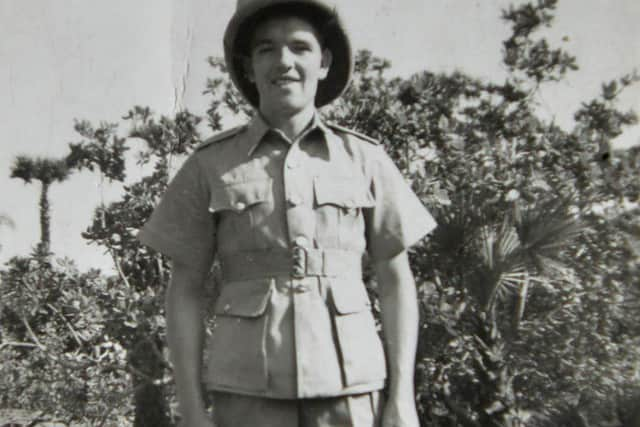
VE Day came and went for Eric Shaw and his pals serving with the 'forgotten' 14th Army in the Far East, grinding down Japanese resistance in the last bloody stages of the Burma campaign. He and his mates in the Royal Air Force Regiment, experts in defending airfields, had been hastily re-trained as foot soldiers to plug the gaps in the British infantry divisions. If the Japanese had known their opponents were so short of trained soldiers, says Eric of Parkfields, Wolverhampton, they might have made one last desperate push for India. As it was, he and his comrades spent VE Day on the offensive, fighting towards Rangoon.
"We were aware that many thousands of people were celebrating and having a knees-up in London, without very much thought of what was going on in other parts of the world."
The Forgotten Army was resigned to fighting all the way to Tokyo. It was three months later that the war in the Far East was suddenly ended by a new and terrible weapon.
"If it hadn't been for the atom bombs on Hiroshima and Nagasaki I reckon we'd still be out there."