
Staffordshire electrician lost his eye and suffered brain damage after metal bar crashed down on him

Mark had been contracted to strip the electrics from an unused factory unit.
A man was left with permanent brain damage after a giant metal bar smashed onto his head while at work - leaving him and his wife surviving on just £1,300 a month.
Electrician Mark Ludlow, 63, was assisting a colleague on a broken lift at a factory, when a giant metal rod dropped from the shaft and struck his face from above.
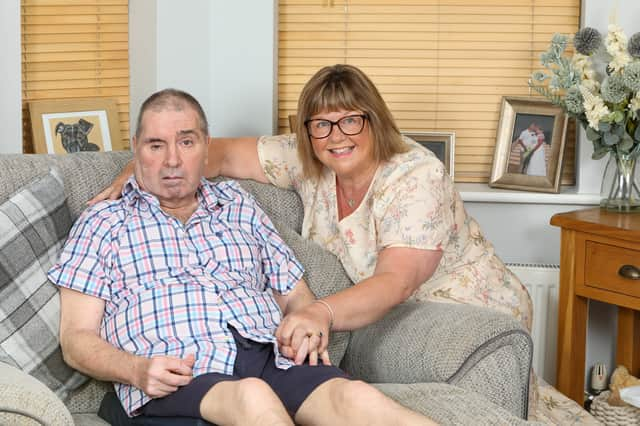

Mark was knocked unconscious and his entire face was smashed, and he was put into a coma for his own survival.
His eye was too badly damaged to be saved and had to be removed.
Surgeons had to meticulously reconstruct his face from his broken bone fragments and metal plates.

He also suffered diffuse axonal injuries and two subarachnoid haemorrhages - bleeds on the brain - which left him with permanent damage.
He is now unable to speak properly, walk or use the loo unaided.
While he is now able to eat independently, he is still unable to do most things and the accident has had a permanent impact on him cognitively.
Devastated wife Rachel Ludlow, 56, has become his full-time carer after giving up her job.
The couple now rely on £1,300-a-month of Personal Independence Payments (PIP), Employment and Support Allowance (ESA) and carer's allowance to get by, compared to their £4,000 combined income before the accident.
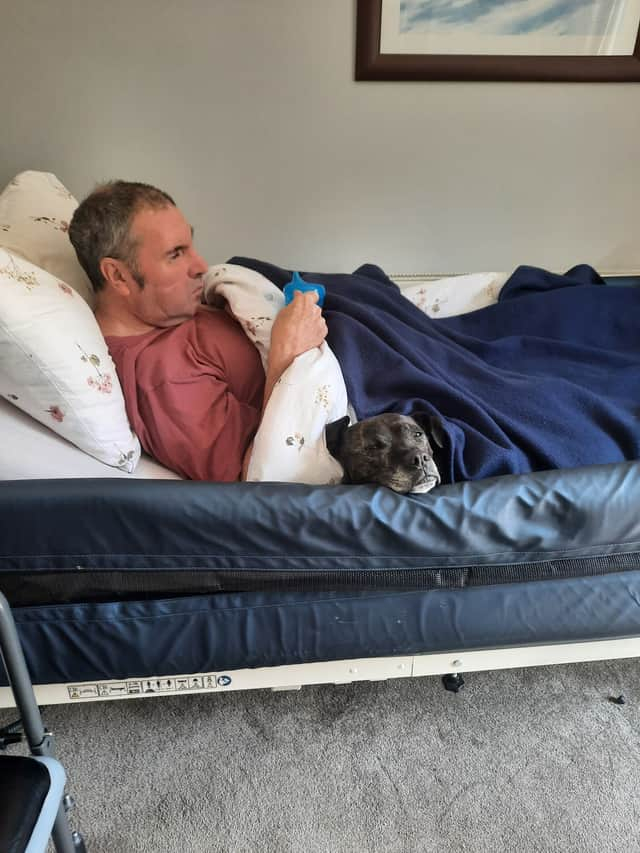
They are raising awareness after a freak accident caused a traumatic brain injury which "destroyed the world we knew".
Rachel, a former medical secretary, from Cannock, Staffordshire, who spoke to Sell Us Your Story, said: "The accident turned our world upside down in an instant.
"I still remember getting the call where I was told Mark had been in an accident and was 'alive but critical'.
"It was awful seeing him lying there ventilated with tubes in him.
"Mark's face was reconstructed on the right side - the maxillofacial surgeon said it was like 'a jigsaw puzzle' because all his facial bones were splintered.
"When he woke up and said Rachel, I was so proud of him, because at least he still knew me.
"Since then it has been a very harrowing journey and we don't know if Mark will ever walk unaided or be independent again.
"It's just horrific but we're having to try and adapt to life as best we can."
On November 17, 2021, self-employed electrician Mark had been contracted to strip the electrics from an unused factory unit.
But mid-afternoon, Rachel got a call from Staffordshire Police informing her that Mark had been in a 'life-changing accident'.
She said: "In that moment, I just went into panic mode. I was hyperventilating, and the police were waiting for me when I got home.
"We jumped in the car with the blue lights on and went straight to Mark, who was being stabilised in resus in the trauma centre of Queen Elizabeth Hospital, Birmingham."
By the time Rachel was led through to see her husband, he had already been placed in a coma to protect his brain due to the damage.
His face had been sliced open by the metal rod and it knocked him unconscious instantly.
She said: "Apparently people didn't know if he was dead or alive until they heard him making noises."
The two days on, he underwent his first surgery to reconstruct his face and place a bolt in his head to relieve pressure caused by the brain bleeds.
The following day, he went under again for a second surgery to remove his right eye, as it would be detrimental to his left eye to keep it due to the damage.
After a week his sedation was removed, and Mark cycled through several infections and rounds of antibiotics in the days that followed.
He began showing vague signs of consciousness such as squeezing a nurse's hand.
Over time he moved to a rehabilitation hospital.
Rachel read from her hospital diary: "12th December. Phoned for an update. Nurse told Mark I loved him. She saw a tear roll down his cheek."
Shortly after, he began working with physiotherapists to rehabilitate him, although he struggled to communicate and still needed tubes to be fed and help to breathe.
When he was finally discharged, a long journey was head - with Mark needing full-time care from Rachel as well as external care visits, physio trips and appointments.
Major adaptations needed to be made to the home including converting the garage to a downstairs wet room and making him a bedroom with a hospital bed in their dining room.
Mark is now able to take a few steps alone, use an electric wheelchair and say words and short sentences - although he struggles to communicate and to regulate his emotions.
He remains unable to feed himself or use the toilet independently.
Rachel said: "He's learnt to talk gradually, like to say he needs a drink, but finds expressing himself difficult.
"He says things that aren't always appropriate, but that's part and parcel.
"He has lost all sense of sensitivity, everything now is just factual. He can't show emotions and we can't have normal conversations.
"The demands of me are quite challenging, he is not aggressive but very persistent, it can be a little suffocating.
"It's like having a young child."
Rachel wants to now raise awareness of the impacts of traumatic brain injuries by showing the reality of their life.
She said: "Mark is a different person to the one I met, I have lost the husband I married.
"The week before the accident, we'd be saying Mark might semi-retire.
"We have been together for 17 years, and one day our world was turned upside down in an instant.
"All we can do is take it one step at a time, and we live in hope that maybe one day things will get better."
Comment Guidelines
Iconic Media encourages reader discussion on our stories. User feedback, insights and back-and-forth exchanges add a rich layer of context to reporting. Please review our Community Guidelines before commenting.