
My confrontation with angry 'Stan': Was grumpy old man really Nazi killer on run?
A cantankerous old man living in a quiet suburb in Shropshire was allegedly a wartime murderer and evil executioner.


The discomfort of the street confrontation made me warm with embarrassment. I cast glances and shrugged at witnesses in a show of bemusement and innocence.
Some flashed an apologetic “we know, mate” smile back, a brothers-in-arms gesture suggesting they, too, had been slashed by the pensioner’s sharp tongue.
Still the old man raged, waving a stick while astride his mobility scooter. He protested I’d blocked his disability carriage with such red-faced venom that spittle fell from his mouth.
“It’s just Stan,” one person told me after the tirade eventually subsided and the apoplectic OAP had fled the scene – actually, mechanically limped from it at around 8mph.
Stan was a sour-faced, then octogenarian, belligerent to the point of bad manners and beyond feisty to the point of being simply rude.
It was best to give Stan a wide berth, particularly when he chugged towards you on his scooter.
To me Stan – resident of a sheltered housing complex in Hadley, Telford, only yards from my first marital home – was an extremely ill-tempered, elderly foreign gentleman, curmudgeonly and crabby.
To others, many, many miles away, he was something much darker. They claimed he was a monster.
I knew him as something of a nuisance.
“We knew him as a butcher,” said Alexandra Davelsky, who stated her husband, Jan, was shot by Stan as he fled a firing squad.
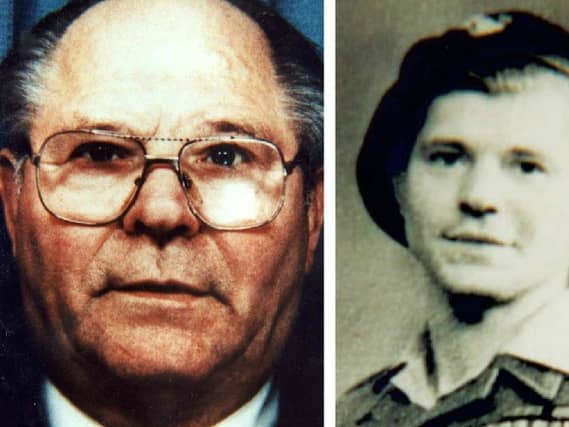
Stan – Stanislaw Chrzanowski, Hadley’s public menace on a mobility scooter – was accused of being a wartime murderer, an evil executioner for the Nazi regime. He was even linked to war crimes by the House of Commons in the dying embers of his long life.
Throughout, Chrzanowski vehemently protested his innocence.
And he died from kidney failure in 2017, aged 96, as a possible trial loomed.
Following an investigation, clearance had been given for the long-time fugitive to face 30 murder charges in Germany.
Police in that country were awaiting the go-ahead to raid Stan’s home.
To his accusers, Stan Chrzanowski was the Hitler henchman living on the fringes of Hadley’s crescent.
I had been in a stand-up row with one of the Third Reich’s alleged sadists: a sadist on a mobility scooter.
And, when the revelation became public, I was astonished by tabloid newspaper interviews with residents who described Chrzanowski as pleasant, an individual who kept himself to himself and lived for his garden.
The description “jolly” surfaced.
You take as you find, I suppose. And I found him confrontational. Don’t believe everything you read: I was not alone.
The case against Stan – helped and supported by his own stepson, John Kingston – stirred a hornets’ nest just two years ago when the BBC said it had evidence that he had been recruited by our own secret service during the Cold War.
It begged the question, how many suspected Nazis, with blood on their hands, were allowed to melt into Britain’s suburbia?
We now know that Stanislaw Chrzanowski was quizzed about his past in 1998, but the Crown Prosecution Service ruled that there was insufficient evidence for a trial in this country.
Chrzanowski’s wartime activities and post-war undercover work remain an allegation. Yet there is no doubt he moved into, first, the Black Country, then Telford with tales of heroics in the face of jackboot Third Reich oppression in Slonim, then part of Poland, now within Belarus’ border.
Stan told neighbours in Balsall Heath, Birmingham, that he was forced to become a civilian guard for the enemy following Germany’s invasion of his country.
He escaped, joined a band of Polish soldiers fighting for the Allies, saw action in Italy and, when the conflict ended, moved here as a European Volunteer Worker. To those neighbours, he was a quiet family man with a passion for ballroom dancing.
Chrzanowski – a charmer when he needed to be – met partner Barbara at a Polish club in Birmingham.
She fell under his spell almost immediately and invited the factory worker to join her and her two children on holiday in Rhyl.
However, Chrzanowski and Barbara went their separate ways in the 1990s.
In the same decade a very different picture of Stan’s wartime exploits was being painted by those who claimed to have witnessed his depravity.
As part of the SS-controlled Belarusian Auxiliary Force – an armed, civilian band of thuggish enforcers – he had, said witnesses, taken an active role in the mass slaughter of Slonim townsfolk.
Men and women were marched to remote woodland, shot and their bodies slung in pits.
Chrzanowski had, they said, fled with retreating German forces in June, 1944, joined a Waffen SS unit in France and was captured in the country.
Alexandra Davelsky gave a particularly chilling statement. Her husband had been rounded up with 120 others in 1942 and as he ran in panic from a firing squad, Chrzanowski took aim ...
“That’s what he did, kill people,” she said.
“I swear on my life I’m telling the truth. He was very proud of wearing the uniform and carrying a weapon at such an early age. He was extremely cruel.”
Alexandra was not alone in providing a testimony of pure terror. Church deacon Kazim Adamovich alleged he witnessed Chrzanowski shoot 50 people over a three day period.
“To him, taking the lives was as easy as spitting,” said Kazim.
With each passing year, the suspicions John Kingston harboured over his step-father’s role in the war grew.
John, who also died in 2017 aged 74, believed he uncovered the “smoking gun” at Stan’s Telford home: a photograph of Chrzanowski, dated March, 1942, in full Belarusian Auxiliary policeman’s uniform.
He “shopped” his step-father, contacting a government inquiry dedicated to rooting out Nazi criminals, in 1988.
Six years later, John made direct contact with Scotland Yard’s war crimes unit.
In 2006, his step-father was named in Parliament.
In an interview with the BBC, John, from Holmfirth, West Yorkshire, spilled his childhood memories.
He recalled playing with his step-dad’s Luger pistol.
He recalled Chrzanowski teaching him to jump off walls “like a paratrooper”.
And he recalled chilling bed-time stories of death and torture.
As he got older, the tales appeared to take on the mantle of confessions.
“He talked about bodies being burned, piles of bodies by barbed wire and having to climb over them,” John said.
“My father used to tell me about killing people and how it was done in quite graphic detail.”
When the near-incredible story broke, when Hadley’s elderly residents realised they’d shared a Post Office pension queue with an alleged wartime executioner, the press corps pounced, hungry to get local folk’s recollections of their neighbour.
“I can’t get my head around it,” said one. “He was the nicest man to me. He lived for his garden and was forever leaving fruit on my doorstep.”
The resident added: “He told me he was in the British Army and said he was injured in a tank explosion during the war.
“There was about 20 people at his funeral. There was mention about his army past, but nothing about this.”
Neighbour Bruno Alsdorf said: “I knew him just as Stan and would always just say hello to him in passing.
“He was protective about his past, but many people who lived through the war were like that, in my experience.
“He used to grow plums and oranges in his back garden. He would come past my house and give me fruit he’d just picked.
“We would talk about very mundane things, like the weather.”
Mr Alsdorf added: “Despite his age, he still went out at least once a day to the shops or just to potter to church.”
But amid the misty-eyed recollections about a mild-mannered and kindly soul, Carly Maddox supplied a more “warts and all” type of description.
“Everyone thought he was one of those grumpy old men who liked being miserable,” she said.
“I remember one time I let my dog run out on the green in the crescent which separated our homes and he hit it with a stick.”
She added: “Because of his age, I didn’t go mad, I just politely asked him to be careful and he blew up at me.
“He was shouting ‘dog, dog’ at me. He was screaming at me and went all red in the face.”
That’s the Stan I remember. Volatile, but, thankfully, too infirm to be violent.
Nearly 50 years in journalism has given me a long list of bar-room anecdotes.
“The day a suspected Nazi war criminal ran over my foot” may be the best of them all.