
The 'secret' train being tested in Shropshire that could revolutionise rural rail journeys
Deep in the heart of the Ironbridge Power Station site, a futuristic-looking train glides along in almost total silence.
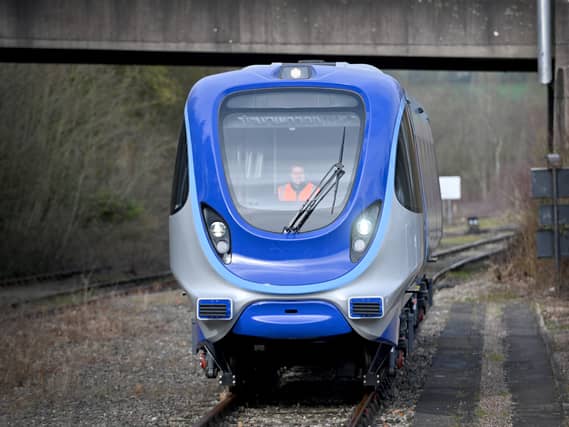


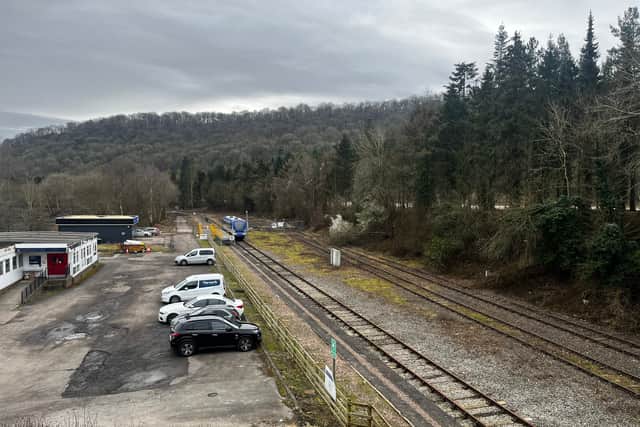
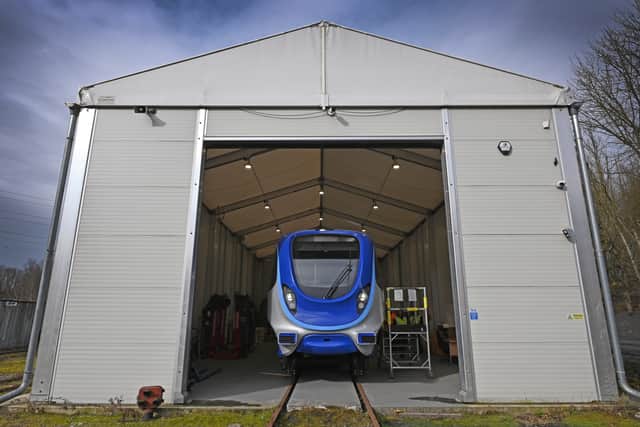
Tucked away in this picturesque corner of Shropshire (looking beyond the construction site), it shuttles up and down a few hundred yards of track between a temporary platform and a purpose-built shed, with the loudest sound being a sedate 'clickety clack' as it rolls from rail to rail, as well as the occasional sounding of the horn.
It's somewhat appropriate that in the town that gave birth to the Industrial Revolution, this train - which also has the word 'revolution' in its name - is being demonstrated as a way to potentially transform rural railways.
Called the Revolution Very Light Rail (VLR), it's the product of a partnership between Eversholt Rail, a firm which owns hundreds of UK trains, and Transport Design International (TDI) which designed and built the train. Those behind it say it "reduces all aspects of operating costs" on branch lines.
Down at the test site, Tim Burleigh, head of external relations for Eversholt Rail, said those involved "believe in the product and know it fulfils a real need for the communities" it's designed to serve.
What's the purpose of Revolution VLR?
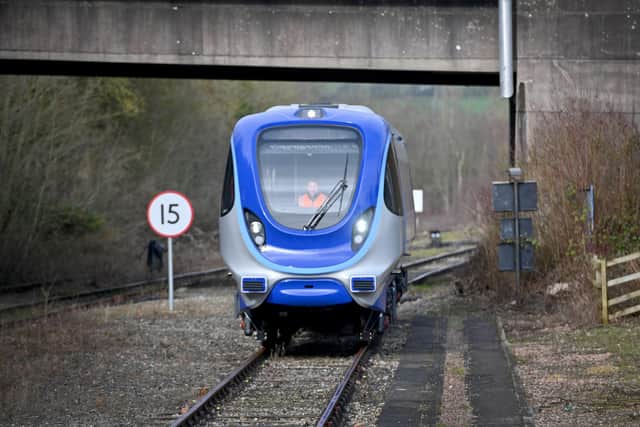
"The role of Revolution is to extend the outreach of the railway, principally helping to achieve modal shift from road to rail, which we all know is needed for the UK to meet its climate change obligations," explained Tim. "It's really a vehicle that is optimised for relatively short operations on segregated branch lines that run into mainline railways.
"We see it very much as a component of a joined up public transport system that could for example have buses at one end, then travelling on Revolution, then travelling on the mainline railway, with everything integrated and time so it makes for a convenient and fuss-free journey."
Revolution VLR would often be seen in rural settings, both on lines that are currently in use and those which could be reopened in future.
By running a low-weight, single-carriage train, it reduces wear and tear on the infrastructure and, therefore, operational costs.
The demonstration vehicle has 56 seats, which is said to often be more than enough for the shorter routes it's designed to run on. This would release longer, heavier trains, to be redeployed in busier areas where the extra seats and standing room they'd provide would be needed.
For those wanting to reopen a railway, Revolution VLR is said to be the answer. Tim explained that by being lighter, the vehicle would not subject any older track still in place to the same stresses as a traditional train, which could allow a railway to be reopened "under budget and ahead of schedule", or in stages.
One of the benefits the train is being tested at Ironbridge is putting that theory to the test; it's been 60 years since the site last saw passenger trains, and coming up to a decade since the last coal trains served the now-demolished power station. Since then, the track has been left in place, but with minimal work it's able to take the weight of Revolution VLR.
What's the train like?
I stood at the temporary platform, close to the site of the former Buildwas station on the long-closed Severn Valley line that once linked Shrewsbury, Ironbridge and Bridgnorth.
The blaring of a horn was the only hint the train was coming as it quietly rolled into view, running on battery power to glide into the station.
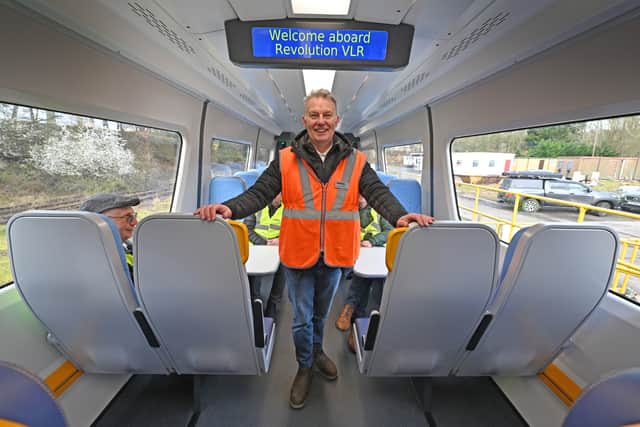
Being on board is a very pleasant experience, and not just because it has that 'new' smell you're accustomed to finding when collecting a new car.
It has three things that make for a satisfying journey which can sometimes be lacking from modern trains: big windows; comfortable seats with plenty of padding and legroom. I'm just over 6ft tall, and not once did my knee come into contact with the seat in front or a table.
Speaking to Tim on the train, he explained how passenger experience was a priority, even though they're designed for short journeys of up to 30 minutes or so.
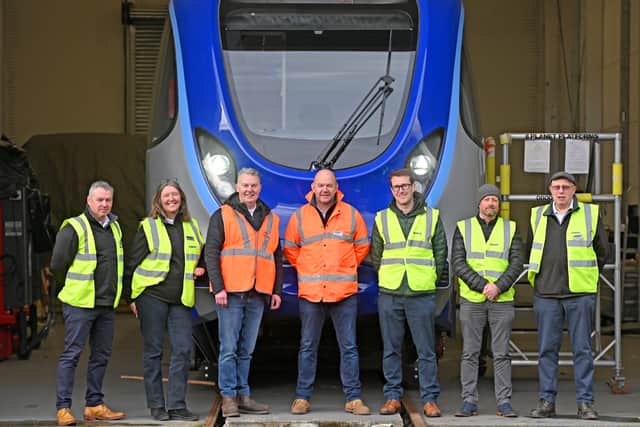
"If you're getting people out of the car, you've got to give them something they want to travel on," Tim said. "We want people to use rail rather than their car."
The train is of modular construction, which allows for changes inside to be easily made.
"We've aimed at providing flexibility, so the seating - we've made sure there's plenty of legroom. That's important because people want to feel comfortable. They also want, typically for short journeys, rucksacks and bags handy by their feet, and you've got to give them space to do that."
The demonstrator doesn't have overhead luggage racks or shelves, but that doesn't always have to be the case.
"We can change the number of seats because we recognise from the stakeholder feedback that people may want more dedicated luggage space, if it's a shuttle to an airport. For tourist destinations they may want more cycle space. Inevitably there's a trade off within a fixed vehicle size; if you have more space for cycles or luggage you have slightly fewer seats, but that's an operator's choice."
At present there's space for one wheelchair. Again, more seats can easily be unbolted to make room for more wheelchairs and prams. The wheelchair space also has USB ports.
"We wanted to make sure people didn't feel short-changed in the terms of connectivity," he said. "Buses have USB ports and WiFi. This needs to be at least as good."
Feedback from wheelchair users has noted that the space is "open and not at all restricted" and "easy to turn in". That, along with USB ports, are said to make the train "a lot more welcoming and brighter" than others.
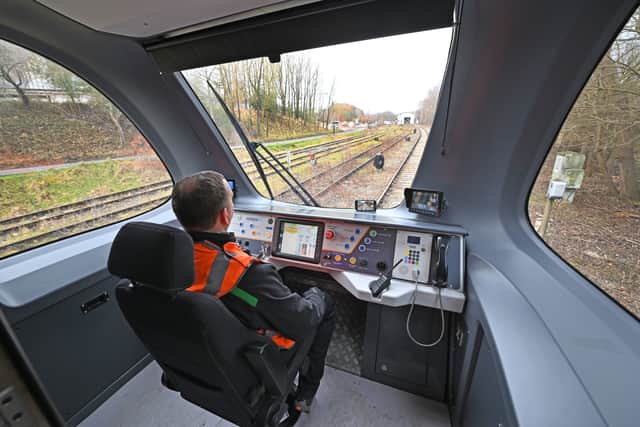
It's also said to have "excellent acceleration", though given the length of the test track at Ironbridge we only can only reach 15mph.
It remains a smooth journey despite the age of the rails, vindicating the decision to use durable wheelsets and suspensions designed to make the ride as comfortable as possible on track that isn't brand new.
What does the future hold?
More than 450 stakeholders, made up of user groups, transport authorities, train operators and more - from the UK and overseas - have given their feedback.
Further prototypes are planned, to run solely on battery power.
The existing train is a hybrid, with battery power and a diesel engine that would take over at higher speeds and to help recharge the batteries, an all-battery version with 'rapid charge' is planed. That means zero emissions.
Paul Salkeld, head of design at Transport Design International, said the plan is to install two 'rails' in the track at appropriate stations. They would then contact a 'shoe' hanging from the middle of the train and charge the batteries, with the driver able to inform the computer how long the charge needs to be. For example, if it will only be in the station for three minutes, the system will be able to perform a 'three-minute rapid charge'.
Two versions are planned, one with four batteries and one with two, which will be able to reach 100km/h and 60km/h respectively.
While people have been invited to try out the train at the private Ironbridge, there's only one way to find out how it works in the real world and that' by testing it on a functioning route.

Bosses have identified "200 UK operations" for Revolution VLR, but before then intend to trial it on a few routes in different parts of the country.
These would be for 12 months to "capture seasonal demand variations and inform business cases for longer term introductions", Tim explained. I.e., by trialling it over a full year, the flexibility of the train's seating and luggage arrangements mentioned above can be monitored to see how easily it can be adapted to cope with demand at different times of year.
Eversholt and TDI have invested heavily in this train which they maintain is the future when it comes to operational costs, passenger needs and accelerating the decarbonisation of public transport.
The team also has a good relationship with the Restore Your Railway Fund, which is working to help communities who want to restore their old rail connections.
"It's the right product for the right time," added Tim.
Trials are expected to start in 2026, and both firms are working with train operators and Network Rail to identify places test routes.
Looking further ahead, it's the kind of train that could be expected to shuttle between Oswestry and Gobowen one day, should the line ever reopen.
For now, it remains tucked away on the site of a disused power station, but one day another Ironbridge-assisted revolution could be rolling into a station near you.
Comment Guidelines
Iconic Media encourages reader discussion on our stories. User feedback, insights and back-and-forth exchanges add a rich layer of context to reporting. Please review our Community Guidelines before commenting.