
Telford cheese firm forced by Brexit red tape to limit trade with Europe hails prospect of fresh rules
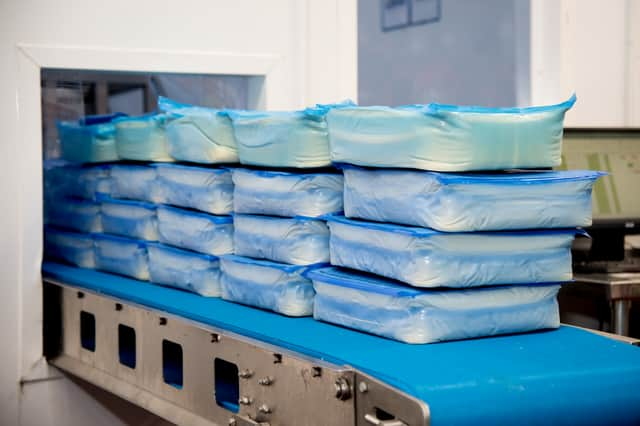
The rules mean a vet needs to inspect pallets of cheese before they can be exported
A major Shropshire business forced to limit trade with Europe due to post-Brexit red tape has welcomed the prospect of relaxed rules.
Bridge Cheese, based at Stafford Park in Telford, employs 92 people and has an annual turnover of £34m.
Last year the firm, which supplies food manufacturers and food service businesses, sold more than 9,100 tons of cheese.
But its managing director, Michael Harte, has revealed that expensive and time-consuming changes to rules on trading with the EU after Brexit have seen the firm forced to look to alternative markets such as Asia - rather than its closest trading partner.


It comes as the Government is expected to agree a deal with the EU to removing post-Brexit checks from food and agriculture exports.
Such a deal would provide a boost for firms such as Bridge Cheese.
Mr Harte explained that under the agreement with the EU his firm is required to get a vet to visit its premises to certify every pallet of cheese it sends to Europe.
That coupled with further paperwork has had a major impact on the appetite of EU firms to buy from the UK, when easier alternatives are available within their own trading bloc.
The managing director stressed he was not interested in the politics of Britain’s departure from the EU, but said the impact of the changes have had a significant effect on the ability to trade.
He said: “Pre-Brexit we would manufacture a product on Monday and have it with the customer in the EU or the Republic of Ireland by Wednesday.
“Now, with the agreement that was put in place with documentation and veterinary inspections, it would not be until the following Monday.”
He said the changes had particularly impacted small and medium businesses, which find it harder to absorb the extra costs when compared to larger firms.
He said: “£500 to £600 extra on 24 pallets is a relatively small cost, but if you are sending two or three pallets that is a bigger cost.”
Mr Harte said that the business, which was set up eight years ago, had been largely focussed on the UK market so the changes had not hit its bottom line.

But he stressed that the situation has prevented significant growth in its closest market, leaving the firm to look towards the Middle East and Asia to expand.
He said: “Our nearest market we had to almost totally exclude.”
Any issues with the lengthy paperwork could also cause major delays at customs - again a significant issue for small businesses which are shipping products with logistics firms carrying items from multiple firms.
He added: “Ultimately if you are doing business, it is a relationship. If you are a customer based in Belgium for example you would say ‘why would I buy product from the UK when I don’t know if it is going to be delivered, when you can buy from France, the Republic of Ireland, Germany, and know it will be delivered in three days with no risk?’”
Mr Harte welcomed the prospect of easier trade with the EU, saying: “What we are expecting is it will go back to the way it used to work without the paperwork and vets inspections, and alignment of standards between the EU and UK will go back to the way they were pre-Brexit.”
Despite the potential for easier trade with the EU Mr Harte said it would not be as simple as flicking a switch and would need fresh relationships to be built up.
Telford MP Shaun Davies said he would back any changes which boosted Telford businesses and created jobs.
He said: “Whether or not people voted remain or leave in the referendum 10 years ago, I don’t think anyone voted for a situation where a vet would need to inspect a block of cheese to export it - but those are the rules that have been operating for many years.
“We have seen many local businesses that have suffered, where those businesses that used to export to the EU have either reduced the amount they export or stopped altogether - this is bad for jobs and growth and simply does not make sense.”
He added: “So I welcome any measures that make it easier for Telford businesses to export to the EU because after all that helps create Telford jobs.”
Comment Guidelines
Iconic Media encourages reader discussion on our stories. User feedback, insights and back-and-forth exchanges add a rich layer of context to reporting. Please review our Community Guidelines before commenting.