
Sudden storm in Shropshire hills sparked what may have been county's worst natural disaster
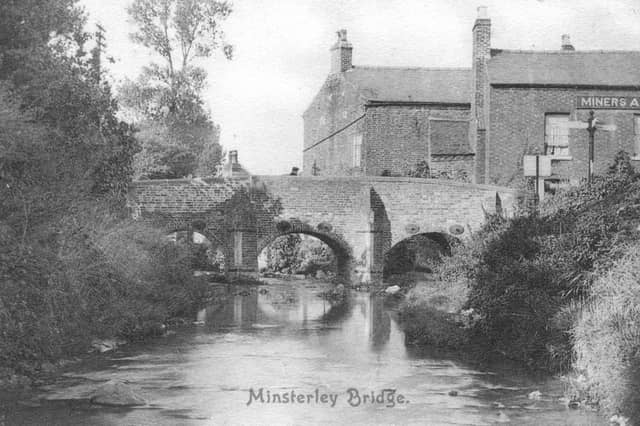

Massive torrent of water which came with little warning washed away everything in its path and left communities reeling in shock
Twelve died, hundreds were made homeless or lost their possessions, and communities were left in shock after a great torrent of water caused mayhem in what may have been Shropshire's worst natural disaster.
This was in the early 19th century, before the Industrial Revolution had transformed the world and long before modern debate about climate change and an increasing trend towards sudden, intense downpours.
There was little warning of the catastrophe. It had been a sultry afternoon when a storm broke, with thunder and lightning. Down came the rain and hail. Near Snailbeach the hailstones were two inches in circumference and lay almost a foot deep.
At about 5pm a cloudburst over the Stiperstones sent a torrent of water down the clefts in the hillsides. It made a thundering sound as it cascaded down, sweeping away several cottages belonging to Snailbeach miners.
Part of the vast quantity of water forked off through Habberley. But the greatest part thundered along the valley through which runs Minsterley Brook.
This wall of water engulfed everything in its path: farms, mills, cottages, bridges, humanity and livestock.

The date was Monday, May 27, 1811. Minsterley, Pontesford, Pontesbury, Habberley, Meole, Pulverbatch, and Shrewsbury all felt the force of the water. But it was Pontesford and Minsterley which suffered most.
Nine of the victims were from Pontesford: Mrs Heighway, and her servants Elizabeth Thomas and Catherine Nailor; Richard Bennett, a clerk; Richard Simmons, Samuel Speake, Richard Hincks, and Jacob Bishop, all labourers; and Elizabeth Reece.
The others were from Minsterley: Mr Hoggins, a farmer; William Hulmes, a labourer; and Thomas Parry, a waggoner.
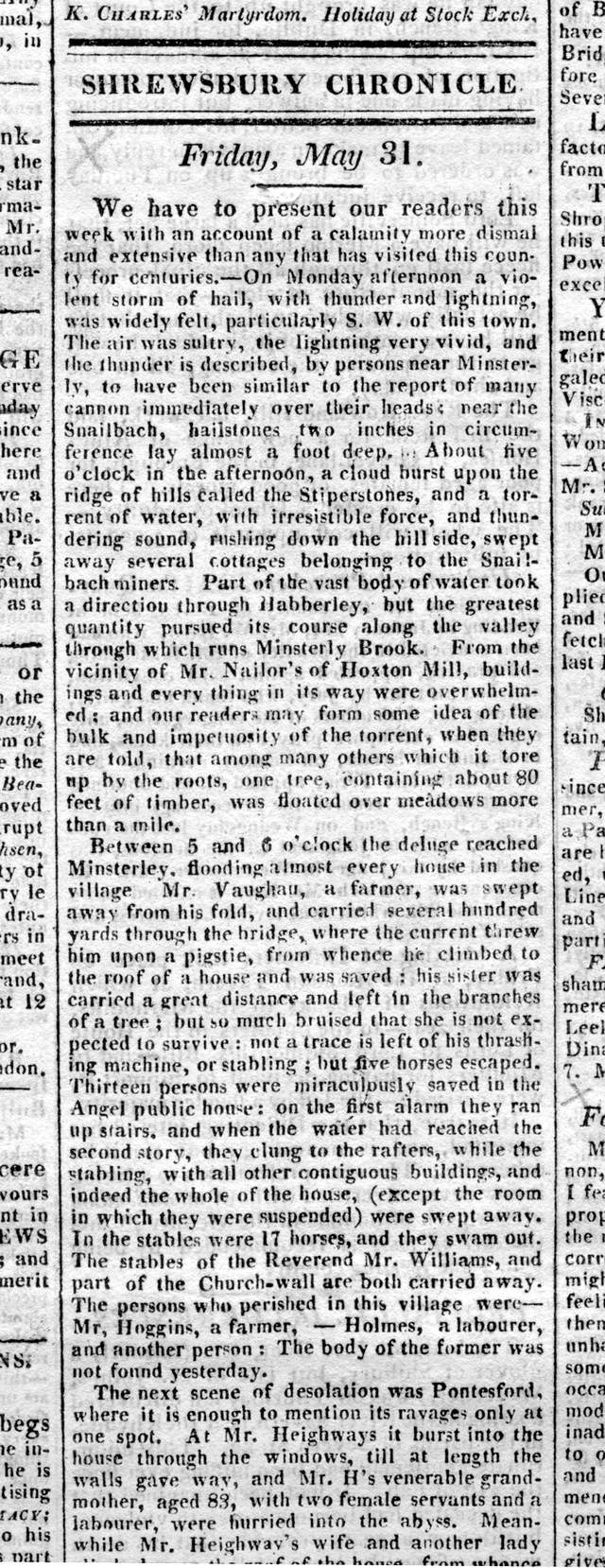
Some of the drama of that day is captured in a contemporary account in the Shrewsbury Chronicle.
"Between 5 and 6 o'clock the deluge reached Minsterley, flooding almost every house in the village. Mr Vaughan, a farmer, was swept away from his fold and carried several hundred yards through the bridge, where the current threw him upon a pigsty from which he climbed to the roof of a house and was saved. His sister was carried a great distance and left in the branches of a tree, but so much bruised that she is not expected to survive.
"Thirteen persons were miraculously saved in the Angel public house. On the first alarm they ran upstairs, and when the water had reached the second storey, they clung to the rafters while the stabling, with all the other continguous buildings, and indeed the whole of the house (except the room in which they were suspended) were swept away."
Next scene of devastation was Pontesford. Mr Bennett, an overseer of Pontesbury Coal Works, and two others, got into a hay loft and thought they were safe, but the building was swept away and all died.
The newspaper noted that at Mr Heighway's farm the water was at least 20ft deep and that at Minsterley it was six to eight feet deep in some houses.
The torrent reached Coleham, Shrewsbury, at about 10.30pm with a tremendous roaring noise. The cellars and lower rooms of the Seven Stars pub and all the houses adjoining were deluged and the street in front of Mr Hulbert's factory was flooded to a depth of nearly 3ft.
Dreadful cries of "Help! Help! Drowning!" added to the horror, the paper said.
In the days that followed there was a procession of sightseers to see the damage and explore the hills from which the destructive torrent had arisen. Partly it was ghoulish curiosity, but there was also a wave of sympathy for the sufferers.
As is the way with modern disasters, an appeal was started. It was an incredible success, with £1,862 raised, of which £1,322 was distributed to nearly 200 families. The Inundation Committee, as it was called, declared that there was a surplus, and as a result £465 was repaid to contributors as a "dividend" of five shillings each.
The committee rewarded the heroism of two people - William Evans, a labourer, from Minsterley, who "by swimming his horse 15 times, saved as many lives," and that of a little girl, who saved an infant of whom she had charge. It awarded 20 guineas to Evans, and "have appropriated £15, under proper directions, for the schooling and apprenticing of the girl."
Couple of points to ponder. Over 200 years later, could it happen again? And if not, why not?
- You can enjoy this and more with our weekly FREE Nostalgia Newsletter - with scores of archive pictures and exclusive features on the history of Shropshire and Mid Wales - all sent to your inbox every week. Sign up here.
Comment Guidelines
Iconic Media encourages reader discussion on our stories. User feedback, insights and back-and-forth exchanges add a rich layer of context to reporting. Please review our Community Guidelines before commenting.