
Gold rings which are hundreds of years old unearthed in Shropshire - including one with intact interesting inscription
Two gold rings which are hundreds of years old have been unearthed using metal detectors in Shropshire - with one bearing an interesting inscription.
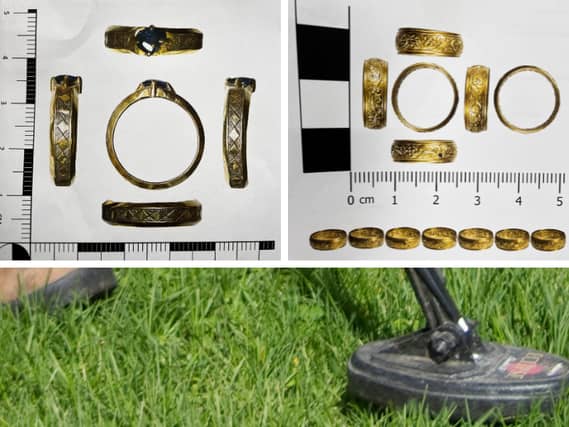


The rings were discovered in villages in the south of the county, and experts have shared their opinions on how old they believe they are based on historic evidence.
Treasure inquests for the items were held at Shropshire Coroner’s Court, Guildhall, Shrewsbury this week.
One of the rings bears an inscription providing a clue as to when it was made.
The piece of jewellery was discovered by metal detectorist Mark Hamilton on January 21 last year in Greete, near Ludlow.
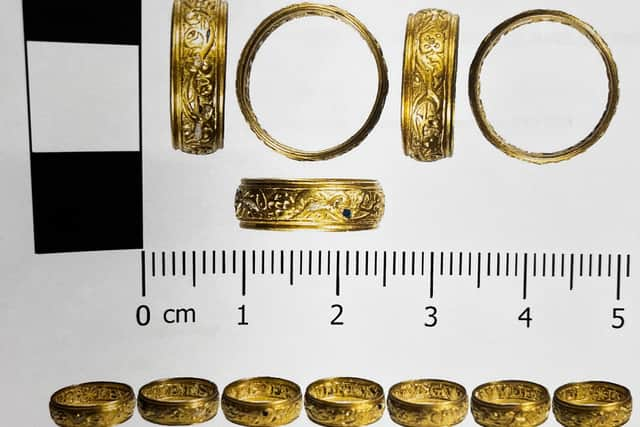
It is described in a report as “a gold, decorated finger ring with an interior inscription, dating from the 16th to the early 17th century (1550-1650AD)”.
The band is 15.7mm long, 5.2mm wide, 1.1mm thick and weighs 2.72g.
“The interior of the band features two flat, plain 1.3mm wide borders,” the report added. “Within these is a Roman capitalised inscription within a recessed central band.
“It reads: ‘LET VERTV GVYDE’. This is presumably a shortened and Latinised version of the more common posy inscription: ‘Let Virtue Be Thy Guide’ or ‘Let Virtue Guideth’.
“The ring features a form of an inscription commonly found on posy rings which date to the early post-medieval period.
“Though no parallels can be found on the Portable Antiquities Scheme database which feature the exact wording used on the ring in question, there are many that have been recorded with similar inscriptions.”
“It is intact and in its original form,” the report continued. “It is circular in plan and D-shaped in cross section.
“It is notably small, with an internal diameter of only 13.7mm. The exterior surface has a central band which has been decorated with a repeating floral and interlace pattern that has been pressed into the surface of the metal.
“Above and below this central band are smaller bands acting as borders. Small amounts of blue and white enamel can be seen in the recesses of the decoration, indicating the ring would have been adorned with colourful enamel decoration.
“There is no maker’s mark or stamp visible on the ring.
“There are remnants of what is presumably green enamel in the recesses of the interior inscription.
The other gold ring was unearthed by Darren Challoner on October 10, 2022 while metal detecting in Bettws-y-Crywn, south Shropshire, between Clun and the border with Wales.
It is described in a report prepared by Susan White, finds liaison officer for North Wales, as “a complete gold finger ring with a broad hoop decorated with engraved lozenges and set with a cabochon sapphire, held in place with four claws, dating to the early post-medieval period (c. 1400-1550 AM)”. There is no hallmark or maker’s mark.
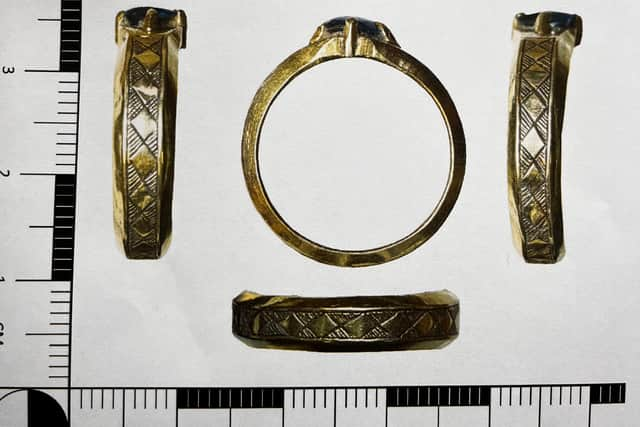
The ring is 21.6mm in diameter, 5.1mm in width and 1.4mm thick.
The report adds: “The hollow hoop construction and the use of a cabochon stone presents some problems with regard to accurately dating this ring.
“Hollow constructed rings are known from the Middle Ages."
It says that cut stones started to be introduced and become fashionable in the 15th century.
“It has not been possible to find parallels for the design motif on the hoop of this ring, however engraved geometric motifs are found on a range of medieval rings.
“In the absence of any closely dated parallels, in terms of either design or construction, it has not been possible to offer an exact date for this ring. However, based on the evidence, tis new example pre-dates 1700AD and is most likely mid-late medieval, i.e. c. 1400-1550AD.
Given the age of both rings is more than 300 years old and they contain at least 10 per cent precious metal, John Ellery, senior coroner for Shropshire, Telford and Wrekin, declared them treasure.
Comment Guidelines
Iconic Media encourages reader discussion on our stories. User feedback, insights and back-and-forth exchanges add a rich layer of context to reporting. Please review our Community Guidelines before commenting.