
80mph train crashed into trailer near Ludlow after signaller 'forgot' about oncoming locomotive
The report includes a number of recommendations to avoid a repeat incident.
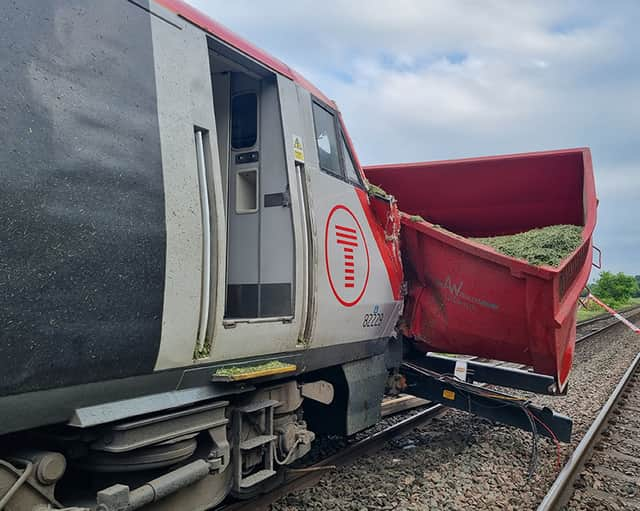
An 80mph rail crash near the south Shropshire border happened after the signaller “forgot” about the presence of the train, it has been revealed.
The Rail Accident Investigation Branch (RAIB) has published its report into the crash between Ludlow and Leominster last year.


The crash, in which six passengers and one member of staff were injured, happened at 10.37am on May 22, 2025, on the Down Main Line.
The train did not derail but an agricultural trailer being towed across the railway was hit by the train, causing major damage.
The crossing at Nordan Farm in Herefordshire was ‘user-worked’.

The RAIB report said the crash happened because the signaller had “forgotten” about the oncoming train when they gave permission to cross.
It added that the signaller’s workload and fatigue may have contributed to their actions.
It stated: “The accident happened because the signaller gave permission to the tractor’s driver to use the crossing, despite the proximity of the approaching train.
“The signaller had forgotten about the presence of the train when they gave permission and did not check signal box equipment which was indicating the presence of the train beforehand, as they had been trained to.

“The signaller’s actions may have been affected by an interruption to their established routine for giving users permission to use the crossing, an increase in their workload, distraction and the effects of fatigue.
“As Nordan Farm level crossing is a passive user-worked crossing, it has no engineered safeguards to warn or protect a crossing user of an approaching train and safe operation is solely reliant on the signaller’s decision as to whether it is safe to cross or not.”
The report said risk assessments did not show the potential danger and includes future recommendations for Network Rail.
It stated: “RAIB found that Network Rail’s level crossing risk assessment process did not effectively recognise nor control the higher risk present at some crossings during intensive seasonal use.
“This was an underlying factor. RAIB also found that Network Rail did not have a coherent process for deciding whether a vehicle using a user-worked crossing should be considered as large, low or slow moving. This was a possible underlying factor.
“RAIB has made two recommendations, both addressed to Network Rail. The first seeks to improve the effectiveness of risk management processes at crossings that see a high variance of use across the year.
“The second asks Network Rail to consider the actions it took in response to a previous RAIB recommendation and is aimed at assisting signallers and crossing users in deciding whether a vehicle should be treated as large, low or slow moving.
“RAIB also identified four learning points. The first reminds staff to comply with their company’s mobile phone policies.
“The second reminds staff to assess their level of fatigue and inform their company as needed.
“The third highlights the importance of signallers using available instruments and indicators when considering level crossing requests. The fourth reminds signallers to follow the correct process for applying signal protection.”
Comment Guidelines
Iconic Media encourages reader discussion on our stories. User feedback, insights and back-and-forth exchanges add a rich layer of context to reporting. Please review our Community Guidelines before commenting.