
Video: Shrewsbury's crumbling Lord Hill Column to be assessed after high winds of Storm Jocelyn
Workers were at Shrewsbury's Lord Hill statue checking for damage after the UK was battered by the high winds of Storm Jocelyn.
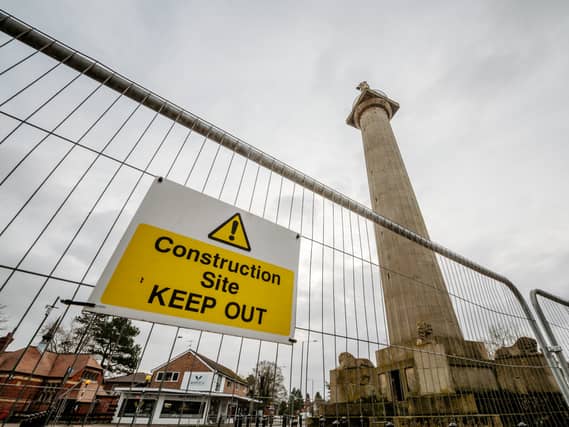


Metal barriers have been surrounding the 40ft column the statue stands on for around three weeks to protect the public from any falling debris.
Shropshire Council staff were out this morning after strong winds last night. Wind speeds of up to 97mph were recorded in some parts of the country.
The authority is arranging an inspection of the statue to determine its condition and if any repair work is needed. The safety measures will remain in place until further notice. It is expected the council will be sending a drone up to look at the condition of the statue.
Councillor Dean Carroll, the authority's cabinet member for housing and assets, said recently: “Lord Hill famously fought in a number of battles, but his biggest enemy is undoubtedly the weather – especially heavy rain, frost and wind.
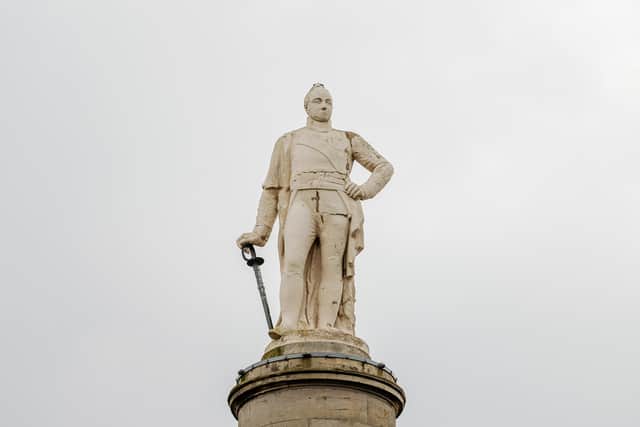
“The historic monument is maintained on a regular basis by us, but unfortunately the recent bad weather has not been kind to the fragile statue.
“As you would expect, our priority is to ensure the safety of people passing by The Column, so we’re arranging a specialist assessment of the statue to determine what action may be necessary.”
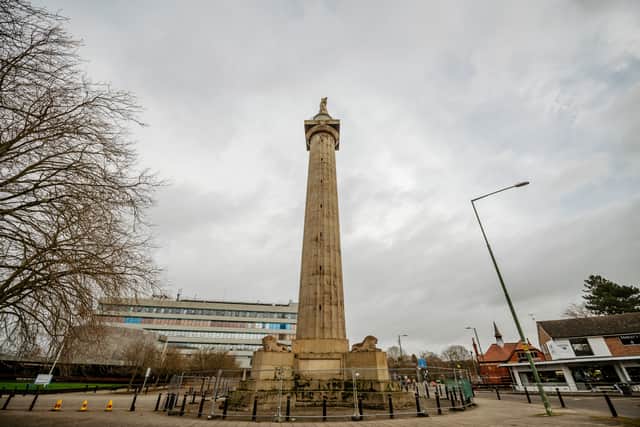
Completed in June 1816, The Column was erected in honour of the Right Honourable Rowland Lord Hill, Baron of Almarez in Spain, and of Hawkstone and Hardwick Grange, Shropshire; Commander-in-Chief of the British Army; a General in the Army; Governor of Plymouth, and Colonel of the Horse Guards Blue.
Born at Prees Hall, near Hawkstone in April 1772, Lord Hill fought alongside the Duke of Wellington at the Battle of Waterloo. The Column was erected to recognise his valour in this and other campaigns. He died at Hardwicke Grange near Shrewsbury in December 1842 and was buried in the churchyard at Hadnall.
The proposal to erect a monument in his honour was first made in the Shrewsbury Chronicle in December 1813, while he was fighting heroically in the Pyrenees. The decision to build a column followed swiftly and the money was raised by the people of Shropshire through 1814.
The column was designed by 22-year old Edward Haycock using stone from the nearby quarries at Grinshill, with revisions, to the base only, by Thomas Harrison of Chester. The statue was made of Coade artificial stone, and was made by Mrs Coade’s firm in Lambeth.
The first stone was laid on December 27, 1814 by the Salopian Lodge of Free Masons, assisted by deputies from adjoining lodges, on the festival of St. John the Evangelist. The last stone was laid on June 18, 1816, the anniversary of the battle of Waterloo. The total expense was 5,972 pounds, 13 shillings and 2 pence.
The Column is 133ft high (40.5m) and is the highest free-standing Greek Doric column in England. Its diameter is two feet wider than Nelson’s Column and, not including the pedestal, it is 13ft higher.
The statue in particular has had a number of significant repairs and the council, along with the Friends of Lord Hill Column, are now seeking support to replace it.
As owners of the Grade II* listed Lord Hill statue and The Column, Shropshire Council has a responsibility for maintaining the structure.
The Friends of Lord Hill’s Column was formed in September 2013 and now has over 2,500 life members. This has been achieved mainly through opening the Column on specified days so that members of the public may climb the 172 stairs to the top. This costs £5 (young people of school age and students in further education climb free) and confers automatic life membership of the Friends who can climb the column free of charge thereafter.
For more information go to friendsoflordhillscolumn.co.uk.
Comment Guidelines
Iconic Media encourages reader discussion on our stories. User feedback, insights and back-and-forth exchanges add a rich layer of context to reporting. Please review our Community Guidelines before commenting.