
Why I think Burnham's vision matters to everyone in the West Midlands
Dr Steven McCabe argues that Andy Burnham's vision of greater devolution could mark a turning point for Britain and bring significant opportunities for the West Midlands, but only if bold ambition is matched by credible funding and effective delivery.
What’s happened?
Andy Burnham, only elected as MP for Makerfield a couple of weeks ago, provided a vision of what he will do if he, as is widely expected, replaces Sir Keir Starmer as leader of the Labour Party and becomes Prime Minister.
Though, as might be expected given the rapidity with which events have moved over the last week or so since he won Makerfield, Burnham’s vision about what his plan for greater devolution will actually consist of was lacking in specificity of detail.
Such detail will be essential in putting in place the infrastructure – both literal and metaphorical policy – which will determine eventual success.
Critically, Burnham’s message exuded the aspiration that success created under his leadership of Greater Manchester can be replicated nationally through a combination of more targeted intervention and devolution.
His commitment to building more social housing – Burnham stated he’d oversee the biggest council housebuilding programme since the postwar period, which would “utterly transform” Britain – was welcomed by numerous housing charities.
Moreover, making public transport more affordable is essential to instilling a belief that prospects will improve for those most disadvantaged.
Ensuring greater opportunity for the over one million and rising young people not in education, employment or training, so-called NEETs, an evolving crisis, requires urgent action which Burnham's vision of devolution will surely encompass.
Dealing with business rates, which, as Burnham accepts, are undermining high street retailers as well as pubs and restaurants, comes as very good news.
What do we know about Burnham?
Andy Burnham, who was MP for Leigh from 2001 to 2017 and held several cabinet positions under the Labour government of Tony Blair and Gordon Brown, left Parliament in 2017 to become Mayor of Greater Manchester, a role he is widely acknowledged to have been highly successful in.
Had it not been for the unpopularity of Labour under Starmer, so amply demonstrated by the dreadful local election results in May, Burnham might not have stood as MP for Makerfield with the specific intention of replacing him.
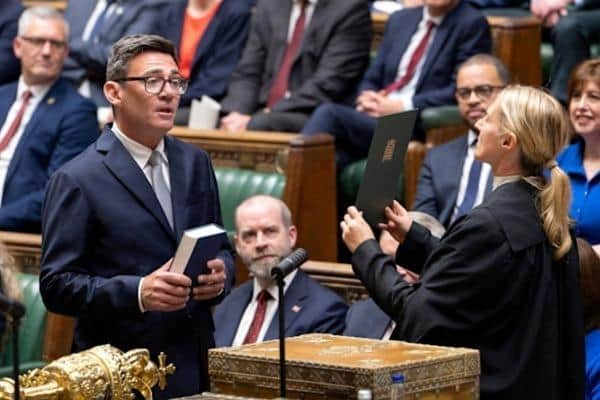

Having become an MP and created an environment in which Starmer has effectively been forced to the question being asked by many is, 'What can Burnham realistically achieve to remedy the malaise felt by so many voters and made plain ten years ago when we voted on our EU membership?'
For starters, Burnham has the immediate advantage of neither looking nor, crucially, sounding like the still current leader of his party.
As someone born in Aintree, a suburb of Liverpool, in January 1970, he’s a northerner and is widely perceived as a natural communicator whose message is authentic.
That his parents were working class underpins his ability to cut through to those who appear to see contemporary political leaders as both remote and elite.
He will have seen as a child in Liverpool the havoc ‘Thatcherism’ wrought on the city of Liverpool, which required the then Environment Secretary, now Lord, Michael Heseltine, to try and fix following the riots of the summer of 1981.
What will his vision look like?
‘Manchesterism’, as Burnham refers to his vision, is one that will play well to those who contend that far too much emphasis is placed on London, especially the city where the country’s finances are largely dictated.
Very symbolically, it’s notable Burnham intends that he would establish a No. 10 office in Manchester to be headed by Caroline Simpson, who’s currently chief executive of the Greater Manchester combined authority, and would be his deputy chief of staff, leading the new No. 10 North.
Simpson, who commenced her career in the West Midlands, would be responsible for creating the circumstances in which devolution of power and resources across the UK could be rolled out across the country.
Given she studied Japanese and business studies at Liverpool John Moores University before entering the public sector, I’d suggest that she will have an intimate understanding of the way in which the total quality management revolution was achieved in Japan, which my PhD was based on.
Amusingly, it’s long been claimed that Hitler, had he defeated this country in the Second World War, had identified Manchester’s Midland Hotel to be his headquarters.
However, like all myths, this story has absolutely no factual basis whatsoever.
Nonetheless, as a student in Manchester in the early 1980s, I can attest to the grandiosity and architectural beauty of the Midland Hotel, though I had to come back many years later to afford to stay there!
What’s abundantly clear is that Burnham envisages a Britain in which all regions, including the West Midlands, freed of what many see as the bureaucratic influence of Westminster, have far more agility to take decisions at speed, targeting opportunities to raise finance and implement creative solutions intended to boost economic growth that will achieve new jobs and raise income for citizens.
Devolution will, in effect, become the driver of change.
Will it work?
This is the million-dollar question.
There is no doubting Burnham’s passion and sincerity in his belief that radical change is possible.
However, change takes time and, of course, money, lots of it, measured in billions.
Remember, the context in which Burnham would become the seventh PM in just over ten years since David Cameron resigned, having led the Remain side in the EU referendum held on 23rd June 2016, won by leave by 51.9% (41,074,241 votes) compared to 48.1% (16,141,241 votes) by those who wished to stay, is a country that’s more divided and disgruntled by a number of factors, primarily that they feel they are getting poorer.
Data demonstrates that this is the case and that income levels have not kept pace with rising prices for food and energy, and, after allowing for inflation, the average working person in this country earns less than in 2008, when the Global Financial Crisis occurred.
Housing costs in terms of buying and renting have gone up, making it far more difficult for young people to leave home.
The economic outlook is challenging in that debt is now approaching £3 trillion, which means it requires over £100 billion just to pay the interest, meaning approximately one pound in every ten raised through taxation is used for this purpose rather than on public services and investment.
There is a worklessness problem.
Economic inactivity, consisting of those aged 16-64 who are unemployed, have long-term illness, retired early, are full-time students, and are individuals with caring responsibilities, stands at 21% (9.14 million) and means a large swath of the population are potentially not contributing to the economy through their ability to pay tax and national insurance.
The welfare bill for the UK is currently £334 billion, 43-44% of which is spent on the state pension.
Rachel Reeves, the current Chancellor, has found that her ability to do anything is stymied by the dreadful state of public finances.
This will be exactly the situation Andy Burnham is confronted by if he becomes PM on 20th July.
His vision may be bold and radical, but tough choices must be made by him and whoever he appoints as Chancellor, assuming he doesn’t leave Reeves in place, in how to finance and which budgets may need to be raised.
Many speculate that further rises in taxation might be needed, and he may have to contemplate an increase in income tax, which the 2024 Labour manifesto explicitly promised not to do.
As always, time will tell, but Burnham, who would become the next PM precisely because Labour MPs are fearful the party will be trounced at the next general election, wants to see success as soon as possible.
What difference will Burnham’s vision mean for us here in the West Midlands?
There is little doubt that deindustrialisation has negatively affected this region.
Manufacturing, which is still a major contributor to the West Midlands’ economy, worth £10.4 billion in GVA (gross value added) and supporting 304-317,000 jobs as well as accounting for 36% of goods exported, does not employ the same number of workers as it did in the 1970s.
Economic inactivity in the West Midlands is a concern, with almost 600,000 of 15-64-year-olds living in the region not working.
Pockets of unemployment, especially among the young, are a major challenge, particularly in Birmingham and Coventry.
Public services are under strain, most notably in Birmingham, a city whose council has had more than its fair share of bad publicity following its declaration of bankruptcy in 2023.
Matters are not helped by a road system which makes getting across the region notoriously slow for both citizens and goods.
Public transport is recognised as needing improvement and to be made more affordable.
All of the above are acknowledged by those in control, including Richard Parker, who attended Burnham’s devolution speech in Manchester, as essential issues to be addressed.
Needless to say, if Parker, in collaboration with all local councils, can avail of additional powers and finance as a direct consequence of Burnham becoming PM and implementing his vision, we’ll all benefit.
What’s the political background?
Ten years ago, we collectively voted to leave the EU, which, it's calculated, has made every person some £2,000 poorer as a consequence.
It’s speculated the argument advanced by supporters of Leave, that we gave more to the EU than we received, created resentment amongst those who felt they’d become poorer because this money could instead be spent on them.
Add in the fact members of the EU were required to allow free movement of goods and, more particularly, people, ensuring a sense many believed those from other member countries who had come to the UK in search of employment had deprived them and their children of jobs.
The matter of immigration is still very much one which needs to be confronted.
Importantly, without new workers, who will fulfil the roles made vacant as we get older and retire?
Moreover, where will the taxation come from to pay the welfare bill which increases far faster than we can raise taxes?
Little wonder that people have, in general terms, become increasingly disillusioned with politics.
Keir Starmer, voted in only two years ago on the promise of changing politics which had become alarmingly febrile and chaotic under Boris Johnson and Liz Truss, has discovered that popularity is based on making promises that you will make things better and, of course, delivering as quickly as possible.
This is the UK Burnham will likely take control of in three weeks.
However, Burnham represents an extremely positive and heartening message.
Many will warm to his ‘let’s make it happen’ vision.
Accordingly, and though there is a great deal to be resolved in terms of detail and financing, and whilst patience is needed before we see any real change, it’s acknowledged by all but the most dogged harbingers of doom that radical political change based on a radically different culture was long overdue.
For all our sakes, let’s hope the success Manchester has enjoyed in recent years is experienced across every region of the country as soon as possible.
Dr Steve McCabe
Steve is Professor and Pro Vice Chancellor, DoctorateHub.
Previously, having worked for Birmingham City Council, he spent the last 35 years as an academic at Birmingham City University teaching and researching economics, management and business. Additionally, he has written extensively for edited texts examining economics and politics.
He regularly writes and comments regularly in the national and international media on politics and the economy and has published texts on quality management, benchmarking, ‘Brexit’ and its economic and social impact, the green economy and manufacturing, house prices and India’s progress since independence.
To read Dr McCabe’s work visit Amazon to find English Regions After Brexit: Examining Potential Change Through Devolved Power.
Comment Guidelines
Iconic Media encourages reader discussion on our stories. User feedback, insights and back-and-forth exchanges add a rich layer of context to reporting. Please review our Community Guidelines before commenting.