
What next for controversial (and eye-wateringly expensive) HS2?
The new Prime Minister has long championed extending HS2 to Manchester. But with the first phase already beset by soaring costs and public finances under severe strain, can ambition survive economic reality?
Imagine it’s the year 2043.
The Prime Minister is officially opening the high-speed (HS2) train connection between London’s Euston station and Curzon Street in Birmingham.
Equally significantly, they proudly announce that what’s become known as the ‘Burnham Extension’, the high-speed connection between Birmingham and Manchester Piccadilly, is making very good progress, and it’s hoped, will be operational “by the end of the decade".
However, as if to spoil the sense of euphoria, the PM is niggled to be questioned on rumours that the final outturn cost for the 140 miles of HS2 will have cost in excess of £150 billion and that the costs of the extension are also rapidly escalating from the original estimated budget of £55 billion.
Instead, the audience are told, as a nation we should take great pride in having ultrafast lines that will greatly enhance economies in regions north of London, an ongoing process first commenced under Andy Burnham, when he became PM in July 2026.


Perhaps this sounds far-fetched.
Or maybe not.
Recent history shows that building high-speed rail lines is fiendishly complex and, more especially, hideously expensive.
Andy Burnham, who’ll formally be declared PM on Monday, 20th July, has yet to declare what his priorities will be.
Nonetheless, we do know that in October 2023, when Phase 2b of HS2, the line between Birmingham to Manchester, was cancelled by then Conservative PM Rishi Sunak at his party’s annual conference due to the rapidly rising costs of the overall scheme, Burnham, in his role as Mayor of Greater Manchester, was angry and claimed those living outside London were treated as "second class citizens".
Burnham added that the decision to axe Phase 2b was short-sighted and that major infrastructure work should be agreed “on a cross-party consultative basis".
Notably, Henri Murison, chief executive of Northern Powerhouse Partnership, asserted that cancellation of Phase 2b of HS2 was a "national tragedy” because in a century the economy of the north of Britain would be smaller than it might otherwise be if it went ahead.
Four years ago, when any hope of becoming PM might have looked forlorn, Burnham stated his intention to pursue an investigation of a cut-price version of the high-speed link between Birmingham and Manchester using a ‘Crossrail-style’ funded approach of combining public and private finance.
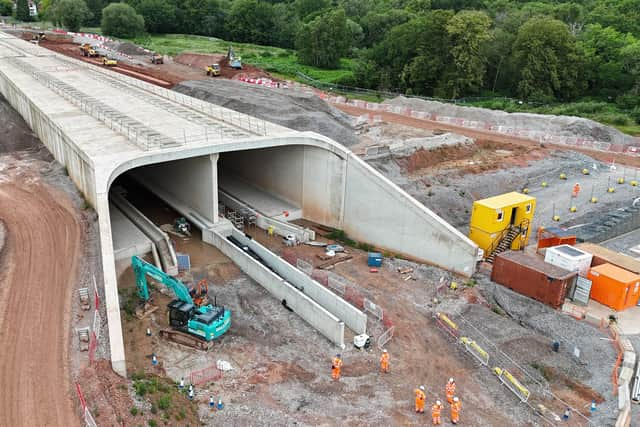
In addition, he’d used this line to release and enhance capacity on the West Coast Main Line.
The harsh reality of the economic climate, undoubtedly caused by the political uncertainty of recent years, meant a ‘bargain basement’ high-speed link north of Birmingham never flew.
Sunak had too many other problems to contend with, and, without a firm commitment from government, private investors were never going to stump up.
Less than a year after cancelling HS2 to Manchester, Sunak led his government to a record election defeat resulting in the ‘loveless landslide’ achieved by Labour under Keir Starmer.
Starmer’s premiership was beset by challenges which he never mastered which has led to him resigning and the installation of Burnham as his replacement and, of course, PM.
Now he’s the person leading this country, we should expect him to make clear his view on the extension of what will be reasonably high-speed line to Manchester; a maximum speed of 185mph but not the 250mph which was proclaimed at the announcement of HS2 in the dying days of Gordon Brown’s Labour administration.
Burnham, interviewed by Caroline Wheeler of the iPaper last month, restated his intention to resurrect HS2 from Birmingham to Manchester, terminating in a newly constructed underground station in the centre of the city as part of infrastructure development intended to provide the foundations for improved growth:
“The lack of high-quality rail infrastructure in the north of England holds back its growth potential.”
As he argued almost four years ago, the way in which London’s ‘Crossrail’ – now known as the Elizabeth Line – was funded, a combination of public funding as well as contributions from businesses and residents, would make it possible to finance the extension of HS2 from Birmingham to Manchester.
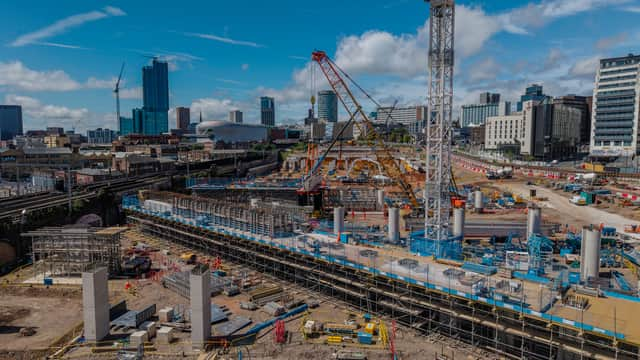
What Burnham also believes is that land, which, certainly in London, tends to vastly increase in value around newly built stations on any new line, offers an opportunity to raise finance:
"You don’t take all the windfall off the landholder, but you share the proceeds of that windfall, and the increase in land values created by the infrastructure is captured to pay back the cost of the infrastructure. So why shouldn’t we fund infrastructure in this country in that way?”
Using this method of funding as part of a devolved approach would, Burnham stresses, move the country away from the centralised and top-down mentality he’s long contended does not serve the regions well.
So, the question may be asked: is the extension to HS2 from Birmingham to London likely?
Firstly, how much would this scheme cost?
And, secondly, could the finance be raised?
After all, what HS2 has surely taught us is that a genuinely accurate estimate is essential so that we avoid the shock of discovering that the cost of getting from London to Birmingham will be in excess of £100 billion, whereas the original scheme, some 330 miles which would have reached Manchester and Leeds in a Y-shaped configuration, was estimated at £35 billion.
Very helpfully, Andrew Gilligan, Head of Transport and Infrastructure at Policy Exchange, writing in the iPaper this week, has provided answers to the question of cost and the likelihood of finance being available.
As he explains, based on phase one currently under construction, and which costs between £626 and £734 million a mile, building the 89 miles from Birmingham to Manchester, and which would include the ‘Golborne link’, enabling connections for Preston and Scotland by joining the West Coast Main Line at Bamfurlong in Makerfield, which the new PM considers equally vital, could cost up to £65 billion.
Gilligan caveats this figure by pointing out that there would be less tunnelling on HS2b, “around 17 per cent of the route versus 23 per cent in Phase 1”.
However, as the first phase has shown, any saving could easily be wiped out by unforeseen problems.
In addition, Gilligan suggests, the cost of the underground station in central Manchester as well as a new line between Manchester and Liverpool, Northern Powerhouse Rail (NPR), as well as a potential connection to Leeds would result in a total cost of “perhaps £80bn”, the big end of what the current phase of HS2 between London and Birmingham is being estimated to cost.
Though a huge sum, not all of this estimate would be publicly funded by the government.
What Burnham describes as a 'cleverer way of funding' was used in London, and called the ‘Community Infrastructure Levy', resulted in a quarter of the £4.7 billion of the cost of the Elizabeth Line being covered by businesses as well as £260 million being contributed by the developers of Battersea Power Station.
However, Gilligan is pessimistic that this approach will work for a much in the case of the far more extensive scheme that HS2 from Birmingham to Manchester would be.
For starters, these were much smaller London-based.
What works financially in the capital does not necessarily apply outside the ‘Big Smoke’.
Gilligan quotes the hugely influential Professor Tony Travers from the London School of Economics, who chaired a commission on land value capture for infrastructure and contends there's the following:
"No way any other part of the country could do anything like [London]. Their economies are just not big enough to bear it. The land values are not enough to raise more than a very modest, gestural amount."
So, it might appear, if Andy Burnham is to remain true to his promise to complete HS2 from Birmingham to Manchester, phase one of which, currently, will terminate in Staffordshire just before the Trent and Mersey Canal, he’ll run the risk of having to commit the treasury to picking up a bill potentially as daunting as the one currently ratcheting up for the line between London and Birmingham.
This is surely not what Burnham will want as his legacy, or is it?
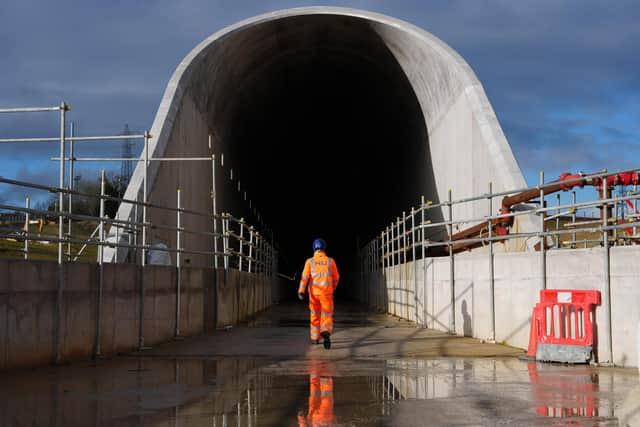
As he prepares to become PM, he’ll know that public finances are already severely stretched.
Only last week the Office for Budget Responsibility (OBR) made clear their concerns that UK government debt, currently £2.98 trillion, equivalent to 95.1% of gross domestic product (GDP), is on an “unsustainable and ever-rising path” and a decision will need to be made in the near future as to whether to increase taxes or reduce spending by £120 billion a year to ensure the debt does not rise even further.
Because of the fact that we pay higher gilt rates than any other G7 nation, currently 5% on a ten-year basis, servicing public debt, a third of which is index-linked, costs £300 million a day, which could instead.
£109.5 billion, if didn’t have to be spent in this way, would allow any government to be act in a truly transformational way.
This is the harsh reality of leadership, and all choices, including long-term infrastructure projects intended to accelerate economic development in regions, have an opportunity cost of making a difference elsewhere.
Becoming PM is a major step up for Burnham, though his experience as Mayor of Greater Manchester, with a population of just over three million citizens and a budget of approximately £3 billion, means he should be well aware of the challenges of matching visions to the money available.
However, according to data just published by the Ministry of Housing, Communities and Local Government, Andy Burnham left Greater Manchester with debt of £1.34 billion at the end of the last financial year, up from £964m before he took office in 2017, the largest of any combined authority in England.
In considering the extension to HS2, there is the elephant in the room of what the current phase is going to cost and when it will eventually be complete.
Unfortunately, all we know is that the final bill will be in excess of £100 billion – many suggest it could be massively above this figure – and that we should not expect to see trains arriving and departing from Curzon Street for at least another fifteen years.
There are some who think that the £44 billion spent on this project should be written off – let’s face it, we wasted almost a quarter of that sum on useless PPE (personal protective equipment) during the pandemic to protect medical staff dealing with patients with Covid – and instead spend the budget on other projects which will have a far better chance of producing benefit.
The Guardian’s Simon Jenkins is one who wrote an opinion piece in May, ‘HS2 is the wildest white elephant in British history. Please put it out of its misery,' in May.
In this article, and in quoting John Maynard Keynes, who claimed that there is economic benefit to those being paid to dig holes and then fill them in, he asserts that scrapping HS2, by cutting our losses on this project, would produce the upside of sites that would be available for development:
“Cancellation would […] liberate multibillion-pound sites for urban development around London Euston and Birmingham and free space for a new town on the site of the vast shambles that is HS2’s Coleshill interchange.”
Whilst there’s undoubtedly an important debate to be had as to whether HS2 is going to produce any real benefit when it’s eventually completed, this is unlikely to happen under new PM Andy Burnham, who’s very much nailed his colours to the high-speed mast.
So, assuming he is not convinced to do otherwise by the state of finances he discovers on taking office next week, we can only assume it will be ‘full steam ahead’ as far as HS2 is concerned both between London and Birmingham, and onwards to Manchester.
Dr Steve McCabe
Steve is Professor and Pro Vice Chancellor, DoctorateHub.
Previously, having worked for Birmingham City Council, he spent the last 35 years as an academic at Birmingham City University teaching and researching economics, management and business. Additionally, he has written extensively for edited texts examining economics and politics.
He regularly writes and comments regularly in the national and international media on politics and the economy and has published texts on quality management, benchmarking, ‘Brexit’ and its economic and social impact, the green economy and manufacturing, house prices and India’s progress since independence.
To read Dr McCabe’s work visit Amazon to find English Regions After Brexit: Examining Potential Change Through Devolved Power.
Comment Guidelines
Iconic Media encourages reader discussion on our stories. User feedback, insights and back-and-forth exchanges add a rich layer of context to reporting. Please review our Community Guidelines before commenting.