
“My life has completely changed forever. I would be financially better off in prison, " says paralysed man
Paralysed Llanidloes man says unsuitable housing has left him ‘a prisoner in his own home’
When Stephen Dyke from Llanidloes was suddenly paralysed from the neck down, his entire life was turned upside down.
Now, over two years later, the 55 year-old has been prevented from rebuilding his life thanks to being placed in an unsuitable home in Crossgates, 30 miles away from his hometown.
He is working with Spinal Injuries Association on their accessible housing campaign to highlight the issues of inappropriate housing.
On January 1 2024, Stephen unexpectedly collapsed in his kitchen. When he woke up, he was paralysed from the neck down, with only the use of his shoulder blades.
He said, “I spent six days on the floor without water, food, or anything. I was very close to death when my friend found me.”
One of Stephen’s discs was pressing into his spinal cord, causing him to lose all function from the chest down. After emergency decompression surgery and 10 months in hospital and rehabilitation, he was able to regain movement in his arms, but still uses a wheelchair for mobility.
While his progress was remarkable, Stephen lost his rented accommodation in the time he was away, leaving him homeless.
He said, “I lost everything. The only stuff I had were the clothes and things that I bought whilst I was in hospital.”
Stephen was allocated a bungalow through social housing, but the property has not been adapted for a wheelchair user.
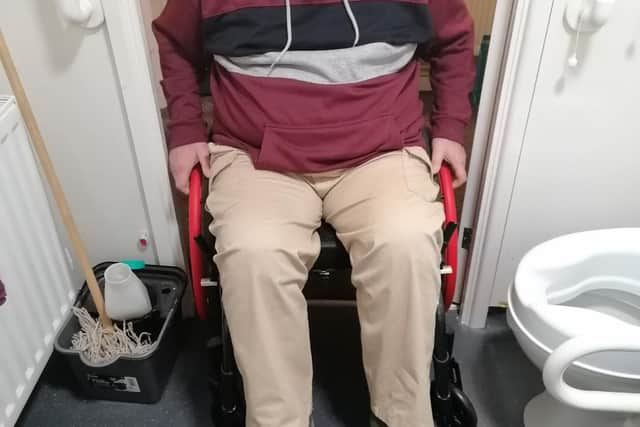
For the last 18 months, Stephen has been contending with doorways that are too narrow for a wheelchair, a bathroom too small for him to navigate, and an access ramp that is too steep for him to self-propel.
When he first arrived, the door to the kitchen only opened to a 45 degree angle, meaning he had no access at all.
He said, “I had a breakdown after two weeks because I was living on takeaways and I was soiling myself because I couldn’t access the kitchen or bathroom. I was using alcohol as a coping mechanism. Social services have done hardly anything. They closed the case because they say they can’t do anything.”
While the door has since been removed, the narrow doorways throughout the bungalow make it difficult for Stephen to navigate his own home as his wheelchair barely fits. Not only is this frustrating for him, but it is negatively impacting his health.
Stephen’s wheelchair is too small for him, causing him constant pain due to poor posture and support, and pressure ulcers that can take months, or even years, to heal and that run the risk of infection.
However, a wider chair will not fit through any of the doorways, meaning it is impossible for him to get the size he needs.
Stephen said, “I’ve gone from being active and being outdoors. My life has completely changed forever. I would be financially better off in prison, to be honest. At least I wouldn’t have to pay for food. I’m trying to help myself, but I’ve got no way forward of helping myself. It’s completely wrong. People are living like me, and we’ve got no control over it. The help you get is very limited and it seems ludicrous to me.”

Spinal cord injury charity, Spinal Injuries Association is launching a campaign calling on the Government to pledge 150,000 wheelchair-accessible homes, which are currently not part of their promise to build 1.5million homes by 2029, to allow people like Stephen to live an independent and fulfilled life.
An SIA spokesperson said: “Cases like Stephen’s are shocking, but sadly we hear all too often of similar dangerous and unacceptable cases. No one should become a prisoner in their own home. With 400,000 wheelchair users currently living in unsuitable homes, and long waiting lists, the need for fully adapted housing is urgent. A home is the foundation of our lives, and we all should be able to live in a home that benefits our health and wellbeing.”
A spokesperson for Powys County Council said: “We recognise how difficult and distressing housing challenges can be, particularly for residents who are adjusting to life‑changing health conditions. While we fully appreciate the concerns being raised, the council does not comment on individual cases.
“The council tries to meet the housing needs of people in Powys in a way that reflects their individual circumstances. This includes exploring suitable accommodation options, preferences about the locations they want to live in, considering necessary adaptations, and working closely with partner agencies to ensure people receive the support they need.
“We know that for those living with serious mobility issues, the right home environment is essential to wellbeing, independence and dignity. Our teams continue to work hard – alongside health and social care professionals, housing associations and specialist services – to support residents as best we can within the resources and housing options available.
“We are committed to improving accessible housing provision across Powys and will continue to do everything we can to support individuals facing difficult situations.”
Comment Guidelines
Iconic Media encourages reader discussion on our stories. User feedback, insights and back-and-forth exchanges add a rich layer of context to reporting. Please review our Community Guidelines before commenting.