
Ofsted inspectors give verdict on Telford secondary school detailing areas which 'need attention'
Detailed findings and recommendations following the February visit have been published.
Inspectors have outlined a number of areas for improvement after the inspection of a Telford secondary school.
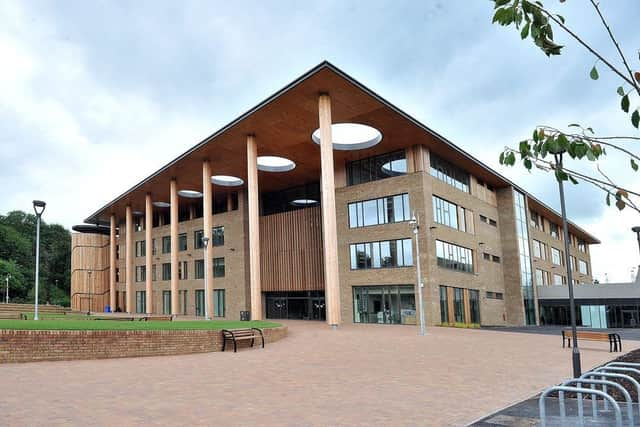
The Ofsted inspection of Haberdashers’ Abraham Darby in Madeley took place in February this year, under the education watchdog’s new regime.
Instead of the previous criteria used to judge schools, they are now graded in seven areas with ratings from the worst - ‘urgent improvement’ - through ‘needs attention’, ‘expected standard’ and ‘strong standard’ to the highest category - ‘exceptional’.
The school was found to have met the ‘expected standard’ for post-16 provision, but was listed as ‘needs attention’ in six other areas: achievement, attendance and behaviour, curriculum and teaching, inclusion, leadership and governance, and personal development and wellbeing.
The ‘needs attention’ rating is applied when “the expected standards are not met but leaders are likely able to make the necessary improvements”.
The report concluded that pupils have a positive experience at the school and says they “enjoy their learning”.
It stated: “Pupils enjoy attending this school. They speak clearly about feeling safe and cared for because trusted adults listen and act when concerns arise.
“Staff remain vigilant for any safeguarding concerns and use their training effectively.
“Pupils learn how to keep themselves safe, both in and beyond school. The school’s values of ‘Aspiration, Respect and Excellence’ shape the calm and courteous relationships observed in lessons.
“Most pupils enjoy their learning. Leaders provide an ambitious curriculum. Teachers structure some lessons well, and pupils engage with the high expectations staff set.
“However, teachers deliver lessons with varying levels of consistency and effectiveness. Some pupils do not receive sufficient challenge in their work.”

Detailing the findings for post-16 education the report stated: “Leaders provide a broad, established post‑16 offer that combines academic and vocational routes with appropriate enrichment.
“Teachers typically teach effective lessons. Students focus well and engage positively with staff. Clear routines promote recall and help students to make progress in lessons.”
But in terms of achievement the report concluded that progress for pupils from 14 to 16 is below the national average.
It said: “Pupils do not attain and progress as well as they should over time. Current published data show that overall pupils' attainment and progress sit below national averages at the end of key stage 4.
“Disadvantaged pupils’ achievement has been close to national averages in subjects, including mathematics, but is not typically secure across all subjects.
“In lessons, pupils sometimes move on before securing key knowledge. This means that basic errors are evident in some pupils' work.
“Tasks do not generally provide sufficient challenge or extended understanding. Pupils in key stage 4 do not typically demonstrate a secure grasp of complex concepts. Not all pupils can explain the key knowledge and skills they are developing.”
But it added: “Interventions to strengthen pupils' core skills run regularly and there are signs of improvement in these skills for pupils, including disadvantaged pupils and those with special educational needs and/or disabilities.”
Behaviour at the school was described as “variable” for pupils moving between lessons - with some loitering and “responding inappropriately” when challenged by staff.
But it said the environment in lessons is “calm and orderly” with most teachers able to teach “without distraction”.
The report also said attendance needs to improve.
It stated: “Overall attendance remains below national averages. Systems to track, challenge and support absence are established and show impact for some pupils, but improvement is not yet typical across all groups.
“Leaders monitor attendance appropriately through daily checks, contact with families and work with external agencies.
“Attendance is improving over time, including for specific groups. Disadvantaged pupils and pupils with special educational needs and/or disabilities now attend more regularly than previously.”
It added: “Pupils' behaviour when moving between lessons is variable. Some pupils loiter between lessons, and a small minority respond inappropriately to staff when challenged.
“Vulnerable pupils do not always receive support in line with their needs and sanctions do not generally improve engagement.
“Pupils can be passive, where teaching does not build on prior knowledge or challenge them sufficiently.
“In lessons, behaviour is usually compliant and learning takes place in a calm and orderly environment. Most teachers can teach pupils without distraction.
“Social times are generally calm under clear supervision. Pupils say staff deal with bullying when it occurs, and that leaders have increased rewards to promote positive behaviour.
“Leaders’ behaviour systems are increasingly embedded. Sanctions are escalated appropriately and pupils report that these are consistently applied. The use of suspensions has reduced but remains high. This reflects raised expectations across the school.”
The report recognised plans for improvement but accepted that they have slowed due to staffing restructuring.
It stated: “Leaders, governors and the trust agree that the school requires sustained and targeted support to drive improvements for the benefit of all pupils.
“They understand the school’s trajectory since the previous inspection.
“Together, they identify clear, appropriate priorities for the school. A significant staffing restructure has slowed the consistent embedding of improvement strategies.
“For example, improvements in classroom practice and behaviour have not been as swift or sustained as they should have been.
“Leaders consider staff workload and wellbeing. However, some staff report high workload arising from recent initiatives to improve the school.”
Responding to the report, school principal Joe Edgar said leaders accept improvements are needed but said the report also outlines the positive experience of pupils.
She said: “As is to be expected, the report highlights areas for us to work on, however we were pleased that inspectors recognised the strength of our post-16 provision.
“There are lots of positive comments throughout the report, including the following examples that demonstrate the 'lived experience' of our pupils.
“‘Pupils enjoy attending this school. They speak clearly about feeling safe and cared for because trusted adults listen and act when concerns arise’.
“‘The school’s values of Aspiration, Respect and Excellence shape the calm and courteous relationships observed in lessons’.
“‘Learning takes place in a calm, orderly environment’.
“’Enrichment is well established and valued’.”
Comment Guidelines
Iconic Media encourages reader discussion on our stories. User feedback, insights and back-and-forth exchanges add a rich layer of context to reporting. Please review our Community Guidelines before commenting.