
Incredible 'Transformer-like' digger provided by Shropshire firm helped rescue canal boats stranded in Whitchurch collapse
The incredible operation to rescue stranded boats following Whitchurch's canal collapse used a stunning 'Transformer-like' digger provided by an expert county firm.

The state-of-the-art spider excavator was supplied by WM Plant Hire from Bridgnorth.
The machine has unique 'Transformer-like' capabilities making it ideal for the complex recovery of the stricken boats on the Llangollen Canal.
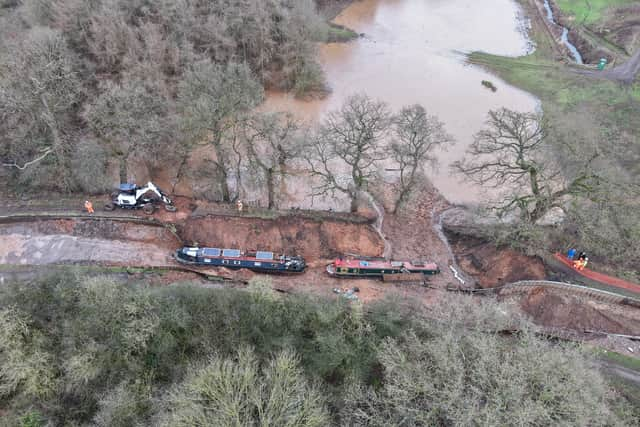
The terrain surrounding the giant collapse was exceptionally challenging: millions of gallons of water had flooded out of the canal as it opened up a huge chasm, which swallowed two boats.
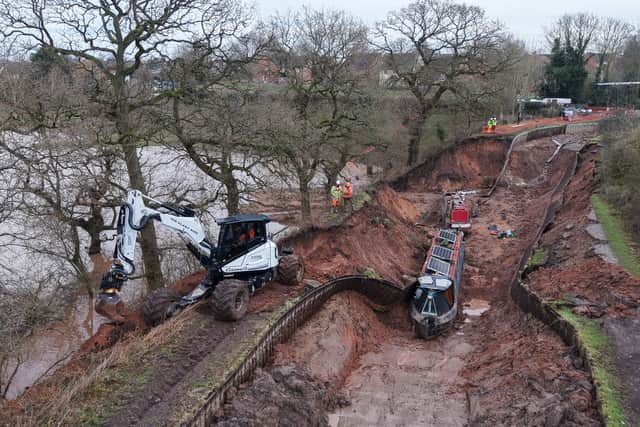
The spider was used to create a special trench to enable the stranded boats to be winched out, and to clear mud and debris which surrounded the boats.
The scene was covered in soft mud across different levels, making access incredibly difficult.
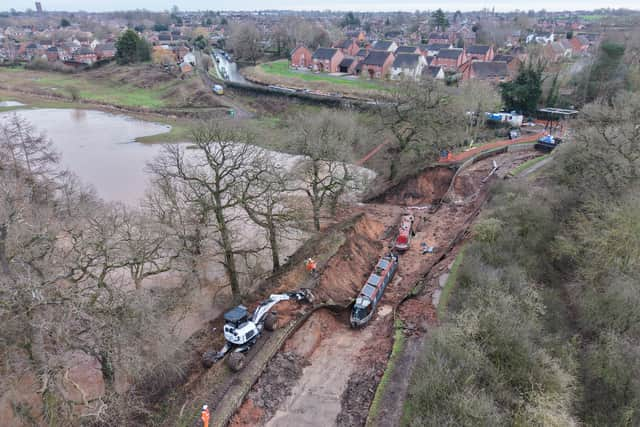

The spider was selected for its ability to dynamically adjust its legs by widening its stance to reduce ground pressure – a critical capability when operating on the weakened embankment with soft and unstable terrain surrounding the breach site.
The adaptive technology, all-wheel drive, combined with the machine's ability to navigate extreme gradients and uneven ground conditions, was essential for accessing boats stranded almost five metres below ground level, semi-submerged in the canal basin.
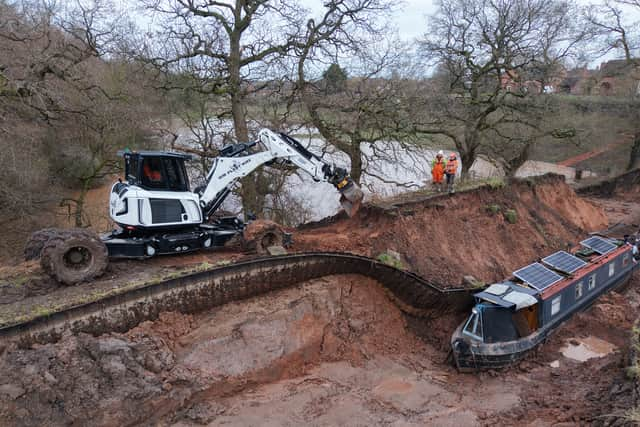
WM Plant Hire operates the UK's largest range of specialist long-reach and spider excavators and worked alongside recovery specialists Commercial Boat Services – repeat clients who have previously utilised the company’s specialist plant solutions.
Together, they supported the Canal & River Trust (CRT) in the delicate recovery operation.
Initial site safety preparations were completed by the CRT's framework contractor Kier and supply chain partners.
"This recovery operation exemplifies how innovative plant technology combined with extensive engineering expertise can solve challenging problems on site," said Damian McGettrick, managing director of WM Plant Hire and Fellow of the Institution of Civil Engineers (ICE).
"The spider excavator's ability to transform its configuration – manipulating the four ‘spider’ legs vertically and horizontally to adjust load, angle, width and height helps to reduce ground pressure and adapt to uneven terrain.
"It also boasts around double the power of a standard machine and has a ‘tilt-rotator’ to enable almost any angle and orientation of the bucket or attachment.
"This makes it uniquely suited to this delicate operation. As a local Shropshire company we are particularly committed to supporting the local community through this challenging situation."
The spider excavator's ‘Transformer-like’ capabilities enable it to dynamically spread its load across its four independent, adjustable legs, to step over obstacles, and maintain stability while performing precision excavation work with full 360-degree and tilt bucket rotation.
Matthew McCombe, operations director at WM Plant Hire and Fellow of the ICE, who worked alongside Mr McGettrick to develop the recovery strategy, said: "Our engineering backgrounds enable us to truly understand our clients' challenges and develop bespoke solutions. The spider's ability to navigate this terrain whilst protecting the weakened embankment demonstrates exactly why this technology is revolutionary for complex earthwork and geotechnical operations involving difficult access."
The recovery operation involved the spider excavator creating a stable ramp for winching operations whilst carefully removing accumulated silt from around the submerged vessels.
The machine's bio-oil operation aligns with strict water-quality and environmental considerations essential for the sensitive heritage setting.
"This project demonstrates how specialist plant solutions can reduce risk, minimise environmental impact, and accelerate recovery after infrastructure failures," added Mr McGettrick. "By avoiding the need for extensive temporary works or access roads, we're providing a more sustainable, cost-effective solution that gets this vital waterway operational again quickly."
Comment Guidelines
Iconic Media encourages reader discussion on our stories. User feedback, insights and back-and-forth exchanges add a rich layer of context to reporting. Please review our Community Guidelines before commenting.