
After £30K gold nugget was uncovered in Shropshire, we examine five other incredible treasure finds in the county
Treasure hunter Richard Brock's £30k find of a spectacular gold nugget in the Shropshire Hills has captured the imagination, but it's not the first time the county has been home to a stunning historic discovery.
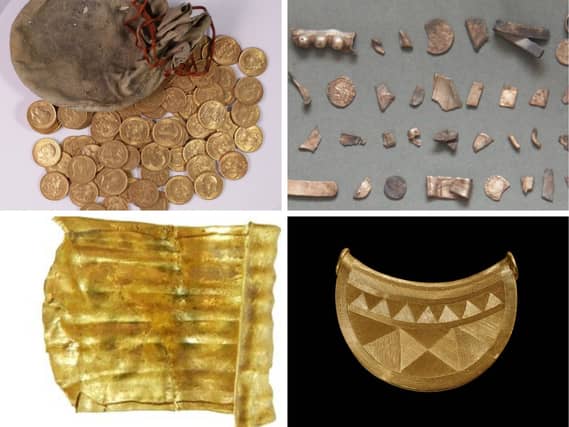


Throughout the years Shropshire's countryside has proved a rich hunting ground for enthusiasts trying to unearth a piece of history.
The are just five of the stunning and unbelievable finds revealed in recent years.
Cast your beady eyes on this
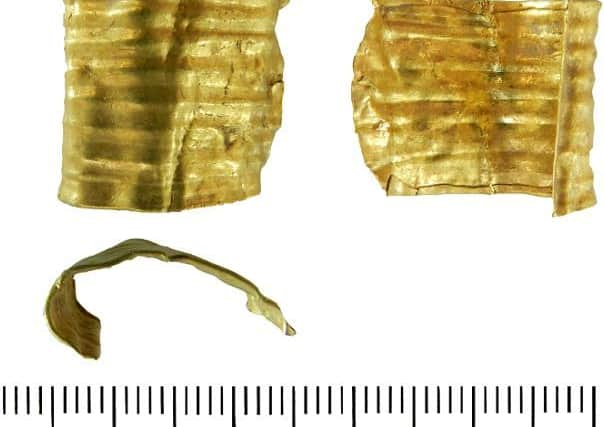
Back in 2016 treasure hunters in Wem found "one of the most important Bronze Age finds discovered in the county”.
The item, a gold bead, was said to date back around 4,000 years.
Peter Reavill, who was finds liaison officer for Shropshire at the time, said: “The gold fragment is relatively small but it is one of the most important Bronze Age finds discovered in Shropshire.
"It is about 4,000 years old being made at the very beginning of the Bronze Age when gold was incredibly scarce and important.
"Archaeologists call this period the Chalcolithic and it is when people first started to work with gold, copper and tin.
"The original owner would have been a very important person within the community and the find may have been passed down before being deposited.
"All we have is this tiny fragment and it is possible that it may have been lost after being damaged. It is much more likely that it was deliberately buried as a grave good in a ‘Beaker Burial’ under a round mound.
"The mound has subsequently been ploughed out by centuries of cultivation and all that remains of the grave is this small gift.”
Historic silver find gets seal of approval
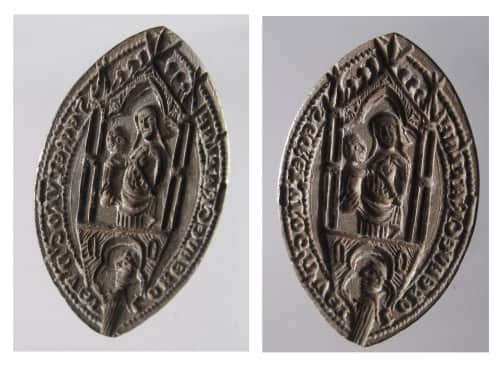
In 2017 a stunning 13th Century silver medieval seal was again found by a treasure hunter with a metal detector.
The seal, which would have been used to close, authenticate and officiate documents, was found on cultivated land near Wrockwardine.
The item had a handle on the reverse and a well cut detailed design on the front face.
The central design depicted a shrine of The Nursing Madonna and Child with a cleric in an act of prayer at its base.
She is hooded or veiled and is garbed in a tradition full length robe with a sash tied around her waist.
The scene is positioned beneath a gothic canopied arch supporting a roof which is topped with carved decorations.
The cleric is depicted below with his head tilted upwards as if looking towards the shrine. His hands are closed in prayer.
The inscription is formed from well cut neat medieval letters, which read: “SECRTV ROG’ D’ VEILOREAVE CLERI’ NR”, which can be interpreted as secret, or counter seal, of Roger of Veiloreave – Clerk.
The form of the name Veiloreave is unusual and it has been suggested that it is a place name which has been translated from Welsh.
The term clerk derives from cleric. The role of a cleric within the 13th and 14th centuries would have involved various administrative responsibilities at medieval courts, where they would have been entrusted with keeping records, as most laymen were illiterate.
A cleric could also be clergyman. The religious nature of the piece does suggest that this clerk was also a priest.
Shropshire's Find Liaison officer at the time, Peter Reavill said: “This type of seal matrix would have acted as a personal seal for the closing of letters or correspondence.
“The form is well known from other discoveries and is securely dated to the late 13th to early 14th century, most likely mid-14th Century c.AD1340 to 1410.
“The fact that it is exceptionally well made in good quality silver indicates that the original owner was relatively rich.
“As a cleric who could read and write Roger would have been an important person who potentially wielded considerable administrative power.”
Coins discovery certainly hits the right note
This horde was evidence that you don't always need a metal detector to find treasure.
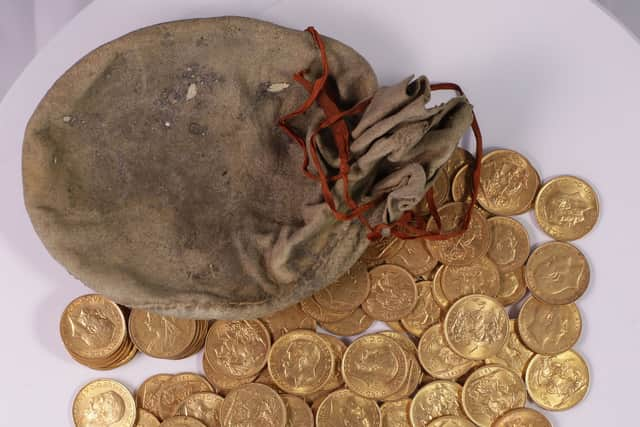
In this case 913 historic coins were found hidden inside a piano when it was sent to be re-tuned.
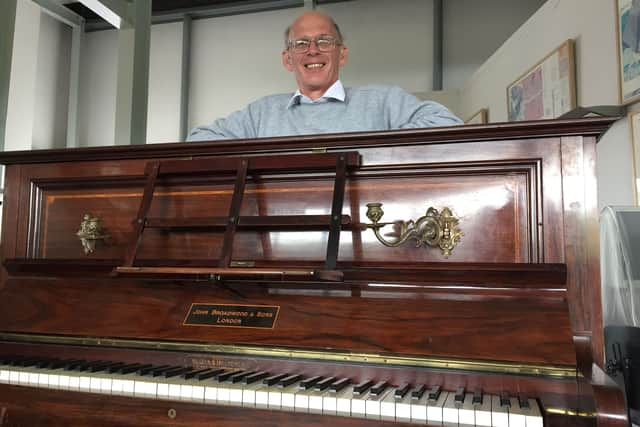
The haul, which was discussed at a 2017 treasure inquest, even sparked an international appeal to find out how they came to be hidden inside the Broadwood and Sons Piano.
The horde was made up of 633 full sovereigns and 280 half-sovereigns – estimated by the British Museum to be from 1847 to 1915.
For 33 years, the piano was owned by Graham and Meg Hemmings, formerly of Saffron Walden, Essex, who used the instrument to teach their children music – all the time being entirely ignorant of its secret cargo.
The couple, who moved to Shropshire in 2015, then donated the piano to Bishop’s Castle Community College, which then decided to have it tuned.
It was tuning technician, Martin Backhouse, who then found the ‘gob-smacking’ stash, initially believing the carefully-wrapped cloth packets interfering with the play of the keys, to be bags of ‘moth repellent’.
Speaking after the discovery Mr Hemmings said her only sadness was not knowing how the coins got there in the first place.
She said: “The sadness is, it’s not a complete story, they’ve looked and searched for the people and they unfortunately haven’t come forward. It’s an incomplete story – but it’s still an exciting story.”
The find was estimated to be worth £350k.
Trio find out what the Romans really did for us
Again it was metal detectorists coming up trumps – this time with one of the rarest finds of the British Dark Ages – The Wem Hoard.
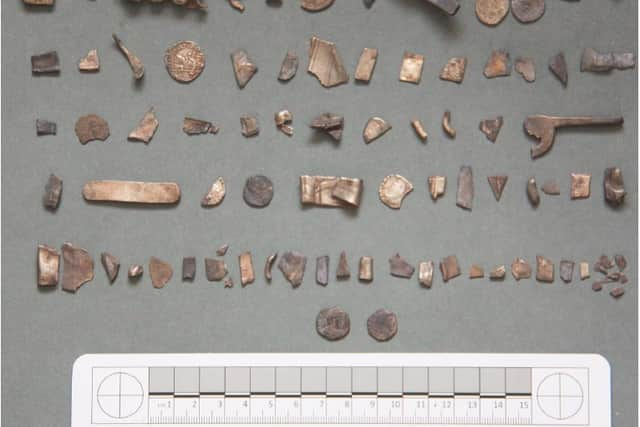
The discovery was according to experts, one of only six finds in the country of chopped-up silver and coins, known as hacksilver – the system of payment by bullion after the Romans left in the fifth century.
It was unearthed at a charity metal detecting event when three metal detectorists made their way to the furthest corner in a farmer’s field in October 2018.
Speaking at a treasure inquest, Shropshire's finds liaison officer Peter Reavill explained the significance of the discovery.
He said: "This is a hugely important discovery from the Dark Ages."
He said the 200 broken fragments included siliquae coins and a halved, well-worn denarius made in the first century and pressed back into service as a piece of bullion.
“The presence of a denarius in a hoard mainly comprised of siliquae is close to unique in Britain,” he added.
Mr Reavill explained that when the Romans left Britain they took with them their coinage monetary system.
The people that were left in the UK could no longer use coins and so instead cut or hacked up silver, whether coins, jewellery, cups or rivets from boxes to used as weighed bullion.
The find came courtesy of Steve Lord from north Wales, Steve King, from near Chester, and Andy Bijskerbosh, from Blackpool.
Mr Lord and Mr King had been on car park duty at the Whitchurch Lions charity dig on a farmer's fields near Wem, and decided to walk half an hour across the the furthest corner of land away from the hundreds of other metal detectorists who were at the rally.
"We had been talking about the one thing neither of us had ever found was a Roman silver coin," Mr King said.
"We started detecting and I saw Steve bend down and pick something up and he said 'you will never guess what I have just found'. It was a silver coin."
Having taken the frequency of the coin, Mr King then continued and within seconds found the same frequency and other coin.
Mr Bijskerbosh then joined them.
"The beeping and finds brought us closer and closer together until we were standing over a small patch of earth," Mr King said.
"We put a probe in and the signals went off the scale so we dug down about a foot and a half. Eventually I put my hand down into the soil - and brought up a huge pile of silver and coins, with the brooch sitting right on the top. It was incredible."
Bob hits the 'Bullas-eye'
Arguably Shropshire's most incredible find came in 2018 courtesy of the retired Oswestry engineer, Bob Greenaway.
The stunning discovery of the Sun Pendant, also known as a bulla, was made in the Shropshire Marches.
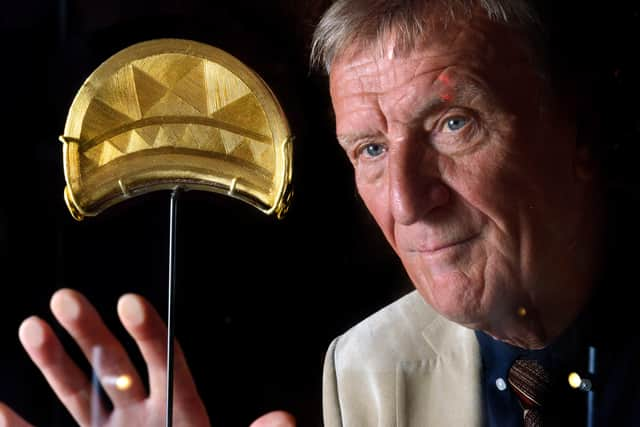
The piece, which is one of the most significant pieces of Bronze Age metalwork ever discovered in Britain, was bought by the British Museum for £250,000.
It went on display at Shrewsbury Museum & Art Gallery in 2021, before returning to the British Museum's permanent display.
The pendant dates from between 1000–800BC in the late Bronze Age period.
The elegant form and intricate decoration of the gold pendant includes an exceptionally rare depiction of the sun – not previously seen on objects found in Britain.
Solar symbolism was a key element of mythology and belief in the Bronze Age and the pendant celebrates the life-giving power of the sun during the time of the earliest metalworkers.
Speaking to the Shropshire Star back in 2021 Bob revealed his emotions upon realising what he had unearthed.
He said: "When I found it my eyes nearly popped out of my head. I put it in my hand and thought 'it's absolutely perfect'. I was so reluctant to turn it over in case it had a large hole or something.
"I put it in my top pocket, and made sure nothing was in there that might damage it. I did try to carry on metal detecting, but it wasn't happening.
"I had it for two days before I handed it in. I took hundreds of pictures of it."
He also revealed how he could have missed out on the discovery – if he had accepted an invitation to go away with a friend.
He said: "I found a hoard about a week before on the same field. I found three axes and a spear top.
"I handed those in on the Tuesday, then went back to the farm the Tuesday after.
"My friend did say 'Bob, would you like to come sailing', but I had to go back to that field."
Comment Guidelines
Iconic Media encourages reader discussion on our stories. User feedback, insights and back-and-forth exchanges add a rich layer of context to reporting. Please review our Community Guidelines before commenting.