
Hospitals 'accepting the unacceptable' with patients dying on corridors - West Midlands nurses share heartbreaking reality of A&E crisis
Nurses across the region have revealed heartbreaking details of A&E departments 'accepting the unacceptable' amid the ongoing crisis in hospital care.


The harrowing details are described in a series of first-hand testimonies from nurses on the frontline of the NHS crisis.
They have been gathered by the Royal College of Nursing, with Professor Nicola Ranger, General Secretary and Chief Executive, describing the findings as 'heartbreaking'.
In an impassioned plea for "investment in our workforce" she warns that without it the future of the "already broken" NHS will "becomes truly bleak".
The accounts of nurses specifically employed across the West Midlands make for sombre reading, frequently describing care as 'undignified', bemoaning a 'lack of privacy', and fundamentally unsafe conditions for treating patients.
They tell of patients left soaked in urine and encouraging family members to complain.
While the testimonies are anonymised - and the names of the hospitals are not included, they detail a pattern of "distressing and upsetting care" across the West Midlands.
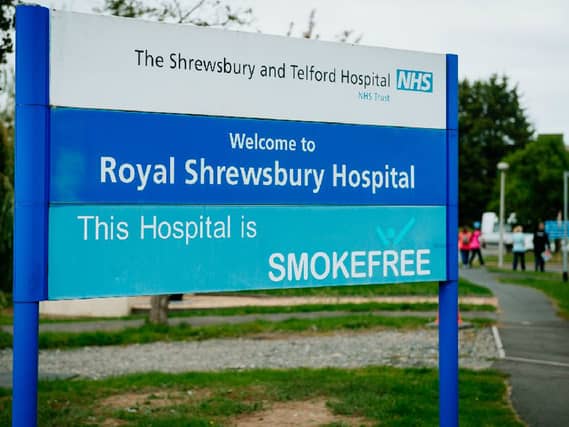
Shropshire's own problems with corridor care at Shrewsbury & Telford NHS Hospital Trust were revealed in a TV documentary last year.
At the Royal Shrewsbury Hospital A&E patients had been held in a corridor on trolleys due to a lack of space - with apologetic doctors carrying out examinations using makeshift screens put up in an attempt to maintain privacy.
The RCN's findings include accounts with nurses saying they would "hate" to see their family treated in the same manner, while others describe their impending retirement as a "window of hope" amid "undignified and dangerous" care.
The pressure on Shropshire's A&E departments, at Shrewsbury and Telford, has been in the spotlight again in recent weeks as they recorded the longest average waits for patients in the back of ambulances - across the entire country.
On New Year's eve ambulances waited for an average of four hours and 43 minutes to hand over patients.
The RCN report includes a host of shocking accounts from nurses across the West Midlands.
One said: "I work in ED (emergency department) and corridor care has become normalised. Without it the department would implode and cease to function.
"We don't need more nurses or more money to make ED work. What we want is the whole healthcare system to function and flow.
"We have some patients who spend days in ED waiting for a bed.
"I can retire, so I have a window of hope. But the younger nurses are stuck in this meat grinder of drudgery, slowly burning out.
"I also try to keep healthy because I know the standard of care I will receive in an NHS hospital is way below what we can give.
"It's broken and I no longer involve myself in recruitment as its hypocritical to suggest ‘ED is a great place to work'."
Another nurse told of her hospital, saying: "After appearing in a TV program, the corridor was closed for several weeks.
"Unfortunately from October 2024 the corridor was opened with four extra spaces being seen as normal, with another four in the ambulance receiving area made up of two which are used as rapid off loads for treatment of sepsis patients then two extra places one against the wall and one against the nurses station desk, one space in majors by the oxygen storage cupboard all became part of the escalation policy and Hospital Full policy.
"This is normal and to have 40 plus medical DTAs in the department."
One nurse told of her depressing experience treating patients on trolleys.
She said: "The patient was nursed in a corridor on a trolley. She was unable to mobilise and had been incontinent of urine. There was no way to provide personal care to the lady as there were no facilities available which we could wheel the trolley into, and we we unable to use the screens that we were provided to enable us to provide personal care in the corridor as they were blocking the corridor which is a fire exit.
"The lady had to remain in wet clothes and bedding until there was a bed space available for us to use.
"Once we had provided personal care we then had to return the patient to the corridor.
"I find it completely unacceptable that we cannot provide fundamental care to our patients and maintain their privacy and dignity. I felt desperately sorry that my patient was in that position through no fault of her own."
Another added that the dignity of patients "was not respected", saying: "Patients were on display in the department while acutely unwell and their privacy was not protected.
"We sometimes were unable to find a place to provide personal care for our patients and people were soiling themselves in the corridor."
Another described "knowing this was wrong" regarding corridor care, but added that they "have reached a situation of accepting the unacceptable."
One said they situation was "shocking", adding: "We don’t have the staff to care for these patients and they are adding unnecessary stress and pressure to nursing staff causing increased sickness.
"We struggle to provide personal care for these patients. We often find in ED that we are pressured by ambulance services to offload patients into corridors."
Another told of the impact on workers, saying: "We had staff already feel burnt out, undervalued and not listened too yet we are expected to just put up and shut up."
Amid scores of accounts of miserable A&E experiences one nurse says: "Having patients in corridor is now regular or the new normal, to ease AE over loading."
A colleague added: "Corridor care happens constantly. It is not a temporary solution, it is a permanent solution that is falsely labelled as temporary."
Another said: "15 patients on a corridor, not enough space for everyone to have care delivered in the one cubicle used to take patients to the toilet.
"I have been asked to put patients on the corridor with broken hips, palliative and quadriplegic patients who can not use a call bed or ask for help. Undignified and dangerous."
The report details how the overcrowding leads to staff relying on families to look after patients.
One nurse said: "I did not come into this profession to witness this mess which is occurring. It’s distressing and upsetting."
Another added: "Family members are relied on to monitor their loved ones as there are so few staff, many displaced from their usual areas and not familiar with emergency care. I have worked in the NHS for 40 years and have never felt so inadequate as a nurse."
Reacting to the report Duncan Burton, Chief Nursing Officer for England, said: "Increasing levels of demand have resulted in extreme pressures on services, particularly over recent months and one of the toughest winters the NHS has experienced. The impact this has on the experiences of patients and staff, as highlighted by the RCN report, should never be considered the standard to which the NHS aspires.
"Despite the challenges the NHS faces, we are seeing extraordinary efforts from staff who are doing everything they can to provide safe, compassionate care every day. As a nurse, I know how distressing it can be when you are unable to provide the very best standards of care for patients.
"That is why, building a health service that is fit for the future is a key priority for the NHS and government and the NHS is continuing to work hard to deliver improvements across urgent and emergency care for patients and our staff."
Comment Guidelines
Iconic Media encourages reader discussion on our stories. User feedback, insights and back-and-forth exchanges add a rich layer of context to reporting. Please review our Community Guidelines before commenting.