
Fascinating history revealed as metal detectorist unearths his first treasure in 40 years in Shropshire
The ancient pendant may have contained herbal medicine to treat severe poisoning

A metal detectorist who has been searching Shropshire’s fields for 40 years has unearthed his first piece of treasure - and learned of its fascinating history.
Colin Corden discovered a late medieval gold reliquary cross in a farmer’s field in Church Aston, Newport while out with the North Staffordshire Metal Detecting Club.
The stunning pendant, which dates back to between 1300 and 1500AD, is shaped in the form of the Greek letter Tau - the 19th letter in the Greek alphabet.
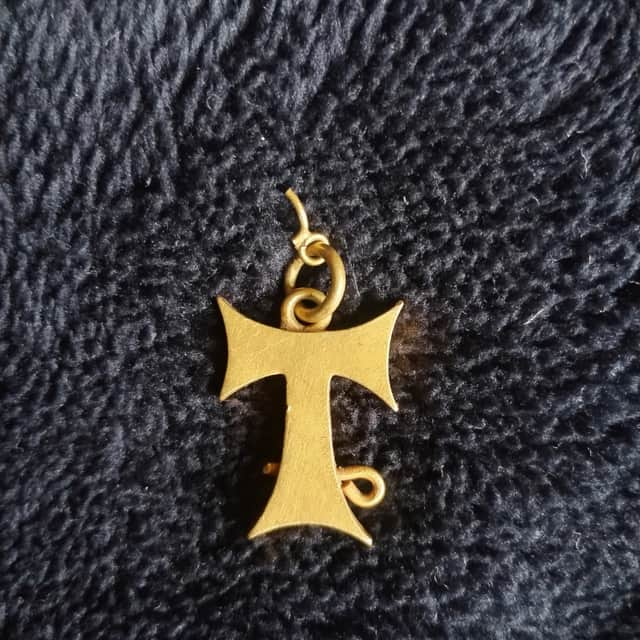

And it may have been used to carry herbal medicine for St Anthony’s fire - a severe poisoning people got from eating fungus-infected rye or cereal.
The cross has garnered interest from Shropshire Museums, but Colin, who found the piece on September 14 last year, has not yet been given any indication of how much money it might be worth.
“We’d been on the field the previous week but the farmer hadn’t worked the field,” he said.
“We were going over the same ground and it showed up.
“This is the first time I’ve found something that’s been deemed to be treasure.”
Colin, who lives near Stoke-on-Trent, Staffordshire, tends to go out metal detecting in Shropshire and Staffordshire, and plans on broadening his searches to Cheshire this weekend.
An inquest at Shropshire Coroner’s Court, Guildhall, Shrewsbury, took place on Tuesday (August 25) to determine whether or not the item meets the criteria to be declared treasure.
Teresa Gilmore, finds liaison officer for East Staffordshire and North West Midlands, prepared a report into the cross which described it as “a complete gold, probably hollow reliquary cross pendant”.
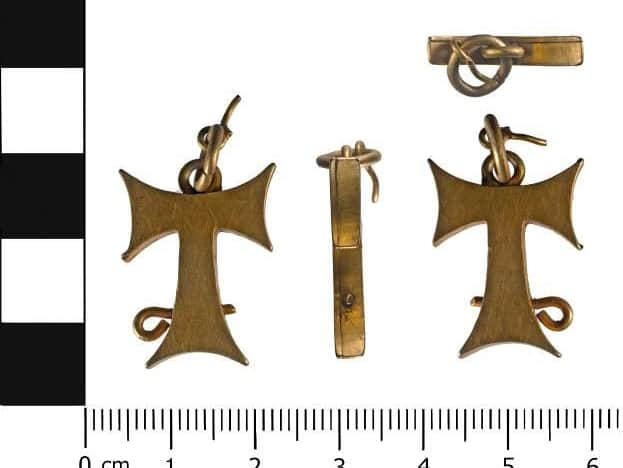
The report added: “The pendant is in the form of the Greek letter Tau and consists of two elements; the hollow walled container front and the flat back cover plate. No decoration is present on either the front or back panels.”
The reliquary is 24.8mm long, 18.7mm wide, 4mm thick and weighs 10.3g.
“These Tau crosses acted as miniature reliquaries which are thought to have contained a herbal compound that was used to treat the symptoms of St Anthony’s fire,” the report said. “Hence the possible association with the depiction of St Anthony.”
This cross had not been opened to discover if anything was contained inside.
Similar pendants have been found in Britain, including a gold, decorated one in North Lincolnshire.
The jewellery is more than 300 years old and contains “well in excess” of 10 per cent precious metal, so it was declared treasure by John Ellery, senior coroner for Shropshire, Telford and Wrekin.
Comment Guidelines
Iconic Media encourages reader discussion on our stories. User feedback, insights and back-and-forth exchanges add a rich layer of context to reporting. Please review our Community Guidelines before commenting.