
Weird weather: Why we’re chilly as rest of Europe bakes
Record temperatures across Europe, but distinctly chilly here.
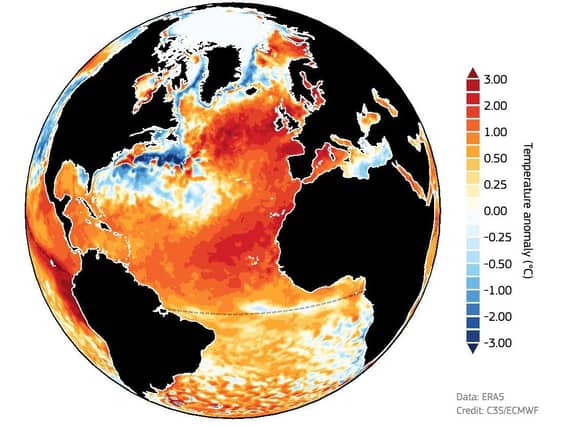

Unlikely as it sounds, both weather events are connected. Our continent is trapped in a period of ‘blocked weather’ and while it is bringing temperatures into the 40s in Italy and Spain, we are suffering sunshine and showers.
Much as we like a hot summer, we are currently the lucky ones.
It isn’t just Europe that is suffering from severe heat. In terms of weather, the extraordinary is now becoming worryingly routine.
Death Valley on California’s border with Nevada is approaching its highest ever temperature, with 53.33C (128F) at the aptly-named Furnace Creek. Las Vegas has also faced the possibility of reaching an all-time record temperature and wildfires in Canada have led to air quality alerts in several US states, stretching from Montana to Ohio.
The hottest temperature ever recorded on Earth was 56.67C (134F) in July 1913 at Furnace Creek, according to an official at the World Meteorological Organisation. Temperatures at or above 54.44C (130F) have only been recorded on Earth a handful of times, mostly in Death Valley.
“With global warming, such temperatures are becoming more and more likely to occur,” the World Meteorological Organisation said.
“Long-term, global warming is causing higher and more frequent temperature extremes. Short-term, this particular week is being driven by a very very strong upper-level ridge of high pressure over the Western US.”
In Europe, a shift in the jet stream has had a profound effect.
The bank of fast-moving air high in our atmosphere dictates the kind of weather that will be passing by.
A distinctive kink in the jet stream has taken it southwards and pushed hot dry air from Africa across much of southern and central Europe. But it has also left the UK trapped in a cycle of cooler air and weather fronts coming in from the Atlantic.
Many of the global ups and downs are also caused by the natural El Nino and La Nina cycle. An El Nino cycle, the warming of part of the Pacific that changes the world’s weather, adds even more heat to the already rising temperatures.
Scientists such as NOAA climate analysis chief Russ Vose said most of the record warming the Earth is now seeing is as a result of human-caused climate change, partly because this El Nino only started a few months ago and is still at a weak-to-moderate stage. It is not expected to peak until the winter, so scientists predict next year will be even hotter than this year.
The impact now is profound, not just for holidaymakers struggling to keep cool in the heat.
Spanish authorities say more favourable weather conditions have helped firefighters slow down the advance of a wildfire on La Palma in Spain’s Canary Islands that had forced the evacuation of more than 4,000 residents.
The blaze affected an area of about 4,600 hectares (11,300 acres) and burned some 20 houses and buildings.
In southern France, human-caused climate change is lengthening droughts, meaning the reservoirs are increasingly drained to lower levels to maintain the power generation and water supply needed for nearby towns and cities.
It is concerning many in the French tourism industry, who are working out how to keep their lakeside businesses afloat in the long term if water levels remain low or unpredictable.
Water levels in the reservoirs are set and managed by national energy giant EDF, which operates the dams.
Last year, the low water levels from a lack of snow and rain in the spring meant the company was forced to draw on the reservoirs to keep hydroelectric power going and water pipes in southern France flowing for drinking and agriculture.
Heatwaves are not as visually dramatic as other natural disasters, but experts say they are more deadly. A heatwave in parts of the South and Midwest United States killed more than a dozen people last month.
It is also a worldwide phenomenon, with devastating heat hitting Europe along with dramatic floods in the US North-East, India, Japan and China.
For nearly all of July, the world has been in uncharted hot territory, according to the University of Maine’s Climate Reanalyser.
June was also the hottest June on record, according to several weather agencies.
Scientists say there is a decent chance that 2023 will go down as the hottest year on record, with measurements going back to the middle of the 19th century.
Death Valley dominates global heat records. In the valley, it is not only hot, it stays brutally warm.
Some meteorologists have disputed how accurate Death Valley’s 110-year-old hot-temperature record is, with weather historian Christopher Burt disputing it for several reasons, which he laid out in a blog post a few years ago.
The two hottest temperatures on record are the 55C (134F) noted in 1913 in Death Valley and the same in Tunisia in July 1931.
Mr Burt, a historian with The Weather Company, finds fault with both of those measurements and lists a figure of 54.4C (130F) in July 2021 in Death Valley as his hottest recorded temperature on Earth, saying that “130 degrees is very rare, if not unique”.
There are other places similar to Death Valley that may be as hot, such as Iran’s Lut Desert.
But these are uninhabited so no-one measures there, Mr Burt said. An official weather station was established in Death Valley in 1911.
A combination of long-term human-caused climate change from the burning of coal, oil and natural gas is making the world hotter by the decade, with ups and downs year by year but the overall trend being one of a planet being warmed.
Comment Guidelines
Iconic Media encourages reader discussion on our stories. User feedback, insights and back-and-forth exchanges add a rich layer of context to reporting. Please review our Community Guidelines before commenting.