
Huge webs in a Herefordshire hedge – find out what it is and what creature has made it
Huge webs in a Herefordshire hedge – find out what it is and what creature has made it!
Huge webs in the countryside – no, Halloween hasn’t come early!
A sinister-looking silken web has covered a hedge along a Herefordshire main road – but it’s caterpillars, not spiders, responsible for the spooky look in June.
The extensive web by the B4362 between Shobdon and Presteigne has been spotted by numerous motorists in recent days.
And though many may fear a spider invasion, they can rest assured that the stunning work is down to ermine moth caterpillars.
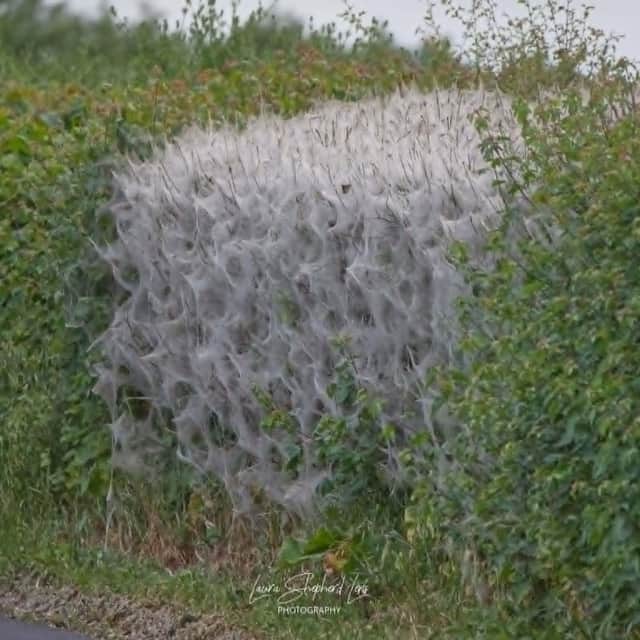

Presteigne-based photographer Laura Shepherd got some stunning shots of the web.
She said: “I instantly thought ‘Halloween!’ Then I thought it was spiders.
“It’s just huge. I believe it's moths. What a natural wonder of nature.”
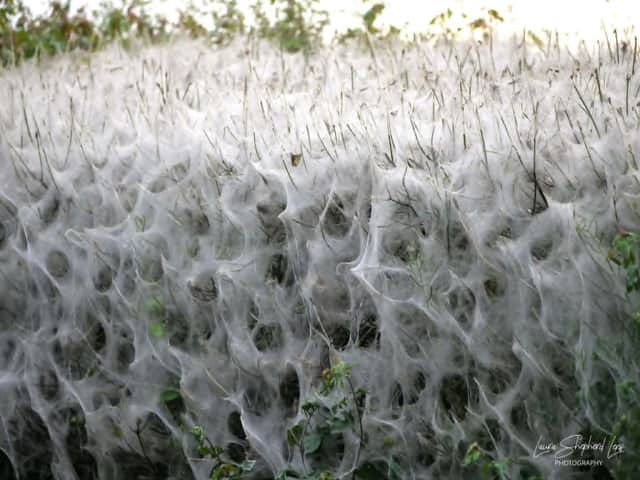
Another resident, Barbara Roberts, also photographed the web. She said: “I thought it was a spider web.
“I just jumped out of the car and took the picture, now I know it’s caterpillars it looks amazing and the work in it was incredible. I had no idea what it was at first, but it looked beautiful.”
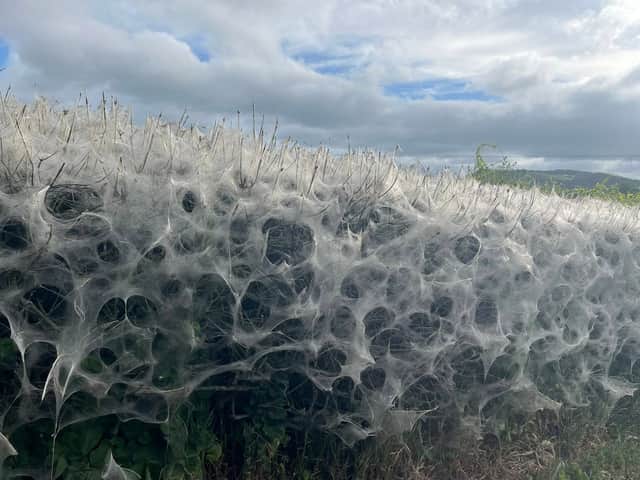
Butterfly Conservation said the webs are often seen around May, as hundreds or even thousands of caterpillars seek to protect themselves from predators; their strategy of safety in numbers also makes them vulnerable as it’s is harder to hide in large numbers.
The caterpillars and webs are harmless and usually only last from May to June. The shrubs and trees beneath the webs are often stripped of leaves, but generally recover.
Mark Parsons, head of moth conservation at Butterfly Conservation, said: “These striking and obvious webs hide hundreds and sometimes tens of thousands of caterpillars of a group of moths called the small ermine moths.
“Sometimes these webs are so extensive that they can cover nearby objects such as benches, bicycles and gravestones.
“Why do these species spin these webs and live together in such large numbers? It's a successful evolutionary strategy, providing protection from predators through safety in numbers. However, numbers are hard to hide and hence the production of the silken webbing.
“The webs slowly disappear over the summer and typically the hedgerow shrubs/trees recover. The adult moths fly later in summer and all look superficially similar, being white or greyish with many small black dots, hence the ermine name.”
Comment Guidelines
Iconic Media encourages reader discussion on our stories. User feedback, insights and back-and-forth exchanges add a rich layer of context to reporting. Please review our Community Guidelines before commenting.