
Convicted Shrewsbury killer's death subject of coroner's report as concerns raised over his treatment
The 40-year-old died after collapsing at a meeting with a probation officer

A coroner has raised concerns over the death of a convicted killer who died after collapsing at a probation service meeting.
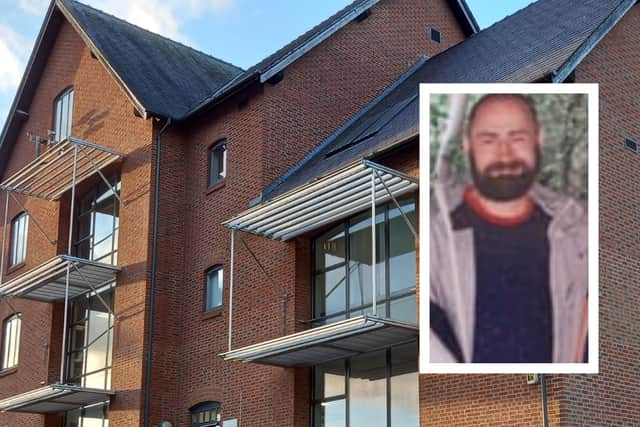
Wayne Austin, aged 40, took unwell in a meeting at Shrewsbury Probation Office in Abbey Foregate, Shrewsbury on October 10, 2024. He died at Royal Shrewsbury Hospital later that day.
Get the latest headlines delivered straight to your inbox with the Shropshire Star’s free newsletter
An inquest into his death at Shropshire Coroner’s Court, Guildhall, Shrewsbury was told that paramedics on the scene struggled to access the correct information for administering naloxone - a fast-acting antidote to treat drug overdoses.

It was also said that ambulances only carry 10 vials of the drug - meaning that to treat a patient who has overdosed on opioids, it would require three ambulances to attend the scene.
Now Heath Westerman, deputy coroner for Shropshire, Telford and Wrekin, has written a Prevention of Future Deaths report, raising his concerns about the treatment Austin received.
In the report, which has been sent to West Midlands Ambulance Service (WMAS) and the Joint Royal Colleges Ambulance Liaison Committee (JRCALC), Mr Westerman wrote: “Wayne Austin attended a meeting with his probation officer. He was asked if he had consumed any illicit drugs, which he denied, but confirmed he had drunk some cider.
“He collapsed and CPR was undertaken and WMAS called.
“Two ambulances attended and paramedics were informed by an unknown female outside that Wayne had earlier consumed crack cocaine.
“WMAS paramedics therefore began advanced life support (ALS) and sought guidance from the JRCALC app on naloxone administration.
“They found the guidance confusing and experienced difficulties identifying and accessing the correct guidance and so opened the first available tab: ’Dosage table: IV/IO – Respiratory arrest/depression’, which confirms an initial dose of 400mg then further doses of 400mg every three minutes until a maximum of 4000mg delivered.
“The paramedics provided a first dose of 400mg at 2.45pm with further 400mg doses at 2.50pm, 2.55pm, 3pm and 3.05pm when a return of spontaneous circulation was achieved and medication was paused.
“No further naloxone was administered and Wayne was transferred to The Royal Shrewsbury Hospital. They could not comply with administering doses every three minutes due to other competing tasks such as continuing with ALS, administering oxygen, adrenaline and sodium chloride.
“The paramedics did not open and apply the correct tab. The JRCALC app has five tabs for naloxone, the fourth tab being the appropriate one in the circumstances: ‘Dosage table: IV/IO Cardiac arrest (where opioid toxicity is the likely cause).”
He added: “During the course of the inquest, the evidence revealed matters giving rise to concern. In my opinion there is a risk that future deaths will occur unless action is taken.”
The concerns Mr Westerman raised were the difficulties paramedics had finding the correct information, their inability to comply with the guidelines for respiratory arrest/depression due to too many competing tasks, and the number of vials of naloxone in the ambulance being too low to administer enough doses to an opioid overdose patient.
“In my opinion, action should be taken to prevent future deaths and I believe you (and/or your organisation) have the power to take such action,” Mr Westerman wrote.
WMAS and JRCALC have 56 days to respond with details of action taken or proposed to be taken, setting out the timetable for action. Otherwise they must explain why no action is proposed.
Austin, of Bicton Heath, Shrewsbury, was jailed in 2011 after pleading guilty to the manslaughter of Paul Wayne Rugg.
He stabbed Mr Rugg to death at his flat in Kynaston Road, Harlescott, Shrewsbury in January 2010.
Austin had only recently been released from prison when he collapsed in the meeting with a probation officer.