
The other Wolverhampton-born Billy Wright, a Loyalist paramilitary gunned down in prison
Google Billy Wright, Wolverhampton, and another surfaces.
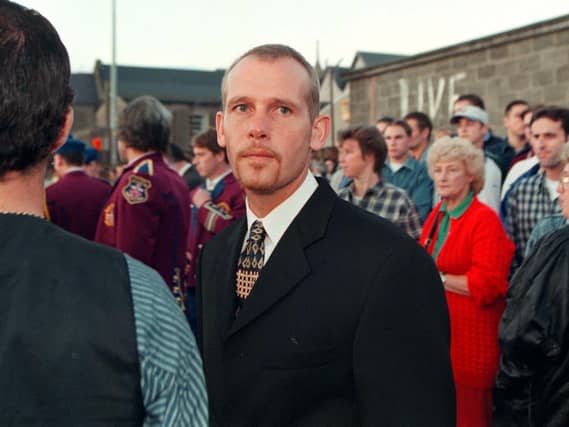


A man far removed from the Old Gold legend whose magic lit up Molineux Stadium, who become a national treasure on the terraces.
Look closely at the other Billy Wright, the cold eyes, pursed lips framed by Pancho moustache, his stare cold and intimidating.
This Billy Wright from Wolverhampton is named through fear, not football, a man whose role as conductor of violence during Northern Ireland’s Troubles earned him the title “King Rat”. He also, allegedly, raked-in cash through drug deals and protection rackets.
Yes, one of the mayhem’s major players was from the Black Country, born in Wolverhampton.
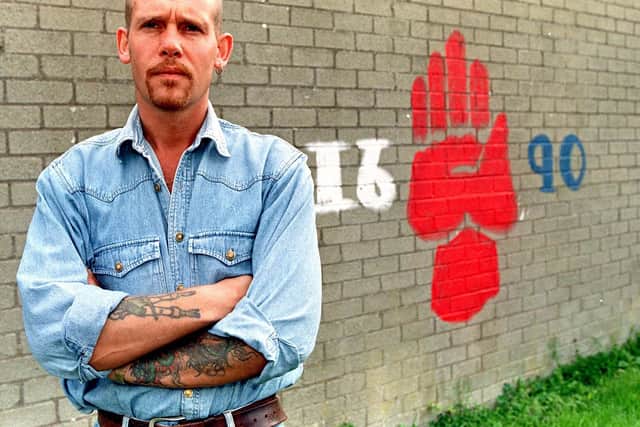
One Billy Wright was a saint, the other a sinner – and he looked the part. He was 6ft tall, muscular, heavily tattooed and with close-cropped blond hair and piercing blue eyes.
The Loyalist paramilitary Mr Big lived up to his King Rat moniker until rubbed out by Republican hitmen inside notorious Maze Prison.
Such was Wright’s ruthlessness, some of his own Unionist colleagues called him “Billy Wrong”. Behind his back, of course.
This Billy Wright was linked by police to 20 sectarian killings – though never convicted of murder – before being shot as he sat in a van on H Block 6 forecourt. On a cold December morning in 1997, two smuggled pistols ended the reign of a 37-year-old who founded the ruthless Loyalist Volunteer Force.
In the years that followed the other Billy Wright’s death, two questions have been asked loudly and repeatedly:
* Was he in cahoots with the Royal Ulster Constabulary’s special branch? More specifically, did Wright become an informer and, in return, did special branch provide information on IRA suspects, protection and alibis.
* Did the authorities – believing Wright, considered a maverick by the Loyalist hierarchy, posed a threat to the fledgling peace process – collude in his assassination? An enquiry into the killing uncovered major Maze security flaws, but no evidence of state involvement.
The government has refused to dub Northern Ireland’s conflict a war, but it was, to all intent and purpose, an extremely dirty war.
And a man born in the West Midlands was knee deep in the blood, mud and murderous conspiracies. A Black Country man who was a complex mess of contradictions, attempting – and failing – to balance his terrorist beliefs with his love of God. He even spread the Bible’s message as a Protestant fundamentalist preacher.
“I would hope that He would allow me to come back,” Wright once said. “I'm not walking with God. Without getting into doctrine, without getting too deep, it is possible to have walked with God and to fall away and still belong to God.”
For him, it could only be war without end and it could not be a holy war. There could never be a truce with Republican paramilitaries. Others grew a conscience; Wright had no regrets.
As Ulster Freedom Fighter John Adair recalled: “He was just 24/7 hours at trying to bring the Republicans on their knees. And that was what most of his life revolved around.”
In a Guardian interview, Wright told reporter David Sharrock: "I met very few brave IRA men, to their own shame. Ninety per cent of their senior officers left the battlefield; they ran away, they headed south. That's the nature of them – they want to kill, but they don't want to be killed.
"The difference between them and us is that loyalists have nowhere to run. The IRA learned to kill when it wanted to and then withdraw. That was no way to fight a war.”
The words drip hatred.
It is a long way from Tettenhall or Three Tuns to the heartland of the Troubles, yet Billy Wright – named after his grandfather, not the Wolves and England captain – made the journey.
Dad David came in search of factory work. He and wife Sarah had five children, with Billy, born on July 7, 1960, being their only son.
It is a long journey, yet Billy’s fiercely political family background primed him for the trek. His grandfather ruffled feathers by successfully standing as an Independent Unionist candidate in elections and was later hounded for defeating the Official Unionist MP.
The ill-feeling drove the Wrights to Wolverhampton. Billy returned to Northern Ireland in 1964 following the breakdown of his parents’ marriage. He was placed in a children’s home.
There, while a part-time, schoolboy farm worker, Wright listened to the hardline Unionist views of labourers and became a cadet to the cause.
His rise through the ranks began with childish vandalism that revealed the indoctrination he had been subjected to. Young Wright scrawling “UVF” (Ulster Volunteer Force) on a Catholic primary school wall and moved from Markethill, County Armagh, after refusing to scrub away the graffiti.
From there, the deeds became darker and the punishments stiffer as Wright steadily climbed the paramilitary ladder.
In July, 1975, he joined The Young Citizen Volunteers, a UVF youth group, and shortly after received a five year sentence for illegally possessing weapons.
On his release, his strides to positions of power within the UVF were rapid. He became head of the Portadown Unit, then, by the start of the 1990s, commander of the UVF’s ruthless Mid-Ulster Brigade which saw its bloody reputation peak with the fatal shooting of three IRA men and a innocent civilian in Cappah, County Tyrone.
Whether Wright was involved in the 1991 murders – he was arrested but had an alibi – is still a matter of debate.
But he certainly endorsed the attack, telling the Guardian: "I would look back and say that Cappagh was probably our best."
Wright first embraced the peace process, then despised it as a “sell out”. Angered by his refusal to buy into it and, more importantly, abide by a ceasefire, the UVF booted out Wright in 1996 – and told to leave Northern Ireland or face execution. He didn’t.
The IRA had already tried to kill King Rat on five occasions, now his former allies wanted him removed.
A violent end was inevitable, his days numbered, and Wright knew it. He said: “I've been prepared to die for long many a year. I don't wish to die, but at the end of the day no one will force their opinions down my throat – no one.”
Wright showed that by launching his own rival firm, the Loyalist Volunteer Force which gathered 250 men and vowed to “restore Ulster's right to self-determination, to end Irish nationalist aggression against Ulster in whatever form”.
The inevitable end came while Wright served an eight year sentence for making death threats and committing an act with intent to pervert the course of justice.
It came while Wright discussed the spiralling cost of Christmas with others in the van – one gunman shouted “f*** up” before squeezing the trigger. It came in a hail of seven bullets.
And few behind-bars murders have been carried out so publicly. When the three Irish National Liberation Army hitman had completed their assignment, they walked calmly to prison guards and presented a statement: “Billy Wright was executed for one reason and one reason only, and that was for directing and waging his campaign of terror against the nationalist people from his prison cell.”
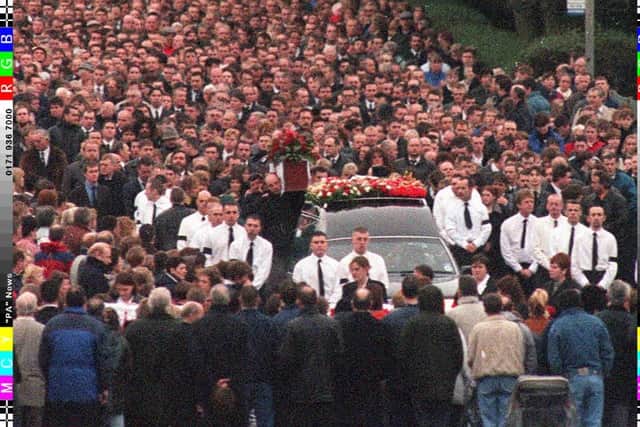
Billy Wright was buried in Portadown with full paramilitary pomp. Before it, four masked LVF gunman maintained a vigil at his open casket. During it, all shops were shut as a mark of respect, all taxis and buses grounded, the Union Flag fluttered at half-mast.
Thousands watched the hearse, proceeded by a lone piper, move slowly to Seagoe Cemetery where a volley of shots were fired over the coffin.
In hindsight, Wright cast such a long, dark shadow over Northern Ireland’s conflict, it was inevitable conspiracy theories would lurk under it.
Was he an agent for the State?
In an interview broadcast this year by BBC NI’s Spotlight programme, convicted Loyalist killer Laurence Maguire said: “I think it came to light he was definitely working for somebody else. I just call it the Crown.”
Former Police Ombudsman Baroness Nuala O’loan said: “We know Billy Wright was an informant.”
In an official statement, Sinn Fein has said: "It is our firm view that Wright and others were controlled, directed and manipulated by the British state."
Was there State collusion in his murder, as Wright’s family believed?
A far-reaching, five year inquiry, costing £30million, ruled that out, but concluded “serious and profound failings in the system” led to the killing: so profound they near beggar belief.
Police had failed to pass on intelligence gathered about threats to Wright’s life. The guns had been smuggled into the Maze, an internal fence had been cut, a roof was insecure and the victim’s name was called out over the Tanoy system, signalling his move to the prison van.
This cocktail of cockups “stretched coincidence to breaking point”, said The Democratic Unionist Party.
In his last interview, Billy Wright wished "I could just be somewhere where nobody knows me."
That’s the big difference between him and our own Billy Wright. Our Billy always wanted to be a part of Wolverhampton.
There’s another difference.
They painted a huge image of the other Billy Wright on a wall close to Portadown Football Club’s Shamrock Park ground. They removed it in 2006.
In 1996, they erected a statue to our own Billy Wright outside Molineux, setting for many of his soccer miracles.
That will never be torn down.