
Cameron and Clegg get to work
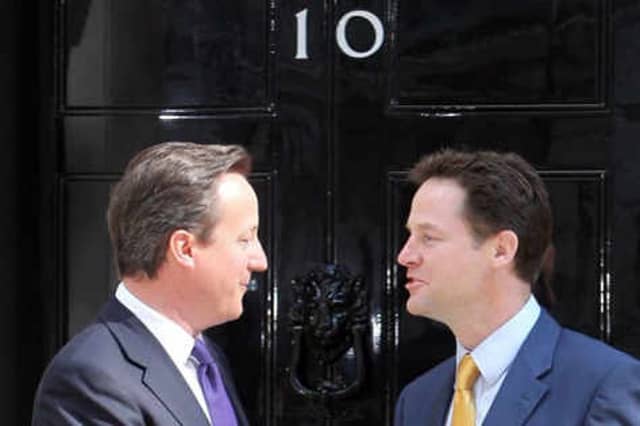

NEW PRIME Minister David Cameron and deputy Nick Clegg today set to work appointing key figures to Britain's first coalition government for 70 years.
NEW PRIME Minister David Cameron and deputy Nick Clegg today faced the world's media and promised not just a new government but new politics for Britain.
The pair appeared side-by-side at a joint press conference in the gardens of Number 10 Dowing Street, to outline their plans for the country's future.
The press conference came after a day which saw Mr Cameron and Mr Clegg appoint key members of the first coalition government for more than 65 years.
Top level posts were handed to George Osborne, Theresa May, William Hague and Ken Clarke. The Liberal Democrats have five posts on the new Cabinet.
Mr Cameron said the coalition was formed around three key principles of freedom, fairness and responsibility.
The Tory leader said the "national interest is more important than the party interest".
Rivals
He added that compromise in government should not be seen as a sign of weakness but "as a sign of our strength".
He said the new coalition would help change the face of politics across the country.
Mr Clegg said: "Until today we were rivals, now we are colleagues and that says a lot about the new politics."
Mr Clegg pledged the coalition government would last and it would be a source of reassurance and stability.
Earlier today the pair met at Number 10 Downing Street to begin forming the new Cabinet.
Following a late-night meeting of Lib Dem MPs and the party's federal executive to endorse the deal, Mr Clegg sought to reassure his supporters who were unhappy at the idea of a coalition with the Tories.
He said: "I want to assure you that I wouldn't have entered into this agreement unless I was genuinely convinced that it offers a unique opportunity to deliver the kind of changes you and I believe in."
Mr Hague said today the coalition represented a "realignment" of British politics.
He revealed that a document setting out the terms of the coalition would name areas - including the married tax allowance, nuclear power and university funding - where Liberal Democrats will be allowed to abstain from Government measures.
Mr Hague said he hoped there would not be any "difficulties" over the issue of the European Union.
"We have written into this agreement that we agree there should be no further transfer of sovereignty or powers over the course of the next Parliament, and that was not a difficult item to agree with the Liberal Democrats."
But he said on the broad range of policy, the parties had been able to agree a platform which both could push forward.
Mr Hague confirmed the new Government intends to introduce fixed-term Parliaments, with the next election to be held on the first Thursday of May 2015.
"This Government will be judged by whether it really brings down the deficit, reforms taxes so there is a fairer tax system, and improves the education system, not by whether it reannounces and misannounces and falsely announces a whole string of things every day, which was the style of the Blair and Brown years," said Mr Hague.
Mr Hague said Britain's first coalition for 70 years would require some "innovations" in the way Government operates.
He Hague acknowledged there would be some people on both sides who would find the arrangement difficult to accept. But he said Mr Cameron and Mr Clegg had already shown they had a "very good working relationship".
Details of the power-sharing arrangements hammered out over five days began to emerge last night following Gordon Brown's resignation and Mr Cameron's appointment as Prime Minister.