
Britain's most haunted road? The spooky stretch where a real mystery killer struck
It is, to commuters, a fairly nondescript stretch of A-road, an asphalt lane running through countryside that has never inspired artists to reach for their easels.


Constable would’ve certainly given the strip a wide berth.
Yet this mere five mile segment of the A513, running from Milford Common, on the outskirts of Stafford, to Wolseley Bridge, on the fringes of Cannock Chase, is the country’s most significant highway on any supernatural sat nav. It is the route of all evil on the route planners of psychics.
This small link of the A513 is - X Files magazines and websites agree – Britain’s most haunted road. And the countryside bordering it has been christened the UK’s “Paranormal Pyramid” following a string of ghostly sightings.
Travel along the bland tarmac ribbon and a bump in the night may be more phantom than mere flat tyre, a poltergeist rather than pothole, say believers.
The catalogue of paranormal activity includes a pedalling poltergeist, beautiful female spectre that only roams on Wednesdays, ghost in “Puritan” garb and more flying saucers than you can shake a shaky camera at.
And the A513’s undead travellers have spread their power to the surrounding acres, with Seven Springs, woodland that is a mere stone’s throw from Wolseley Bridge, a particular hotspot.
According to folklore, spirits have strolled with unsuspecting hikers at the beauty spot for hundreds of years. Some visitors have even glimpsed the “Spectre of Seven Springs”, a beautiful, veiled woman who glides gracefully between the trees.
After she made herself known to a number of startled nearby residents, local paper the Stafford Advertiser despatched a reporter to hunt the lady down – on the night of Christmas Eve, 1949.
This spawns two questions that are very much of this world: what kind of a hard-bitten editor sends one of his staff on a Christmas Eve midnight ghost hunt?
Did any young journalist, with more ambition than sense, volunteer for such a vigil?
Unsurprisingly, the young man failed to clinch an interview with the phantom. In his shoes, I would’ve hit the pub, drank myself dizzy and dragged an imaginary account of the search – apparently on a very cold night – through the fog of my hangover a few days later.
The lad did, however, paint a very compelling picture for readers: “Seven Springs is a well-known Cannock Chase beauty spot where many Staffordians will have happily picnicked and walked their dogs…by day.
“Come the night, the scene is changed. There is no warmth in the air; eerie shadows are thrown by the gaunt-limbed trees. Just the atmosphere for a ghost, in fact. A vicious, headless ghost, perhaps, with rattling chains and blood-curdling groans.
“But the Spectre of Seven Springs is quite different. She is…very beautiful, her hair falls in tresses about her shoulders, her eyes are clear, but seem filled with unhappiness.”
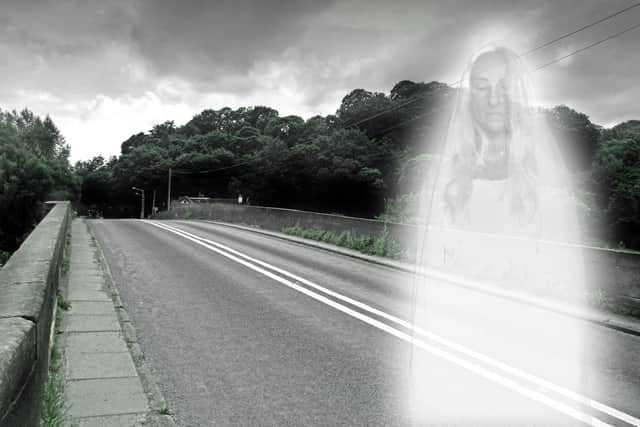
The journalist leaves it outlandishly late in the feature to inform readers “the most inoffensive spook to have walked the face of this Earth” didn’t show up.
But he did interview two people – one a prominent local councillor – who had seen the spectre.
The Advertiser revealed: “Alderman George Owen saw a woman bathed in an iridescent light apparently anxious for a lift along the road. His chauffeur stopped the car and leaned out to speak to the woman. She looked at the woman…and disappeared.
“’There was no covering for her,’ a bemused Mr Owen claimed. ‘One minute she was standing near my car, the next she had disappeared. I hardly had time to see, but I thought at first she was on her way home from a dance. Her gown reached the ground and she had a veil over her head. She looked into my car for about 30 seconds, but never said a word. I’ve looked for her ever since, but she has never returned.”
The sceptic in me believes a woman, probably returning from a night out, attempted to hitch-hike. The Alderman’s limo pulled-up, she didn’t like the look of those inside the vehicle and legged it. Errr, that’s it.
Frederick Wiggin spied the ghost while riding his bike. “A tall figure, dressed in black who stood watching me for two minutes,” he said. “Her face was illuminated as though she stood in the beam of a car headlamp, but there was no one else near us. The woman just disappeared.”
The many “other world” stories surrounding Wolseley Bridge and Seven Springs can – and probably should – be taken with a pinch of salt. Yet the most chilling mystery of all is very, very real. It, too, has spawned a stream of female spook sightings.
It has been 66 years since the murder of Elsie Taylor, a woman whose love life can best be described as tangled, complex and extremely active, and still the killer remains unmasked.
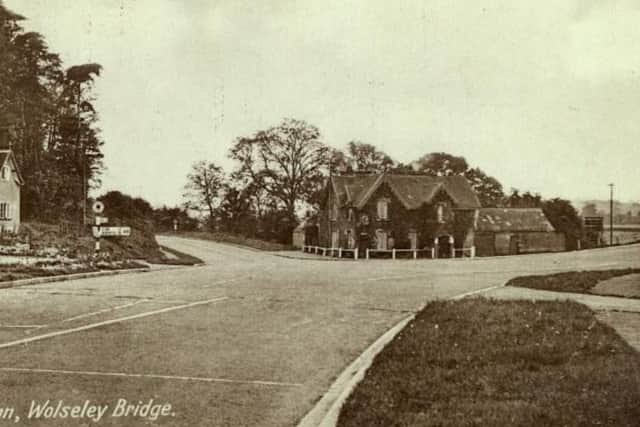
The 47-year-old was last seen drinking in the Wolseley Arms – a pub on the A513 – with a mystery man. Her companion that night, April 12, 1957, could have been any one of several suitors.
Elsie’s beaten and bound body was discovered at her Bridgtown, Cannock, home three days later. Despite a massive manhunt and a police operation that saw 1,000 sets of fingerprints taken, no one was ever arrested for the crime, archives studied by historians Richard Pursehouse and Ben Cunliffe have shown.
Elsie, always immaculately dressed, had her share of male admirers. She was having an affair with two lovers – both married - at the same time and allocated each set days for romantic liaisons. Mondays, Wednesdays, Saturdays and Sundays were spent with one lover, the other had to make do with Tuesdays and Fridays.
The two men were blissfully unaware they had a rival.
Public opinion at the time dripped 1950s morality: the woman had played fast and loose and paid the ultimate price.
Even at the inquest, the coroner stated: “The jury might think that if her sexual life had not been so varied, she might still be alive today.”
You can almost hear him whisper “hussy” under his whiskers.
The finger of suspicion was initially pointed at the lover who found the body, colliery fireman John Holgate. He was erased from the list of suspects after providing what police believed was a cast iron alibi. Some modern day sleuths now believe Holgate could’ve slipped unnoticed from his workplace and murdered Elsie.
It was the affair with Holgate that led to the break-down of Elsie’s seven-year marriage. Husband Dave found out about the infidelity and kicked her out of the marital home.
Holgate died just 12 months later in an unsolved hit and run. That crime has produced its own conspiracy theory: was he deliberately mown down by someone wanting justice for Elsie?
The other man in Elsie’s life was Cannock poultry farmer Harry Richards, believed to be her drinking companion at the Wolseley Arms.
Police interest in Holgate, from Great Wyrley, as the possible murderer is understandable. He didn’t contact police straight after discovering the body, but strangely returned to work. At the pit, he reportedly told a colleague: “I’m in terrible trouble. The blonde is dead, I have been in the house.”
Detectives decided Holgate was not the man they wanted after workers testified he’d been at the colliery at the time of the murder.
Yes, there is the scent of something unexplained hanging over the Paranormal Pyramid, but it has nothing to do with crypto conspiracies, tormented spirits or extra-terrestrials.
It is the whodunnit surrounding Elsie Taylor’s murder.
Comment Guidelines
Iconic Media encourages reader discussion on our stories. User feedback, insights and back-and-forth exchanges add a rich layer of context to reporting. Please review our Community Guidelines before commenting.