Leader calls for curbs on windfarm construction
Saturday 18th June 2011, 11:29AM BST.
The leader of the Welsh Assembly has called for the number of windfarms being built across Mid Wales to be restricted. First Minister Carwyn Jones made the plea.
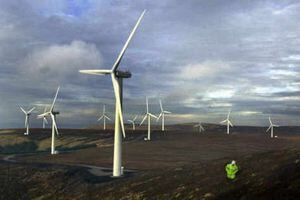
He said large scale developments of windfarms were “unacceptable” and added his Government would not support the construction of pylons in rural areas to connect windfarms to the National Grid.
He has called for Westminster to allow the Assembly to make decisions about major energy projects affecting Wales.
The announcement has been greeted with delight by campaigners fighting proposals by National Grid to build a substation either at Abermule or Cefn Coch to link windfarms to the National Grid, which could see hundreds of pylons built in Shropshire and Mid Wales.

To read our stories in full, log in to the premium 24 website.
Shropshire Star on Twitter
Keep updated with the latest breaking news and content on our Twitter feed.
Lifestyle
Interactive Dining Out map
Hundreds of reviews by the Shropshire Star and Express & Star's teams to help you decide where to eat.
Entertainment
All the film reviews
Before you plan a trip to the pictures, get our critics' verdicts on all the latest movie releases.
OUR NEW APP
Get the new Shropshire Star app
Download the Shropshire Star’s new app to your iPad or iPhone to get one week of access to our digital newspapers absolutely FREE.

Excuse me, First Minister, as you don’t want any windfarms, where would you like me to put these nuclear and coal-fired power stations instead?
Report abuse
Battersea!
Report abuse
How about in HIS back yard, see how that goes down?
Report abuse
He didn’t say he doesn’t want “any” wind farms – he said the Assembly should be able to decide on “major” energy projects. This proposal is huge – just check the carbon payback calculations for wind turbines and see how many include grid extensions – none!
That’s because it would not normally be considered wise to build so many turbines so far from the existing grid (NG confirm only Lands End is further).
It is only the sheer size that would oblige NG to construct a massive grid extension (with an equally huge carbon footprint, vast use of fossil fuels and widespread destruction of ancient and unspoiled landscapes).
Also, if you put so many turbines so close together, when the wind doesn’t in that one spot … no electricity. So don’t forget those conventional power stations – you’ll need those as backup!
Report abuse
‘Over the last decade, nearly half of all new installed capacity was renewable, not fossil fuel-based generation.’
[Source: 'Battle of the Grids, How europe can go 100% renewable and phase out dirty energy', Greenpeace, Report 2011]
Let’s keep this hopeful trend going for our grand-children.
Report abuse
Carwyn Jones has stumbled onto a basic Conservation of Energy issue here;
How many windfarms are needed to stop the world from rotating altogether?
This is the unspoken of danger. You can’t get energy for nothing – perpetual motion machines can only work if they deliver no energy to their surroundings – so something must be lost for energy to be gained.
Come on you so called boffins, explain that !
.
.
BTW If anyone responds with a serious response to this comment, may I suggest they have missed the point.
Report abuse
As a visitor to the areas concerned (Lovely and unique part of the world by the way). I can assure you wherever you have LARGE wind generators you will not have tourists. Areas where substantial plantation timber plots exist or locations a kilometer or two offshore would have far less imapact for locals and tourists alike
Report abuse
We drove for miles at the weekend to go see a wind farm up close. We had lunch out, spent some money in the local town before going home. Wind farms are a tourist attraction and bring money to the local area. Stop talking rot!
Report abuse
This issue is mainly about the associated grid extension.
How many miles have you driven to visit electricity pylons?
Report abuse
While it is true that one or two of almost anything may be a tourist attraction, this is not a scalable effect. People will visit a sewer plant or nuclear power plant to see one in action – this does not mean that 840 sewer plants in one area must therefore be attractive to tourists. That would be considered a blot on the landscape – much like huge wind farms are.
Report abuse
I think you are completely wrong. We can see a wind farm from the place we stay in aberdovey. The town and the site are always busy in the summer months.
Report abuse
… and how many 150ft pylons/400kVA lines pass over the place where you stay?
Oh, that would be none – as these would be the first ones ever built in Mid Wales!
Report abuse
I support what you are saying about the pylons, Jamie.
They should go underground.
Report abuse
There are other people living in Montgomeryshire who want the area to play a part in green energy production and realise the potential this area has for energy production. It is of concern that good jobs have gone out of the county when Siemens left Newtown. Dulas has been taken over by a German company……..
It does seem that Tesco and Care Homes will be the employers here. There again this may suit the growing ‘retired population’ we have here. The schools are closing because there are fewer young families and children here.
Report abuse
Here in Canada we are also fighting windfarms. They are being built too close to homes and people are complaining of the noise which is quite prominent. These people complain of headaches, loss of sleep because of the droning noise and in actual fact they are not that energy efficient as people seem to think.
It has been found nuclear powered stations are quite safe as long as they are handled properly in an efficient manner and they are not as expensive as green initiatives put forward by what we call “Tree Huggers”, who only want to get in on the action by asking for handouts in order to increase their own agendas. Please do not see this as not caring about our environment, but there are other ways to save and make sure that the lights do not go out and their is an abundance of heat for everyone
Sincerely
Mary McNaul, Ontario Canada :o)
Report abuse
Where do you put the waste from the nuclear power station? Will it all fit in your back garden?
Report abuse
Hi Mary, I’m also from Ontario, Canada and I know we are not fighting them and have in the last couple of years a rather large wind farm built locally, I know a lot of folks here would rather the turbines than a nuclear station believe me! The noise, if any is no worse than the highway and many people live by them no issues at all, droning noise soon becomes white noise in the background (and windfarms doesn’t come with the same amount of pollution as a highway)
I can see them from my house and personally I rather like them, they are graceful and calming to watch. I hear there may be an issue with birds that they are working on but other than that not heard too much else about it. Maybe those by me are correctly sited or maybe it’s all fuss and bluster as people worry about something they don’t really know much about, personally I think its the sign of the times, and far less of a blot on the landscape than all other forms of providing energy when considered from cradle to grave.
Report abuse
Mary, you said that ‘nuclear powered stations are quite safe as long as they are handled properly in an efficient manner and they are not as expensive as green initiatives’.
Did Fukushima not change your views in any way, then?
Do you regard the impacts of this disaster on residents, food producers and fisherman as inexpensive?
Report abuse
Tokyo Electric tested the Fukushima plant to withstand a quake up to magnitude 7.9, the quake that caused the disaster was a 9.0.
I think that falls under “handled properly”. Japan suffers over 1500 earthquakes per year, the UK somewhat fewer.
We should be spending more on Thorium research (like India & China)- more plentiful, cheaper, safer and cannot go critical (losing power means auto shutdown).
Report abuse
Yes, the size of the Japanese earthquake was massive, Jamie, but would you not agree that geological events are extremely hard to predict (eg Colchester earthquake, 1884) and that it is better to expect the unexpected?
You mentioned India. What do you think of the Indian government’s decision to build the Jaitapur nuclear power plant (not a Thorium reactor) in an earthquake zone? And do you think HSBC bank customers would be happy to know that their bank is financing it?
Yes, the UK suffers from fewer eathquakes, but my original point was rebutting Mary’s point about the expensive nature of nuclear energy.
Would you argue that nuclear power is a cheap way of generating energy, Jamie?
Surely wind energy, coupled with a MASSIVE international campaign on energy conservation is a much cheaper and much safer course for us to take?
Report abuse
… in addition to other renewables like concentrated solar (the use of mirrors to heat a fluid), geothermal, tidal, solar photovoltaics (rooftop solar panels), wave power and hydroelectric.
Report abuse
Huw, yes I agree we should be looking at all those renewables. I have solar water and a wood-pellet stove. I have also (in my day job – through customers) reduced the electrical demand in the UK by many megawatts, so I’m very much with you on reducing demand (No.1 priority in my view!). Also Micro-CHP, and have you seen VIVACE converters?
I only recently heard about Thorium and I was amazed we had not made it a priority years ago … but then you can’t use it to make nuclear weapons!
I am not anti-wind, as such, I just believe the grid extension makes this project economically and environmentally untenable.
Report abuse
Where in the UK would you put your thorium reactors, Jamie, and would they be inexpensive for taxpayers today and in the future?
Report abuse
Huw, thorium power is touted as much cheaper than conventional nuclear. I’m pretty new to the idea of thorium reactors but, as I understand it, one the the best things about them is they are scalable from a small size. So it may not be necessary to have large power stations, just a small building in a town as the power source. See :-
http://www.thorium.tv/en/thorium_reactor/thorium_reactor_1.php
Report abuse
So, you are saying thorium would be cheaper than wind and renewables are you, Jamie?
Report abuse
If the quoted figures are to be believed, then yes, certainly in this instance, a reactor like the one shown would be significantly cheaper than the grid extension alone!
I don’t know how it would stack up compared to sites within reach of the grid. For the people investing in turbines the main money is in ROCs, but regarding pence per unit of purchased electricity it may well be cheaper. It’s not commercial yet, so we don’t know.
As you are aware, there are more issues than financial here anyway.
Report abuse
Who produces the Thorium TV site, Jamie? There is no About Us tab to find the source of all the information.
By the way I notice that Dr Hashemi-Nezhad, the director of the Institute of Nuclear Science at the University of Sydney, who is prominent on your Thorium TV link, was far more sanguine about levels of radioactive contamination in the sea off Fukushima than the World Health Organisation (WHO).
[Source: 'Pacific fish stocks not affected by nuclear plant fallout', Radio Australia, March 22, 2011.]
Do you share his optimistic reading of the situation in Fukushima, Jamie?
Report abuse
I’ve never seen the site before Huw, nor Dr Hashemi-Nezhad, so I don’t know. It was just the first site I found when looking for a diagram of a scalable Thorium reactor, so you could see what I was talking about.
If you look up thorium on Wikipedia there is a reasonable overview. It just sounds as though it may be a cheaper, safer, more scalable way of producing nuclear power. My preference is for fusion, but we will have to wait a while for that.
Report abuse
So you forwarded a link to a site you had never seen before?
Don’t you think that people concerned about misinformation and manipulation of the democratic process should be confident about the SOURCE of information in the public domain?
I’m concerned that the most prominent scientist talking up thorium on the website you forwarded is also on public record talking down the disastrous impact of the Fukushima reactor meltdowns. Aren’t you?
Report abuse
I don’t have time to check all the opinions of every scientist I read about. Some of history’s most brilliant minds and greatest inventors had questionable opinions/ethics on some matters and scientists often disagree with each other, that’s how science works.
As I explained, I was looking for a diagram and brief explanation. This is a comments section, not a thesis, and I cannot paste pictures or large tracts of text. So web links are handy as a short cut, that’s all. If you want to attempt to discredit those with a different opinion then I’m sure it’s possible.
I’m not paranoid about misinformation, I’m a sceptic. The whole internet is in the public domain!
Report abuse
OK. Point taken. I apologise if you feel I over-reacted.
However, would you not accept that thorium is a bit of a red herring as it is not being used in the UK?
Wind power is cutting carbon today, and I urge all those who want to cut our country’s carbon emissions and speed up our trasition to renewables to support it vocally.
Report abuse
Thank you, accepted. I didn’t intend the thorium issue to be a red herring and I did say it’s not (yet) in use. It may not take long to become commercial though, and if so may offer better safety and a lower CO2 per kWh than conventional nuclear (smaller more efficient plants, easier to mine) and give us time. I agree that wind is available now and has its place, but I hope that we will crack fusion before we have to carpet vast tracts of the UK, Spain and the Sahara in turbines and PV – then create many thousands of miles of “supergrid” to interlink it all. A relatively small number of safe clean (green) fusion reactors seems a less industrial solution. I know it’s not certain we will find it viable, but I think it’s imperative we find out ASAP and we should invest more in doing so.
Report abuse
Huw – you stated that wind power is cutting carbon today. Actually, there have been a rash of papers written that give the opposite view. Basically, the reason for this is that since the only way to provide a steady form of electricity to counteract the spikes and troughs, caused by the inherent intermittent nature of wind power generation, is to use fossil fueled power plants (since nuclear plants cannot be ramped up and down quickly enough to take up the slack). Since these power stations need to be on stand-by all the time and then ramped up and down to suit what the wind is doing – they become extremely inefficient and the evidence is that the fuel used puts more carbon into the atmosphere than if they got rid of wind turbines and just generated the power. Then added to this is the cost of making the wind turbines and transporting them to site – making the roads to transport them, the carbon cost of making the massive cement bases and in many cases the loss of the peat bogs they stand on. When you also add the carbon cost of decommissioning the wind turbines and any other associated carbon costs the total carbon cost is more than just using a fossil fuel power station in the first place. Wind power is not carbon friendly.
Report abuse
Wind is more carbon-friendly than any other form of energy, Robin.
See Öko-Institut figures on grammes of CO2 emitted per kilowatt hour. See also Edinburgh University’s Professor Harrison’s work. Or have a look at this plan, published in Scientific American in November 2009, to move rapidly to renewables by Mark Z Jacobson from Stanford University, USA:
http://www.scientificamerican.com/article.cfm?id=a-path-to-sustainable-energy-by-2030
Jacobson: ‘To ensure that our system remains clean, we consider only technologies that have near-zero emissions of greenhouse gases and air pollutants over their entire life cycle, including construction, operation and decommissioning.’
After having studied the relative carbon footprints of different energy forms Mark Jacobson concluded that wind had the lowest carbon footprint. Do you think Jacobson has got his calculations wrong, Robin? And if so, why?
Report abuse
Robin, surely if we wish ‘to counteract the spikes and troughs, caused by the inherent intermittent nature of wind power generation’ we need to build a smart grid, which links the system up, don’t we?
Report abuse
No Huw – we need to stop using such a silly method of electricity generation and concentrate on those that will give us clean energy at a reasonable cost. And I just detailed why wind turbines were not CO2 friendly – didn’t you read it?
Report abuse
Yes, I did read it, Robin, but the figures I cited totally contradict your argument.
The Öko-Institut showed in 2007 that CO2 was the most carbon-friendly form of energy generation.
Wind produces 24 grammes of CO2 per kilowatt hour.
Nuclear produces 32 grammes of CO2 per kilowatt hour.
Solar power (depending on the country where it is sited) produces between 27 and 101 grammes per kilowatt hour.
Hydroelectric power produces 40 grammes per kilowatt hour.
Gas: 428 grammes of CO2 per kilowatt hour.
Coal: 1,153 grammes of CO2 per kilowatt hour.
Professor Gareth Harrison of Edinburgh University calculates that the carbon payback time for wind farms in mid-Wales will be about 1 year.
If you dispute these figures, could you explain why?
And could you say which form of clean energy you favour?
Report abuse
There are many people living in Montgomeryshire who are glad that clean energy is produced here. These people want this county to have a thriving future. At the moment the momentum here is to stop any developments. Companies are moving out. Siemans has left Newtown. Dulas has been taken over by a German company…
We have an ageing population owing to the fact that so many retired people live here. This sector is quite happy to have people working on minimum wages in Tescos and care homes. Our schools are closing because there are fewer young families and children in our rural communities. Community centres and traditional community activities are under threat. I hope that the politicians who have so eagerly supported the anti-pylon etc campaign can tell us what economic activities they are actually promoting for the benefit of their constituents.
Report abuse
The people of Abermule say that their largest employer is considering moving out in light of these plans and people in the area where I live are worried about the effect on tourism – the largest employer in the area, outside agriculture.
What sort of jobs do you think this is going to create?
It is unlikely to affect total demand for turbines – it’s just a matter of giving some thought to how many you put in one place. It makes no economic or environmental sense to create the requirement for a massive grid extension.
Report abuse
Doesn’t the future success of renewable energy in the UK depend upon grid extension, Jamie?
Report abuse
Huw, given the extent of our existing grid I would imagine there are already sufficient windy (or hydro) locations within easy reach (132kV). I would also favour small scale distributed generation (lower transmission losses), better insulation and reducing waste – putting less demand on the existing grid.
Report abuse
Quoting from this Economist article from Jun 19th 2008 [ http://www.economist.com/node/11565667 ]
‘Wind power has come of age. But to make the most of it, electrical grids will have to be overhauled’.
You said that you are not anti-wind, Jamie. What do you think supporters of a rapid transition towards renewable energy should campaign for if their hopes for a green future depend on a grid overhaul?
Report abuse
The grid that most needs an overhaul is in America, judging by the article. The UK grid infrastructure is already extensive (check the map) and runs close to much of the coast – where a “supergrid” could connect to Europe (we already connect to France). As mentioned in the article DC connections can be easily put on the sea bed.
The UK grid capacity could be increased without wasting resources by extending it randomly in pointless directions. Smart switching could further improve capacity, without massive new infrastructure. As you are so keen on CO2 reduction why are you so unconcerned with the huge carbon footprint of a grid extension?
In the long term, if we want to end our reliance on fossil fuels (electric vehicles, hydrogen fuel cells), we will probably need far more electricity. I hope that we will crack something like fusion power and end our worry about energy security and CO2 at the same time.
Report abuse
I agree with you, Jamie, that in the long term, if we want to end our reliance on fossil fuels, we will need far more electricity.
However, would you not agree that this greener renewables-powered future will not be possible without an extended, over-hauled grid?
If most people want renewables to succeed, then surely we need to make our grid smarter and better adapted to renewable technology.
While I agree with you that the controversial cables should go underground and pylons should be opposed, I must challenge what you are saying about a ‘huge carbon footprint’.
Wind, after all, produces less carbon than any other source of energy.
Wind: 24 grammes of CO2 per kilowatt hour
Nuclear: 32 grammes of CO2 per kilowatt hour
Gas: 428 grammes of CO2 per kilowatt hour
Coal: 1,153 grammes of CO2 per kilowatt hour
[Source: Öko-Institut, 2007]
In addition, Professor Gareth Harrison of Edinburgh University calculates that the carbon payback time for wind farms in mid-Wales will be about 1 year.
Could you give a link to the map you spoke about and to your ‘huge carbon footprint’ figures, please, Jamie?
Report abuse
Huw, you can see the existing grid here :-
http://www.nationalgrid.com/uk/LandandDevelopment/DDC/GasElectricNW/
The figures are more complex, as no one produces them. I calculated some myself, using what information is available, and carbon figures from The Carbon Trust and http://www.greenrationbook.org.uk. There isn’t space here, but to summarise …
There are no figures for the 20 acres of concrete and steel that will comprise the “hub”, nor for the smaller pylons (and there will be more of those than the large ones). But for the 400kV pylons alone, excluding fossil fuels used during transport and construction (which will be significant) and carbon released felling trees and (ancient, wildlife rich) hedgerows, you are looking at around 160 x 50m pylons: approx 13000 tons of steel, (at least) 4000 tons of concrete, 600 tons of aluminium (per supply route). In short you are looking at around 100,000 tons of CO2e in materials alone, for just the 400kV pylons! That is equivalent to around 183,400 MWh of grid electricity.
None of those payback figures include grid extensions. They are thorough in calculating the footprint of turbines, but ignore grid connection!
Report abuse
In my haste to summarise my figures I ended up simplifying and possibly overstating the total. It would be approx 75,000 to 100,000 tons of CO2e, depending on the number of 3 phase cables carried by the pylons and what percentage of the aluminium used is recycled.
When you add the fossil fuel used in transport and construction the figure will be rise a lot anyway.
Report abuse
You said ‘the figures are more complex, as no one produces them’.
This is not the case.
What about Germany’s Öko-Institut and Professor Gareth Harrison of Edinburgh University, who I quoted earlier?
Are you challenging their figures, which are publicly available?
Wind power produces 24 grammes of CO2 per kilowatt hour.
Nuclear (which also requires concrete and metal in construction) produces 32 grammes of CO2 per kilowatt hour.
Do you dispute the Öko-Institut’s conclusion that wind has a lower carbon footprint than nuclear, Jamie? And if so, why?
Professor Harrison calculates that the carbon payback time for wind farms in mid-Wales will be about 1 year.
http://www.see.ed.ac.uk/~gph/carbon/
Could you explain where you think he has got things wrong?
Report abuse
Thanks for the link Huw, but I can’t find the figures for the Mid-Wales turbines. Can you tell me how to find them?
The figures I have been unable to find are those for grid extensions, I can find lots of figures for turbine construction. I searched the net for grid construction figures and found none. Also National Grid told me they had none and RenewableUK suggested I ask National Grid. That’s why I assumed there weren’t any. I can’t find them on the Öko-Institut site either (though they would be different for Germany).
I don’t dispute the CO2 per kWh figures, although there are none for thorium or fusion as yet. I agree that the materials used in nuclear construction are also a big factor, which is precisely why it’s important with wind not to waste resources by building turbines in locations that require extra infrastructure.
Report abuse
Doesn’t the future of renewable energy in this country, which has massive public support (see http://www.bbc.co.uk/news/science-environment-12810867 ) depend on this extra grid infrastructure, Jamie?
I got the 1-year carbon payback figures for mid-Wales from George Monbiot, who had e-mailed Professor Gareth Harrison of Edinburgh University.
http://www.monbiot.com/2011/05/30/underground-movement/
See the e-mail from Professor Harrison [Reference #8 at the foot of the article]
Prof Harrison: “I’ve used previous work on the materials, construction and operation of transmission/distribution network infrastructure and wind farms to estimate the carbon impact of 150 km of transmission/distribution lines and 800 MW of wind turbines. Using conservative estimates (generator capacity factor of 0.25, displacement of gas generation etc.) the time required to pay back the carbon in the man-made infrastructure is 6 months (which is entirely in line with my initial guess).’
Professor Harrison arrives at the 1-year carbon payback time for wind-farms in mid-Wales because of problems with peat around the sites of some windfarms.
You said the grid extension would have a ‘huge carbon footprint’.
Professor Harrison says the carbon payback time for this extension would be 12 months, notwithstanding the problem with peat.
I’m interested to know what you think of his figures, Jamie.
Report abuse
Thanks for the links. As the survey was commissioned by Friends of the Earth and took place a week after Fukushima it’s not too surprising that wind came out top (I would like to know how the questions were phrased) – though I was surprised that 16% said they were more likely to support nuclear! What happened to improve their opinion?!
I enjoyed the article by George Monbiot (I’ve read his stuff before). I thought he let him himself down with the attack on Glyn Williams though, as he said Glyn’s figures were rubbish, then justified himself using figures that were 7 years out of date! See :-
http://www.bbc.co.uk/news/uk-scotland-12985410
http://www.timesonline.co.uk/tol/news/environment/article7069938.ece
(I thought I saw more recent yearly information somewhere, but could only find these)
I was frustrated that there were still no grid figures though! George said that he could not “obtain relevant data” either. I was hoping for some actual figures from prof Harrison, but all he said was that he had “used previous work on the materials, construction and operation of transmission/distribution network infrastructure” – which is what I was told no one had (certainly not National Grid). What figures did he use? I also used 25% efficiency, but where he compared gas generation I compared standard grid electricity (CO2/kWh). Given that RenewableUK and Vestas seem to quote 6-12 months payback for the turbines alone, it seems surprising he anticipates such a rapid carbon payback (I have no data on the peat impact). As far as I can see there will be well over 100,000 tons of CO2e in materials (including the hub), plus construction to recover, on top of the turbines. Maybe if I write to prof Harrison he will say what he thinks the grid footprint is …
Report abuse
NUCLEAR: The Italian referendum on nuclear took place 7 weeks after the opinion poll I cited and 8 weeks after Fukushima.
94% of Italians opposed returning to nuclear power. Was that in line with expectations, Jamie?
PROFESSOR HARRISON’s FIGURES: I wrote to Professor Harrison and he e-mailed back with this:
‘The main point is that while grid infrastructure looks ‘big’ it
actually requires surprisingly little material overall. In fact the main impact arises in the form of carbon associated with the losses.
With a project such as this where the line carries power away from a large wind farm cluster one extreme argument is that all losses are fed by the wind farms themselves and are therefore ‘carbon free’.
Power lines tend to avoid trees and have relatively little physical footprint on the ground so I doubt there would be much impact on plant carbon sequestration.
I notice that you advocate burying the lines. Other than cost, arguments against burial include the amount of material and other emissions associated with the cables and the fact that the land under which the cables lie must be carefully managed with, for example, construction and tree plantation forbidden.
They can however be less prone to extreme weather which is one reason why the Danes are engaged in a large scale under-grounding exercise. Personally I like pylons but they aren’t to everyone’s taste.’
This gets across the gist better than any summary I could do, but it seems clear from Prof Harrison’s calculations that the carbon footprint of the grid extension is not as great as you suggest.
Report abuse
I saw the Italian vote and it didn’t surprise me at all. I know nothing about Italian politics or popular opinion and would not assume to know the mood regarding nuclear power over there, but over the years I have come to accept rational reasoning is not a good way of predicting a vote. Sarah Palin may yet become president – I rest my case!
I would be interested in discussing this with prof Harrison and I avoided the under-grounding issue for the reasons he states (and also because the carbon footprint may even increase). Although I agree with George that it is the only way most people will accept the grid connection.
Unless prof Harrison has different figures (still no numbers!!) for the weight of pylons (hard to find) or the CO2e figures for steel etc to the sites I mentioned then my figures are not an over estimate – they are simple maths (though long winded – I previously said complex instead of long). The trees and hedges would not be removed to make way for the pylons – they would be removed to widen the roads for access during construction. Maybe he regards over 100,000 tons of CO2 as minimal?
Report abuse
I have just spent yet more time trying to pin down figures for the grid construction. You will be pleased to know that I significantly overestimated the weight of a standard pylon (looks like the figure I found was outdated – I should have read the tech specs more carefully), however the pylons used wherever the direction changes are much closer to the original estimate and I also underestimated the concrete bases and the materials used in the hub. The hub will include (amongst much else) up to 5 Supergrid Transformers, each weighing 140 tonnes (“surprisingly little material”?). Each comes on a 220 tonne lorry load from Ellesmere Port. All this excludes the transmission system used to reach the hub. The transmission losses will inevitably increase the carbon payback time and I am still perplexed by the dismissive attitude to the grid footprint.
I say again that all this would be unnecessary if the turbines were situated within reach of the existing grid. Do you deny that wind power is more effective when widely distributed?
A point that came up at the council meeting yesterday was that Denmark’s highest point is only 170 meters (no need for mountains) and Wales is already a net exporter of electricity, so why not site the turbines around England’s major cities and reduce the transmission losses to virtually zero? (Well it made me laugh!)
Report abuse
So 94% of Italians are ‘irrational’ in your opinion, then, because they reject nuclear power? OK. Are the German and Swiss governments being irrational, too?
I am interested that you concede Professor Harrison’s point that the trees and hedges would NOT be removed to make way for the pylons.
This is NOT what anti-wind campaigners like Cadwrieth Ucheldir Powys or Oppose Peel have been saying. The former spoke of ‘tens of thousands’ of trees being felled and the latter spoke of ‘hundreds of thousands’ being felled for the footings of the turbines. Where did they get their information from? And -if it is denied by Professor Harrison’s work- is it perhaps mis-information?
As for your second contribution, I would say again that the grid needs to be extended to prepare the way for the renewable energy revolution that a large majority of the British population would like to see taking place in the coming years, not only in mid-Wales but also closer to their towns.
Professor Harrison sent me a PDF copy of his article for the journal, ELSEVIER ENERGY POLICY, published on 6th March 2010, which was co-authored by Edward J. Maclean, Serafeim Karamanlis and Luis F. Ochoa.
I will not quote it at length (yet) but this figure from the abstract of the article completely contradicts the main thrust of your contributions, Jamie.
‘The CO2 embodied within the raw materials of the network infrastructure itself represents a modest 3% [of the carbon equivalent emissions of the transmission network over a 40-year period].’
3%.
Report abuse
You’re putting words in my mouth again! I am merely saying that the results of a vote depend not on the most rational decision, but more on people’s emotions at the time. When people feel threatened by something they vote to remove it. Many extreme political leaders only got in because people were afraid. After Fukushima people were afraid of nuclear, but the fear is not necessarily proportional to the risks applicable to nuclear power plants in the location where they live.
When I talk of trees and hedges I am speaking from personal knowledge of certain areas along some of the proposed routes, where the roads are narrow and lined with ancient hedges (judged by counting the variety of species of plant in a given stretch). There are trees in the hedges. These will have to be removed if construction comes that way, to widen the road. In these areas I don’t imagine the pylons themselves will require large scale tree removal. There are tens of kilometres of the proposed routes I am totally unfamiliar with – so don’t try to use my words to contradict people who may have local knowledge of different parts of the route!
You also “sidestepped” my question. If I can find time I will request of copy of the full figures myself, as I am still puzzled. But to answer your question, nothing you have quoted contradicts anything I have said. What is the significance of 40 years? Why not 1.5% of 80 years, or 6% of 20 years? I have seen 20 years quoted as the expected life of a turbine. It is still CO2 that would not be expended if the turbines were situated within reach of the grid. I wonder what percentage of the population would be in favour of the revolution you speak of, if they realised the scale of the industrialization that may come with it.
I have tried to be reasonable, good humoured and polite, but I have to be so careful and long-winded in order to make sure you will not try to twist my words that I am not interested in any further discussion.
Report abuse
I welcome Carwyns moves to securing planning control for large scale developments in Wales, largely because this would create an opportunity to secure a proportion of the profits from these development to invest in Community Energy Schemes. We know from sites like energy share that many communities would like the opportunity to develop a community energy scheme but lack the financial capital to do so. For groups looking to generate an income through FITs EU funding is not an option and the scale of many community schemes means banks aren’t interested. Several investment programmes exists for community energy but they are not going to be able to meet the demand. By ring fencing a proportion of profits from large energy infrastrcuture developments we can secure sufficient capital to develop a community energy project on every community building in Wales and a substantial energy scheme in many others – owned and run by the community.
Report abuse
Put these monstrosities in Chelsea and Kensington, then see if tourism is affected!
Report abuse
nimbys
say Yes 2 wind
http://www.yes2wind.com
Report abuse
(2nd attempt – edited)
I can find nothing on this site which gives any justification for the huge carbon footprint and environmental damage caused by the huge grid extension, as required for this proposal. They just ignore anything which does not suit their arguments.
RenewableUK (who speak for the wind industry) say the first thing they look for when planning a wind farm is a convenient grid connection. I think a 50km 400kvA grid extension would not be considered “convenient”!
Yes2Wind are not all they seem. See :-
http://www.southdalewindfarm.co.uk/yes2wind-ltd-now-exposed/
Report abuse
Jamie, your link claimed that wind companies are trying to ‘manipulate the democratic process’.
Personally, when I see how many metric tonnes of greenhouse gases are being pumped into the earth’s atmosphere every second, [ http://www.dbcca.com/dbcca/EN/ ] I feel quite encouraged that people are pushing for wind power.
After all, surely the most appalling manipulation of the democratic process has been by companies funding the climate denial industry.
Or would you argue that wind companies trying to encourage the public to stand up for green power is worse, Jamie?
Report abuse
I believe that two wrongs do not make a right. Pushing people into submitting auto-generated letters, designed to fool planning authorities into thinking they were individually written is a highly suspect practice.
I do not approve of companies trying to manipulate public opinion either (it’s similar to the tobacco companies strategy). I see reducing CO2 and fossil fuel use as a win/win situation, as we will be conserving resources. Even if we did later discover that MMGW was a mistake we would still have the resources we saved.
Report abuse
Would you agree that vested interests in competing industries don’t want the wind industry to succeed and are lobbying the public day and night with very clever PR techniques (see Canada’s Desmogblog for details)? Shouldn’t this manipulation be exposed more in the media?
Report abuse
The only reference I could find was in regard to company propaganda for children, which everyone seems to be at (misleading, but not surprising). It wasn’t anti-wind, it was pro-conventional energy.
The problem in trying to get objective information is that sites like this cherry-pick news and facts in a similar way to the anti-wind sites.
In this area, by demanding a grid extension, the wind industry has turned thousands of supporters into vehement opponents in one fell swoop. If we had run out of windy locations within reach of the grid I could understand this proposal, but as a first choice location for huge expansion this is crazy. It speaks more of developers greed than environmental consideration. Wind works better when more widely distributed.
Report abuse
I don’t accept your argument that the wind industry has turned supporters of wind energy into opponents.
I would put the focus more on clever PR techniques like ‘Teach the controversy’, which are highly successful at shifting opinion and which I think should be exposed and explained more to the public.
http://www.businessgreen.com/bg/james-blog/1810225/-teach-controversy-tactics-threaten-wind-energy-revolution
Report abuse
Huw, my statement that “thousands” have changed their minds was a guess based purely on personal experience.
Of the handful of people I know locally who I would have said were very much pro-wind 6 months ago most are now anti-wind and the others (including myself) now think that its advantages depend very much on sensible choice of location and scale of development in one spot.
If you assume that a similar thing is happening over the area affected then the number would be thousands.
If the proposed development had not been so large then a grid extension would not be needed and most people would not have cast such a critical eye over the proposal.
I think there is a temptation to regard wind power as a universal panacea, without considering the complications of the real world. I’m in the RSPB, who have just withdrawn their green energy product, apparently over issues regarding turbine sighting. I buy electricity from Good Energy and feel I should check their policies.
Report abuse
It’s a pity but not very surprising that you side-stepped the question about PR techniques and ‘teaching the controversy’, Jamie.
This is a tactic I come across nearly every day on the Shropshire Star site, when discussing climate change with increasingly evasive denialists.
(If anyone reading this is interested to find out more about the tactics used by corporations against the environmental movement, then I recommend ‘GLOBAL SPIN’ by Sharon Beder.)
By the way, the RSPB has NOT just withdrawn their green energy product.
http://www.rspb.org.uk/supporting/green/greenenergy.aspx
In fact the RSPB positively promote the switch to renewables and wind power and away from fossil fuels.
This is the RSPB policy on wind farms:
http://www.rspb.org.uk/ourwork/policy/windfarms/index.aspx
‘We scrutinise hundreds of wind farm applications every year to determine their likely wildlife impacts, and object to about 7%, because they threaten bird populations.’
‘Wind power has a significant role to play in the UK’s fight against climate change. With the right strategic approach and planning safeguards, it can be expanded without significant detrimental effects on birds of conservation concern or their habitats. We will work with Government and developers to ensure this outcome.’
I wonder if you can comment on your suggestion that the RSPB are anti-wind-farms when it is crystal clear on their website that they support them, Jamie?
Report abuse
I did not intend to side-step anything. I was trying to say that I didn’t feel that either I, nor the people I knew, who had re-evaluated their position, were the victims of that process.
Yes, it is an issue with climate change, as with evolution, that those against will pick holes without offering alternatives. This relies on not being able to prove a negative. I believe the climate is changing and I believe we are very probably exacerbating the situation. A good many scientists I trust believe it and like all science we have to act on what we currently know.
I read the RSPB scheme was closing in their “Birds” magazine and see :-
http://www.energyshare.com/news/342/
http://raptorpolitics.org.uk/2011/03/28/rspb-energy-partnership-with-scottish-southern-energy-to-close/
The scheme has closed. I rang them to check and the web site is out of date. I did not say they were against wind power (they have a small turbine at one of their reserves) – don’t put words in my mouth. I said it was about turbine sighting, which as you correctly pointed out is part of their policy. It could be down to the issue discussed on raptorpolitics, but they haven’t said.
Report abuse
I apologise, Jamie. I was over-hasty in responding, and I stand corrected.
Years debating with anonymous climate change deniers, astroturfers, BNP- and UKIP-activists and corporate propagandists on this site has made me mistrustful and cynical, as did Sharon Beder’s book (above) about corporate tactics against grassroots green organisations.
One-to-one I am much more trusting of others.
Sorry.
Report abuse
Apology accepted, don’t worry about it. I feel there is some irony in arguing with you about this, as I suspect I agree with you on practically everything else! I did a web search for your other posts and if you’re the same Huw Peach that wrote a review on Amazon we even like some of the same music.
My surname is uncommon and being a computer geek (and therefore paranoid about security) I avoid using it to stop people joining the dots.
Report abuse
What motivates me is my desire to join the dots, Jamie.
Isn’t that what all of us should be doing when there is so much anonymous mis-information being pushed around?
Surely the more of us who are open about who we are and speak out for what we believe in, the better the debate and the likelier we are to join the dots.
The RSPB seem to be joining the dots between climate change and responsibly sited windfarms in these 3 examples?
1) RSPB supports the Renewables Grid extension:
http://www.renewables-grid.eu/menu-dropdown/partners/rspb.html
“Climate change is rapidly becoming the most serious threat faced by birds and wildlife. We need a renewable energy revolution to keep climate change within safe limits, which in turn demands new investment in electricity transmission, distribution and storage.”
2) RSPB climate campaigner supports a renewable energy revolution in harmony with nature:
http://www.rspb.org.uk/community/ourwork/b/climatechange/archive/2011/05/09/rspb-responds-to-renewable-energy-report-renewables-in-harmony-with-nature.aspx
3) RSPB climate campaigner is concerned that the 3% rise in CO2 emissions in 2010 (announced today by the Climate Change Committee) ‘reminds Government of the importance of reforming how the energy market works so it better delivers for renewable energy.’
http://www.rspb.org.uk/community/ourwork/b/climatechange/archive/2011/06/30/uk-emissions-up-hopes-for-wildlife-down.aspx
Report abuse
I agree that it’s laudable to stand up for what you believe in and I applaud you for doing so. Unfortunately the internet is exploited by unscrupulous people, who will use linked information for identity theft – that is what I am avoiding. I also work in the energy industry, trying to reduce consumption, and most energy companies are customers!
Like I said the RSPB are not anti-wind, and to quote from the first link “We want this investment to take place in harmony with the natural world, which means avoiding and minimising the impacts that infrastructure development can cause if poorly planned, …”
I object to this because I believe it is poorly planned. I am not against upgrading the existing grid, but I am against constructing new infrastructure when/where there is no need. I know less about the Severn valley route, but the Vyrnwy valley route would pass through several conservation areas and habitat for Peregrines, Curlews, Lapwings and Greater Crested Newts. Conservation is probably my greatest interest, so naturally I am concerned about climate change, but as I have said several times I believe this grid extension is just a waste of resources.
Report abuse
Where exactly would you be in favour of upgrading and extending the existing grid, Jamie?
After all, the future of renewable energy in this country depends upon it, doesn’t it?
Report abuse
I would rather the noise from a turbine than the cars that race passed my house at night and as for the tourism argument, it’s not harming the mid Wales towns where we camp. The campsites are all ways busy.
Report abuse
How many 400kVA lines pass over your camp site?
Are there many 150ft pylons running through these towns? No, because there aren’t any in Mid Wales!
Report abuse
No those pylons are coming right passed my house. Those directly effected are being compensated I believe, the rest of us will have to look at them but it’s hardly a reason to turn down the wind farm.
Report abuse
I wish you luck in getting whatever compensation you think is worth the constant buzzing and devaluation of your property – though you cannot know they will definitely pass your house, as the 400kVA route has not been decided.
I take it then that, as you may live next to one, you will also choose to holiday by them too?
Report abuse
They are all busy now – but the 840 wind turbines that are undergoing planning permission have not yet been built, the convoys of cement for the bases and 20 acre sub-station hasn’t started, the continual stream of trucks carrying construction materials for the pylons and electricity substations is not on the road and the towering pylons are not erected. It is because the campsites are full that Mid-Wales is able to survive – tourism is vital to it. If we remove the reasons for tourists to come to Mid-Wales there will be an economic disaster in the area.
Report abuse
All those in favour of these inefficient monstrosities, consider this question:
Would any wind farms be built without taxpayer’s subsidy?
The answer, of course, is no in consideration of their uselessness in generating sustainable electricity on demand:
http://www.theregister.co.uk/2011/04/07/wind_power_actually_25_per_cent/
(The above link has further links to sources BTW).
I think this crystallizes the issue:
http://www.cartoonsbyjosh.com/old_new_energy_scr.jpg
Report abuse
Nuclear would not be/have been built without subsidy either. Nor would many of the coal power stations we have. So basically winja, without using taxpayer’s money you are proposing we do without energy altogether.
Report abuse
A very poor strawman argument, that.
I have no problem at all, Julian, with taxpayer’s coin paying for energy production that is both flexible and efficient, and can adapt to demand.
Windmills, as evidenced by my first link, can clearly do none of that. Based on recorded data, the power output of one 1,200MWh nuclear facility would require 7,200 turbines.
7,200 turbines, placed – say – 200m apart would stretch for 1,440km or 894 miles. A line of turbines stretching from Lands End to Shetland. Just to replicate the output of one power station.
Of course, during harsh winters (which, due to impending reduced sunspot activity, will be rather frequent in the coming years) with extreme cold and little wind, windmills won’t provide any energy at all. At the time when we most need it.
Report abuse
My only point was that all forms of energy production are subsidised. So to rubbish one on that basis is to rubbish them all.
Report abuse
I’m not surprised to read your anti-wind contribution, winja, because you are so convinced that the climate is not warming and have no concerns whatsoever about mankind flooding the atmosphere with CO2.
Denial of climate change is often to be seen alongside denial of practical, clean and sustainable technologies to combat it.
‘Useless’? How come Denmark gets about 20% of its energy from wind?
‘Monstrosities’? What are your views on open-cast coal-mines? You seemed very keen on them in other chats we have had.
Subsidies.
I think that it is important for our government to support renewables, and incentivise the spread of renewable energy like wind, so that we can meet our climate change targets, boost employment and manufacturing.
By the way, in December 2010, the European Commission decided to allow EU members to subsidise coal until 2018. What are your views on that, winja?
Report abuse
Denmark does not get 20% of its power from wind. Because Denmark built a massive amount of wind turbines – when the wind blows it creates a glut of electricity that then is sold across the border to Sweden and Norway at vastly reduced prices. When the wind drops, Denmark then buys electricity from Germany. Since this is a constant seesaw effect they have to sell off more electricity at rock bottom prices than they would if they knew what the wind would be generating and buy more than they would need to. The most Denmark has ever managed to get from wind power is less than 15% of it’s energy consumption – and even that figure is not usual.
Report abuse
What about building a European Renewables Grid fit for the 21st century, Robin?
Then when the wind blows, you could -via the extended, smarter grid- export energy to wind-poor parts of Europe, pump water uphill to create stored energy, and import energy from windy places when turbines aren’t operating?
http://www.renewables-grid.eu/
What is your preferred long-term energy source, Robin?
Coal? Deep-sea oil? Tar-sands oil?
Report abuse
We booked a cottage in Anglesey that overlooked Wylfa Nuclear Power Station and there was a wind farm nearby too.
We had a fantastic holiday.
I prefer the wind turbines to fields of static caravans any day.
Report abuse
I, also, am not surprised by your support of hopelessly inefficient “green” energy considering your political agenda Huw.
For the avoidance of doubt, I do not “deny” climate change as evidenced by links previously posted on here by myself such as this:
http://rps3.com/Files/AGW/VOSTOK-DOMECIceCoreCompare_Stewart2009.pdf
What I do question is evidence of any clear signal of anthropogenic CO2 that has a direct causal effect on the global climate.
With regard to the Denmark model, in 1998, Norway commissioned a study of wind power in Denmark and concluded that it has “serious environmental effects, insufficient production, and high production costs.”
Denmark (population 5.3 million) has over 6,000 turbines that produced electricity equal to 19% of what the country used in 2002. But, Huw – and this is important – no conventional power plant has been shut down. Because of the intermittency and variability of the wind, conventional power plants must be kept running at full capacity to meet the actual demand for electricity. Most cannot simply be turned on and off as the wind dies and rises, and the quick ramping up and down of those that can be would actually increase their output of pollution and carbon dioxide (the primary “greenhouse” gas). So when the wind is blowing just right for the turbines, the power they generate is usually a surplus and sold to other countries at an extremely discounted price, or the turbines are simply shut off.
A writer in The Utilities Journal (David J. White, “Danish Wind: Too Good To Be True?,” July 2004) found that 84% of western Denmark’s wind-generated electricity was exported (at a revenue loss) in 2003, i.e., Denmark’s glut of wind towers provided only 3.3% of the nation’s electricity. According to The Wall Street Journal Europe, the Copenhagen newspaper Politiken reported that wind actually met only 1.7% of Denmark’s total demand in 1999. (Besides the amount exported, this low figure may also reflect the actual net contribution. The large amount of electricity used by the turbines themselves is typically not accounted for in the usually cited output figures.)
Link here (with further informative links):
http://www.aweo.org/problemwithwind.html
Finally, if you really “think that it is important for our government to support renewables, and incentivise the spread of renewable energy like wind, so that we can meet our climate change targets, boost employment and manufacturing”, then you must clearly support the £18 billion per year government spend pledged to reduce CO2 emissions over the next 20-odd years? Yes?
I’ll repeat that for readers: £18 billion of taxpayers money to address a trace gas that constitutes 0.03% of the atmosphere, globally. Of which the United Kingdom contributes – say – less than 1% of the overall 0.03%.
Report abuse
The costs of inaction are greater, winja (see Stern Report, October 2006). (And by the way, you never said what you think about coal subsidies.)
The UK historically has pumped more CO2 into the atmosphere than any other country in the world, and as such has a responsibility to lead the transition away from fossil fuels, winja.
You say you do not “deny” climate change, and simply question whether mankind’s greenhouse gas emissions are causing it.
This is not true.
In this thread, while defending climate denier, Lord Monckton, a right-wing ideologue with a very clear political agenda, you claimed that there is ‘no global warming in the oceans’( http://www.shropshirestar.com/news/2011/01/05/letter-does-weather-prove-global-warming-is-a-myth/ #19)
This sounds like denial to me.
If it is not denial, perhaps you could indicate what you think about the IPSO State of the Ocean report, released on June 20th 2011 : http://www.stateoftheocean.org/index.cfm
An interdisciplinary workshop at Oxford University used existing research about the oceans and concluded, ‘The Ocean has already absorbed more than 80% of the heat added to the climate system and around 33% of the carbon dioxide emitted by humans.
Ecosystems are collapsing as species are pushed to extinction and natural habitats are destroyed. Scientists believe that there is still time to prevent irreversible, catastrophic changes to our marine ecosystems but that this requires drastic action within a decade.’
IPSO has collated the science about our oceans and has concluded that climate change is the biggest threat to marine species because of warming and acidification of the oceans. You deny this.
More recently than the report you cited (out of context) Norway said it wanted, through wind power, to be ‘the battery of Europe’. Do you deny this, too?
Do you think climate change denial helps the anti-wind argument, winja?
Report abuse
winja?
Report abuse
There is no doubt about climate change. It is a fact. Climate change itself is not up for discussion – it is the cause of climate change that is in doubt. Whether or not carbon dioxide has any effect on climate change is still being discussed, but even assuming it is the ONLY thing that could make a difference, producing low carbon anything and then selling the carbon credits to another country, like China, so they can then produce carbon dioxide in the amount that was just saved by us is ludicrous and goes absolutely nowhere towards solving the problem. Unfortunately this relentless charge towards a low carbon economy in the UK is simply unaffordable at the moment and is leading many people in the UK right into fuel poverty.
Report abuse
As the Stern Report showed, our future will be unaffordable if the world does not move rapidly towards a low-carbon economy, Robin.
This is clearly understood by the Chinese.
Witness China’s relentless charge towards renewable technology in recent years.
In 2010 China invested more in clean technology than any other country ($34bn compared to $18bn by the US). What is more, 7 of the planet’s top 10 solar panel makers are now Chinese. [Source: Guardian, Friday 4 February 2011 -'China plots course for green growth amid a boom built on dirty industry'].
In 2010, China also became the largest wind energy provider worldwide, with the installed wind power capacity reaching 41.8 GW. [Source: wikipedia -Wind power in the People's Republic of China]
Do you think that China’s green industrial revolution will turn out to be ‘unaffordable’, Robin?
I would argue that it is a wise strategic move, that it will be good for China’s economy, good for its emission rates and beneficial for the planet’s future.
In addition China’s foresightedness, if it widely talked about and understood, could potentially inspire ordinary people in other countries to challenge the arguments put about by defenders of the status quo and demand a more courageous, long-term stance from their political leaders.
Report abuse
China just stopped importing any more parts for wind turbines. In fact, the stock price of one American Wind Turbine manufacturer tumbled 50% in one day last week because of this.
I can’t believe you believe the Chinese currently care less about CO2 production. Between 2005 and 2009 Europe reduced its CO2 production by 370 million tonnes. During that same time.. China and India increased their CO2 production by 2,650 million tonnes. Also from the end of 2005 to the end of 2009 (four years), the UK reduced its CO2 production by 64 million tonnes which is equal to just slightly more than 1 month worth of the Chinese and Indian increase for the period of 2005 to 2009. From 2008 to 2009 China and India increased CO2 production at a rate of 86 million tonnes per month. Thus henceforth, 5 years worth of expensive CO2 reduction in the UK will be undone by but one months worth of CO2 increase in Asia.
This is not foresight. The only reason the Chinese bought wind turbines is to provide electricity to remote areas.
Report abuse